Understanding National Prosperity Through the Lens of Economic Institutions
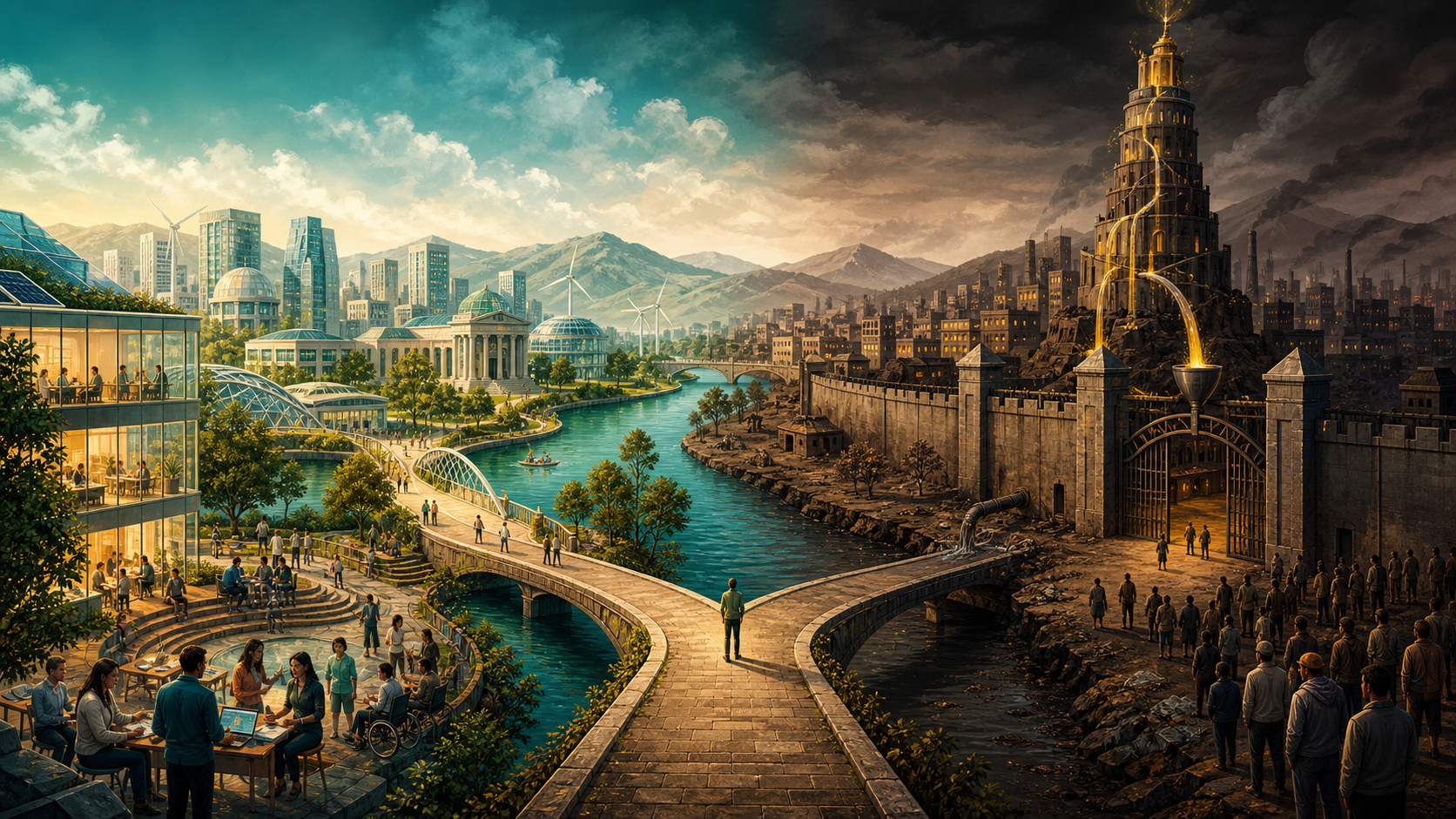
Introduction to Prosperity and Institutions
In economic life, the notion that “economics comes first, politics follows” has long dominated public thinking. However, this perspective overlooks a critical reality: all economic development, innovation, and protection of legitimate rights require a solid foundation backed by fair rules and free institutions. Like a rare seed needing fertile soil to sprout, brilliant business ideas struggle to thrive without a healthy political foundation. Research in political economy often raises a fundamental question about why certain nations achieve extraordinary prosperity while others fall into prolonged stagnation and poverty.
Debunking Geography and Culture Myths
Conventional thinking frequently attributes poverty to natural factors such as tropical climates, a lack of mineral resources, or even the perceived lack of capability among the populace. However, these elements are not definitive barriers to a nation’s progress.
To demonstrate this, visual geographical comparisons offer compelling evidence. A prime example is the town of Nogales in Arizona (United States) and the region of Sonora just across the border in Mexico. Situated side by side with nearly identical natural conditions, climates, and resources, these two areas exhibit stark disparities in economic development, living standards, and public health. The core reason lies not in the soil or the biological traits of the inhabitants, but in the different political and legal institutional systems governing each area.
Similarly, the division between North and South Korea provides a striking illustration. Sharing the same ancestry, cultural background, and long history, the absolute differences in governance models have created two opposite extremes: one side features vibrant illumination and high-tech development, while the other faces persistent economic instability and systemic crises. These examples reinforce the argument that politics and institutions are the primary drivers shaping a nation’s economic landscape.
The Core Role of Political and Economic Institutions
Political institutions encompass the management of state power, the transparency of the legal system, the fairness of property rights protection, and the scope of freedom enjoyed by citizens. When a nation builds institutions that incentivize rather than stifle growth, individuals gain the confidence to invest, innovate, and expand commerce.
Conversely, in political systems where power concentrates in the hands of a small elite, media outlets often transform into tools serving the ruling class. The absence of an open information environment and freedom of speech deprives society of self-correcting and monitoring mechanisms. When citizens’ efforts to improve their living standards continually face barriers from monopolistic interest groups, they gradually yield to exploitation by extractive institutions.
Historical and Critical Perspectives
Alongside major contributions to global macroeconomic thinking, certain theoretical models also face debates and critiques from professional historians. Some researchers point out that applying overly broad historical generalizations can sometimes simplify complex and nuanced historical processes.
For instance, the development of Prussia from a state devastated after the Thirty Years’ War into a centralized military and administrative power demonstrates that the interaction between state and society cannot be reduced to simplistic theoretical models. Similarly, the historical trajectory of China’s Song Dynasty or the political structure of the Byzantine Empire carry unique exceptions that generalized models may not fully capture.
Some historical experts also note that explanations regarding the origins of the Industrial Revolution in England or political dynamics in ancient empires require deeper analysis into science, economic geography, and demographic shifts, rather than attributing outcomes solely to institutional factors. These debates open a broader academic space to continue exploring the complexity of human development.
Conclusion
Despite ongoing academic discussions surrounding the interpretation of specific historical events, the core message retains profound practical value. A nation’s prosperity or decline is not a destiny predetermined by geography or culture, but the result of institutional choices shaped by human society. Building fair, transparent governance and fostering an environment of freedom for innovation remains the most sustainable path to lift nations out of poverty and onto a trajectory of long-term development.
❓ Frequently Asked Questions (FAQ)
Why are some nations prosperous while others remain poor?
According to prominent economic frameworks, prosperity is driven by fair, inclusive political and economic institutions rather than geography, climate, or cultural factors.
How do inclusive and extractive institutions affect development?
Inclusive institutions protect property rights and encourage innovation, while extractive institutions concentrate power and discourage economic progress.
Related Articles
Master Your Financial Mindset Today
Download the Traudio app for iOS & Android to listen to synchronized audiobook summaries and chat with StickWise AI.
Download Traudio App Free