10 Free Microlearning Apps You'll Keep Using
The best learning app isn’t necessarily the one with the most courses.
For many, the real problem is simpler:
How can I learn something useful every day without spending hours in front of a screen?
That’s why microlearning is becoming increasingly appealing.
Instead of a 90-minute lecture, microlearning breaks down the learning process into small units that can be completed in:
- 5 minutes while drinking coffee
- 10 minutes on your commute
- 15 minutes during a break
- A few minutes before bed
But a good microlearning app needs to do more than just create short content.
It has to make you want to come back tomorrow.
The list below includes 10 free microlearning apps, prioritizing global products or those particularly useful for English learners.
The selected apps also serve different purposes. Traudio is the only representative on the list focused on microlearning from books, so we haven’t included other similar book-summary apps.
10 Free Microlearning Apps Worth Trying
| # | App | Best for | Microlearning type | Can learn for free? |
|---|---|---|---|---|
| 1 | Duolingo | Foreign languages | Short lessons + gamification | Yes |
| 2 | Khan Academy | Math, science, academic subjects | Videos + short exercises | Yes, completely |
| 3 | Quizlet | Memorization and exam prep | Flashcards + Active Recall | Yes |
| 4 | Brilliant | Math, logic, STEM | Interactive lessons | Yes, with daily limits |
| 5 | Traudio | Learning knowledge from books | Audio + text + quiz + flashcards | Yes |
| 6 | Sololearn | Coding and AI | 5–15 minute coding lessons | Yes |
| 7 | Busuu | Foreign languages | Structured mini-lessons | Yes |
| 8 | Memrise | Practical foreign languages | Videos + vocabulary practice | Yes |
| 9 | Anki | Long-term memorization | Spaced repetition | Yes, on desktop/Android |
| 10 | Photomath | Mathematics | Step-by-step learning | Yes |
Note: Some apps use a freemium model. Advanced features, unlimited AI, offline learning, or an ad-free experience may require a paid subscription.
Chart: 10 Free Microlearning Apps by Suitable Daily Duration
The chart below is an editorial estimate of the reasonable minimum time to maintain a daily learning habit, not official data published by the platforms.
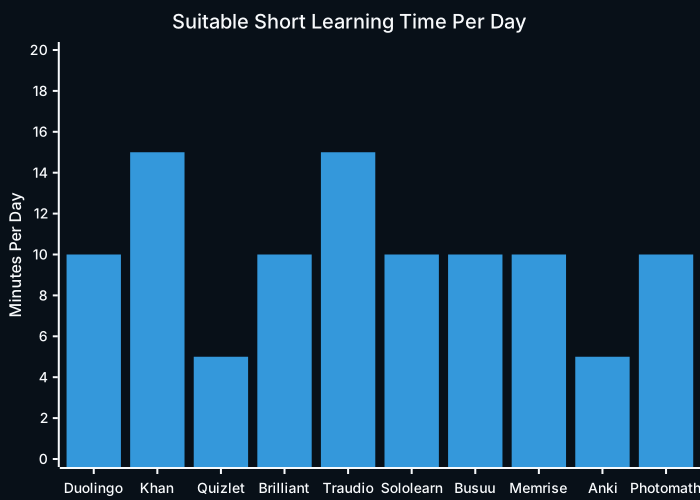
The common thread is very clear:
You don’t need a free hour to start learning.
Most of these apps can create a useful learning session in just about 5 to 15 minutes.
1. Duolingo
Best for: Building a Foreign Language Learning Habit
Duolingo is perhaps the most famous example of successfully gamified microlearning.
Instead of giving users a long chapter on grammar, Duolingo breaks learning into very small lessons:
A few new words
↓
A sentence structure
↓
A listening exercise
↓
A spoken phrase
↓
Complete lesson
Learners then receive:
- XP
- Streak
- Achievement
- League progress
- Daily goal
This transforms learning from a large task into a small, repeatable daily action.
More importantly, Duolingo still allows users to access free courses. The company states that Duolingo’s language, math, and music courses can all be used without mandatory payment; Super and Max plans primarily expand the experience and premium features.
Why you might keep using it?
Duolingo understands a very important principle:
A 5-minute lesson you actually complete is better than a 40-hour course you abandon.
Suitable for
- New foreign language learners
- Those who want to maintain a streak
- Those with only a few minutes each day
- Those who enjoy gamification
Free tier
Yes.
You can learn without a subscription, although the free experience includes ads and does not cover all premium features.
2. Khan Academy
Best for: Math, Science, and Academic Knowledge
Khan Academy differs from most apps on this list in one important aspect:
Its core content is truly free.
Khan Academy confirms the platform is free for independent learners, teachers, and parents, with thousands of lessons on math, science, reading comprehension, test preparation, computer science, and many other subjects.
The mobile app is also free, has no mandatory subscription, and supports video downloads for offline learning.
How does microlearning work on Khan Academy?
You don’t necessarily have to complete an entire course.
A learning session can be as simple as:
Watch a 6-minute video
↓
Answer 4 questions
↓
Get 1 question wrong
↓
View explanation
↓
Stop
The next day, you continue from there.
Strengths
- Very strong in Math
- Science
- Economics
- Computer Science
- Test preparation
- Interactive exercises
- Mastery system
Why you might keep using it?
Khan Academy is suitable both when you need to follow a long curriculum and when you just want to address a small knowledge gap right then and there.
Free tier
Completely free for individual learners.
3. Quizlet
Best for: Active Recall and Exam Prep
Rereading notes multiple times feels like learning.
But familiarity with the content doesn’t mean you can recall it when needed.
Quizlet solves this problem with flashcards and Active Recall.
A 5-minute learning session could be:
10 flashcards
↓
Try to recall answers
↓
Check
↓
Get 3 cards wrong
↓
Review those 3 cards
This is a very effective form of microlearning because it requires the brain to retrieve knowledge rather than just receive it.
Quizlet still allows free account creation and use of basic study tools, alongside expanded subscriptions.
Suitable for
- Students
- Language learners
- Certification
- Medical terminology
- Vocabulary
- Exam preparation
Why you might keep using it?
Quizlet isn’t necessarily where you learn knowledge for the first time.
It’s where you check:
Do I really remember what I just learned?
Free tier
Yes.
Some study modes and advanced AI features may be limited by plan.
4. Brilliant
Best for: Interactive Math, Logic, and STEM
Brilliant doesn’t want you to just watch others solve problems.
It wants you to solve problems directly.
Lessons focus on:
- Math
- Logic
- Data
- Computer Science
- Science
- Coding
through interactive questions, visual explanations, and problem solving.
This is particularly well-suited for microlearning because each lesson focuses on a small problem rather than a long lecture.
Free tier in 2026
Brilliant currently allows free users to access content with daily limits.
Free users receive two keys per day, corresponding to a maximum of two lessons or practice sets, which must be learned sequentially, and have limited access to the AI tutor Koji.
Interestingly, this very limit is quite suitable for microlearning.
2 lessons
↓
10 minutes
↓
Complete daily learning
Why you might keep using it?
Brilliant feels more like a puzzle than a lecture.
You have to interact to progress.
Free tier
Yes, with daily limits.
5. Traudio
Best for: Microlearning from Books with Audio, Text, and Active Recall
Traudio approaches microlearning from a different direction.
Instead of starting with:
- Language lessons
- Math exercises
- Coding challenges
Traudio starts with ideas from books.
The platform focuses on topics such as:
- Personal finance
- Investing
- Business
- Productivity
- Psychology
- Leadership
- Personal development
Traudio currently boasts a library of over 2,000 book summaries, designed for users to read or listen to in short learning sessions.
From Audiobook to Learning Loop
A typical audiobook might work like this:
Play
↓
Listen
↓
Continue listening
↓
End
Traudio tries to transform that process into:
Listen or read
↓
Grasp main ideas
↓
Quiz
↓
Flashcards
↓
Bookmark
↓
Ask AI
↓
Review
The platform combines:
- Synchronized Audio & Text
- Interactive Quizzes
- Flashcards
- Bookmarks
- StickWise AI
- Guided Learning
- Personalized learning plans
Microlearning for Downtime
Traudio is designed around those times when it’s hard to sit down and read a book:
Commuting
+
Walking
+
Exercising
+
Doing chores
+
Break time
=
Learning time
Users can choose daily goals of approximately 5, 10, 15, or over 20 minutes within the app’s learning plan experience.
This is the advantage of audio microlearning:
You don’t necessarily need to look at a screen.
Is Traudio Free?
Yes.
Traudio states that free users can log in daily and listen to the books provided for free. The free plan also has limited AI usage, while VIP expands to unlimited audiobooks, unlimited AI, offline downloads, and car integration.
Traudio’s website also has a free library of audiobook summaries with content on finance, productivity, and personal growth.
Why you might keep using it?
Traudio is suitable for people with the problem:
I want to learn from books but can’t read a book every week.
A session of about 15 minutes is much easier to maintain than constantly finding one or two hours to read a book.
Free tier
Yes.
Selected books and a portion of the learning experience can be used for free; unlimited features are included in VIP.
6. Sololearn
Best for: Learning to code in 5–15 minutes
If you’ve ever opened a 30-hour Python course and given up after the second module, Sololearn takes the opposite approach.
The platform designs coding lessons into extremely short segments:
Small Concept
↓
Example
↓
Write Code
↓
Run
↓
Quiz
↓
Continue
Sololearn describes its lessons as bite-sized, often lasting only a few minutes, and states that about 5–15 minutes per day is enough to maintain progress.
Available topics include:
- Python
- JavaScript
- TypeScript
- HTML
- CSS
- SQL
- Java
- C
- C++
- C#
- Generative AI
- Prompt Engineering
- Data Analytics
Key Highlights
You write code directly in the app or browser.
No need to:
Install IDE
↓
Configure environment
↓
Install compiler
↓
Start learning 30 minutes later
You can start coding almost immediately.
Free Tier
Sololearn states that core course content is provided for free; PRO and MAX plans primarily remove limits and add practice or AI features.
Why You Might Stick With It
Coding becomes an activity you can do during a break instead of a project that requires an entire evening.
7. Busuu
Best for: Structured Language Learning
Busuu sits between two styles:
Gamified language learning
and
Traditional structured course.
Learners still get short, mobile-friendly lessons, but the course is organized with a clearer progression.
Busuu currently allows users to learn and progress through language courses with a free plan.
The free plan includes:
- Essential course
- Community feedback
- Basic progress tracking
While grammar review, offline mode, AI Conversations, and pronunciation feedback are part of higher tiers.
Microlearning Flow
Vocabulary
↓
Mini Lesson
↓
Exercise
↓
Community Feedback
↓
Continue Tomorrow
Why You Might Stick With It
Busuu is suitable for those who want short lessons but still feel like they are progressing through a real curriculum, rather than just completing standalone mini-games.
Free Tier
Yes.
You can complete the course in the free tier, but some review tools, AI, and offline features require Premium.
8. Memrise
Best for: Learning How Native Speakers Really Talk
A major problem when learning a foreign language through textbooks is:
You might know the grammatically correct sentence but still not recognize it when a native speaker says it.
Memrise strongly focuses on bridging this gap.
The app uses video clips of native speakers to expose learners to:
- Accent
- Rhythm
- Real-world phrasing
- Common expressions
The free plan currently offers official courses for many languages, native speaker video clips, gamified tests, and personalized review plans.
Memrise also states that users can start for free without a credit card, with access to vocabulary lessons and tens of thousands of native speaker videos.
Microlearning Flow
Watch Real Sentences
↓
Listen to Native Speaker
↓
Learn Phrases
↓
Test
↓
Review
Why You Might Stick With It
Very short videos make Memrise easy to use when you don’t have enough focus for a long lesson.
Free Tier
Yes.
More advanced features are included in Pro.
9. Anki
Best for: Spaced Repetition
Anki isn’t as aesthetically pleasing as many modern apps.
Nor does it try to turn learning into a social network.
But Anki is exceptionally good at one task:
Showing you information you need to review just before you’re likely to forget it.
This is spaced repetition.
A session might only take 5 minutes:
20 cards due
↓
Recall
↓
Rate memory level
↓
Anki calculates next review date
↓
Done
Anki will schedule the next review based on how well you remembered each card.
Suitable for
- Language learning
- Medicine
- Certification
- Law
- History
- Technical terminology
- Subjects requiring extensive data memorization
Free Tier
The desktop version of Anki is free on major operating systems. AnkiDroid on Android is also free; the official AnkiMobile app on iOS is a paid product.
Why You Might Stick With It
Anki doesn’t require you to decide:
What should I review today?
The system decides that based on the review schedule.
You just open the app and start.
10. Photomath
Best for: Microlearning the moment you’re stuck on a math problem
Photomath is a form of on-demand microlearning.
You don’t need to open a course.
You start with a specific problem.
Can't solve problem
↓
Scan
↓
View step-by-step
↓
Understand the incorrect step
↓
Solve it again yourself
Photomath supports everything from arithmetic to algebra, geometry, word problems, and calculus. The app provides step-by-step solutions instead of just showing the answer.
How Free Is It?
Photomath allows you to download the app and view basic step-by-step explanations for free. Photomath Plus adds more advanced explanation features.
Ineffective Ways to Use Photomath
Scan
↓
Copy answer
↓
Submit
Better Ways to Use It
Solve it yourself
↓
Get stuck
↓
Scan
↓
View the exact step you don't understand
↓
Close Photomath
↓
Solve it again from the beginning yourself
When used in the second way, a math problem becomes a small lesson exactly when you need it most.
Free Tier
Yes.
Basic step-by-step explanations are free; advanced content is part of Photomath Plus.
Quick Comparison by Goal
| If you want to… | Try |
|---|---|
| Learn a foreign language daily | Duolingo |
| Learn English from native speakers | Memrise |
| Learn a foreign language with more structure | Busuu |
| Learn math and science for free | Khan Academy |
| Develop math and logic skills | Brilliant |
| Study for exams with flashcards | Quizlet |
| Memorize knowledge long-term | Anki |
| Learn to code in 10 minutes | Sololearn |
| Learn from books via audio | Traudio |
| Understand a math problem you’re stuck on | Photomath |
How “Free” Are These Apps, Really?
“Free learning app” can mean different things.
There are three common models.
1. Completely Free
Typical example:
Khan Academy
Individual learners can use the core content library for free.
2. Free Core, Paid Premium
This is the most common model:
Free
↓
Enough for daily learning

Premium
↓
More content
No ads
Advanced AI
Offline
Unlimited
Examples include:
- Duolingo
- Brilliant
- Busuu
- Memrise
- Traudio
- Photomath
- Sololearn
3. Varies by Platform
Anki is an interesting example.
Desktop is free.
AnkiDroid on Android is free.
The official AnkiMobile app on iPhone/iPad, however, is paid.
Therefore, before downloading any app, you should check the exact free benefits available on the platform you are using.
Microlearning Doesn’t Mean Learning Less
This is a common misconception.
Microlearning doesn’t say:
Just 10 minutes of learning will make you an expert.
It says:
Make learning small enough so you can do it regularly.
Suppose you learn:
15 minutes/day
×
365 days
=
5,475 minutes
Equivalent to over:
91 hours per year
A small session isn’t impressive.
But hundreds of small sessions add up.
Why Are These Apps Easier to Stick With Than Long Courses?
A long course often has significant friction:
Open laptop
↓
Find course
↓
Find the right lesson
↓
Prepare to focus for 45 minutes
↓
Start
Microlearning reduces friction:
Open app
↓
5–15 minutes
↓
Done
This small difference can determine whether you learn for 100 days or give up after 10.
4 Notable Types of Microlearning
The list above shows that microlearning isn’t a single product type.
1. Lesson-based Microlearning
Examples:
- Duolingo
- Busuu
- Sololearn
- Brilliant
A large skill is broken down into small lessons.
2. Recall-based Microlearning
Examples:
- Quizlet
- Anki
The goal isn’t to learn a lot more.
The goal is:
not to forget what you’ve learned.
3. Problem-based Microlearning
Examples:
- Photomath
- Khan Academy
You start because you have a concept or problem you need to understand.
4. Content-based Microlearning
Examples:
- Traudio
A large content source, like a book, is transformed into small learning sessions that can be listened to, read, tested, and reviewed.
A Simple Microlearning Stack
You don’t necessarily have to choose just one app.
A system might look like this:
LEARN NEW KNOWLEDGE
Traudio / Khan Academy
        ↓
PRACTICE SKILLS
Brilliant / Sololearn
        ↓
TEST
Quizlet
        ↓
LONG-TERM MEMORIZATION
Anki
        ↓
MAINTAIN HABIT
10–15 minutes daily
The most important point isn’t the number of apps.
It’s that each app has a clear role.
If You Only Have 15 Minutes a Day, Which App Should You Use?
This depends on your goal.
Want to Learn a Foreign Language
10 minutes Duolingo or Busuu
+
5 minutes Anki
Want to Learn Coding
10 minutes Sololearn
+
5 minutes rewriting code yourself
Want to Learn from Books
10–15 minutes Traudio
↓
Quiz / Flashcard
Want to Learn Math
10 minutes Khan Academy or Brilliant
+
5 minutes re-solving problems
Want to Study for Exams
5 minutes Quizlet
+
10 minutes Anki
Which Free Microlearning App Is Best?
There isn’t one best app for everyone.
Duolingo stands out if the goal is to build a foreign language learning habit.
Khan Academy is a particularly strong choice if you want to learn seriously for free.
Quizlet is suitable for Active Recall and exam preparation.
Brilliant transforms math and STEM into an interactive experience.
Traudio is suitable if you want to turn non-fiction books into short audio and text learning sessions, then reinforce them with quizzes, flashcards, and AI.
Sololearn is an appealing option for learning to code on your phone.
Busuu is suitable if you want structured language learning.
Memrise is useful when you want to hear how native speakers actually use the language.
Anki remains one of the most powerful tools for spaced repetition.
Photomath is very helpful when you need an immediate explanation for a specific math problem.
Conclusion
Microlearning doesn’t try to replace schools, books, in-depth courses, or practical training.
It addresses a different problem:
how learning can exist within a busy day.
Duolingo breaks language learning into small lessons.
Khan Academy helps you tackle individual academic concepts.
Quizlet and Anki turn review into multi-minute sessions.
Brilliant creates short, interactive STEM challenges.
Sololearn fits coding into your breaks.
Busuu and Memrise make language practice easy to do every day.
Photomath turns a difficult math problem into a mini lesson.
And Traudio transforms ideas from books into microlearning sessions combining listening, reading, Active Recall, and AI.
None of these apps require you to completely change your schedule.
That’s why they are likely to become apps you actually keep using.
Start with:
5 minutes.
Then come back tomorrow.
Related Articles
Master Your Financial Mindset Today
Download the Traudio app for iOS & Android to listen to synchronized audiobook summaries and chat with StickWise AI.
Download Traudio App Free