Best Free Microlearning Apps for Adults: 10 Free Apps Worth Using
If you’re looking for the best free microlearning apps for adults, the problem usually isn’t a lack of apps to learn from.
The problem is that you have too little time.
An adult might want to learn more English, coding, finance, math, professional skills, or simply read more books. But between work, family, commuting, and daily responsibilities, a 40-hour course can easily become a browser tab that’s never reopened.
Microlearning solves the problem differently:
Don’t try to find more time to learn. Design learning to fit into the time you already have.
A learning session might only last:
- 5 minutes to review flashcards
- 7 minutes to learn a coding concept
- 10 minutes to practice a foreign language
- 15 minutes to listen to an idea from a book
- 10 minutes to solve a math or logic problem
But not every app with short lessons is a good choice for adults.
In this article, we won’t just ask which apps are free.
We’ll ask:
- Is the free tier sufficient for long-term learning, or is it just a demo?
- Does a session truly fit into a busy schedule?
- Does the app make you think, or just keep you scrolling?
- Does it help you learn new knowledge, practice skills, or memorize information?
- After 30 days, are you likely to still be using it?
Quick List: Best Free Microlearning Apps for Adults
| App | Best for | Reasonable Session | Free Model |
|---|---|---|---|
| Khan Academy | Foundational knowledge, math, science | 10–20 minutes | Very extensive free |
| Duolingo | Building language habits | 5–10 minutes | Free + ads |
| Quizlet | Exam review and Active Recall | 5–10 minutes | Free core |
| Anki | Long-term memorization | 5–15 minutes | Free on Desktop/Android |
| Brilliant | Math, logic, quantitative thinking | 10–15 minutes | 2 lessons/day |
| Traudio | Learning from books when busy | Around 15 minutes | Selected content free |
| Sololearn | Coding and AI skills | 5–15 minutes | Course content free |
| Busuu | Structured language learning | 5–10 minutes | Essential course free |
| Memrise | Listening and understanding native speakers | 5–15 minutes | Free vocabulary/native video |
| Photomath | Understanding a specific math problem | 5–10 minutes | Basic explanations free |
The important point is that these 10 apps don’t do the same thing.
That’s intentional.
If a list of ten apps all addressed the same type of need, you’d still have to decide which one to choose.
This list is built so that each app represents a different learning job.
What Do Adults Really Need in a Microlearning App?
Before choosing an app, ignore the number of courses, badges, or AI features and look at four more important factors.
1. Activation energy must be low
An app suitable for adults must be easy to start.
Compare:
Traditional Course

Open laptop
↓
Find course
↓
Find current lesson
↓
Prepare notebook
↓
Watch 45-minute video
↓
Do exercise
with:
Microlearning

Open phone
↓
Learn 5–15 minutes
↓
Done
The important thing isn’t whether 45 minutes is better or 10 minutes is better.
The important thing is:
Which one do you actually do more often?
2. The app must have a learning loop
Short content isn’t necessarily good microlearning.
For example:
Watch 60-second video
↓
Watch next video
↓
Watch next video
that might just be short-form content.
A better learning loop is:
Receive
↓
Think
↓
Try
↓
Get feedback
↓
Recall
This is why the apps on the list have mechanisms such as:
- Quiz
- Flashcard
- Code exercise
- Interactive problem
- Step-by-step explanation
- Spaced repetition
- Speaking exercise
3. Free must be enough to form a habit
A 7-day free trial isn’t really a free learning app.
In this article, we prioritize products that users can continue to use without paying.
The level of freeness still varies significantly.
Almost entirely free
Khan Academy
The Khan Academy app for individual learners is provided free of charge, with no mandatory subscription; the platform also supports offline exercises and videos on mobile.
Free core sufficient for long-term use
Examples:
- Duolingo
- Sololearn
- Busuu
- Quizlet
- Memrise
Freemium with clear limits
Examples:
- Brilliant
- Traudio
- Photomath
Understanding this difference is more important than seeing “Free Download” on the App Store.
Chart 1: Which Microlearning App Requires the Most Proactivity?
The chart below is an editorial assessment, aimed at helping adults choose apps based on the level of cognitive effort, not official scores from platforms.
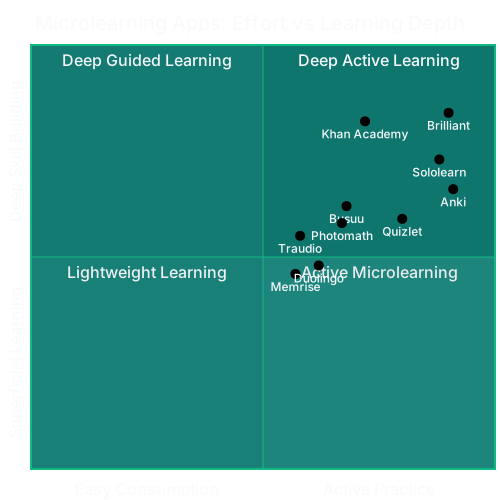
No position is automatically better.
For example, when driving or doing housework, an app that constantly requires solving logic problems is not suitable.
In that case, audio microlearning might be more useful.
Conversely, if the goal is to learn coding, passive content listening will not be enough.
Choose Apps by Problem, Not by Ranking
Instead of ranking from 1 to 10, a more useful approach is to start with the question:
What learning problem am I trying to solve?
If you always say: I don’t have time to read
Traudio
Traudio is suitable for a very specific type of learner:
I want to learn from non-fiction books but find it very difficult to finish long books.
The platform focuses on content such as:
- Personal finance
- Investing
- Business
- Productivity
- Psychology
- Leadership
- Personal development
Traudio designs summaries that can be accessed in about 15 minutes, combining audio and text. The platform also adds flashcards, quizzes, bookmarks, StickWise AI, and goal-oriented learning plans.
Why this model is suitable for adults?
Because audio changes where learning can take place.
You don’t necessarily have to learn at a desk.
Commute
+
Walking
+
Gym
+
Housework
+
Waiting
=
Potential learning time
A lesson on Brilliant requires you to look at a screen.
A coding exercise on Sololearn requires you to interact.
But audio can run during times when these two forms are not feasible.
Traudio states that free users can listen to some books for free when logged in, while VIP expands access to audiobooks, AI, offline downloads, and car integration.
More noteworthy than audio
Traudio doesn’t just stop at:
Listen
↓
Finish
The model aims for:
Listen or read
↓
Quiz
↓
Flashcard
↓
AI review
↓
Review
This is what makes it more aligned with the concept of microlearning rather than just an audiobook player.
When not to choose Traudio?
If you need:
- A complete specialized course
- Professional certification
- Coding practice
- Interactive math
- Language learning
choose a different specialized tool.
If you want to learn fundamentals without paying a subscription
Khan Academy
If your number one criterion is:
truly free
Khan Academy is very hard to beat.
Khan Academy states that its app for learners is 100 percent free and offers thousands of skills along with interactive exercises.
Content ranges from:
- Math
- Science
- Computing
- Economics
- Finance
- History
- Test preparation
Khan Academy’s strength for adults isn’t that it’s an “adult learning app.”
It lies in its ability to fill knowledge gaps.
For example, a data analyst who realizes they are weak in probability doesn’t necessarily have to enroll in a new degree.
They can:
Probability concept
↓
Short video
↓
Practice
↓
Feedback
↓
Next concept
Best suited when
You need to rebuild basic knowledge for:
- Career change
- Coding
- Data
- Finance
- College
- Professional study
Limitations
Khan Academy doesn’t feel as light as Duolingo or Traudio.
It still requires you to sit down and learn.
If you want to build an almost automatic language habit
Duolingo
Duolingo is highly optimized for one thing:
coming back tomorrow.
Duolingo’s courses can still be accessed for free. The paid model primarily removes ads and adds advanced benefits or AI features.
A session is usually small enough that you can do it when:
- Waiting for coffee
- On the train
- Between meetings
- Before bed
What Duolingo does well
Not:
Teaching you everything about a language.
But:
Reducing the likelihood that you’ll give up language learning entirely.
Gamification creates:
Cue
↓
Lesson
↓
XP
↓
Streak
↓
Come back tomorrow
Limitations
A streak does not equate to fluency.
Someone can maintain a streak for hundreds of days but still need:
- Conversation
- Long-form listening
- Reading
- Real-world interaction
If you prioritize structure over gamification, Busuu might be a better fit.
If you want to learn a language with a short, clear curriculum
Busuu
Busuu describes its lessons as short, focused lessons, typically around 3 to 5 minutes.
The difference from Duolingo is that the experience feels more like a structured course.
The Free plan currently includes:
- Essential course
- Community feedback
- Basic progress tracking
Features like AI Conversations, pronunciation feedback, and some review tools are in higher tiers.
Choose Busuu over Duolingo if
You prefer:
Curriculum
↓
Topic
↓
Lesson
↓
Practice
↓
Progress
over:
Game
↓
XP
↓
Streak
↓
Next challenge
If the problem is: I learn but forget too quickly
You don’t need more content.
You need retrieval.
This is where Quizlet and Anki become important.
Quizlet: good for quick Active Recall
Quizlet allows users to create a free account and study with flashcards and basic activities. Some advanced modes and features are included in Quizlet Plus.
A session might just be:
12 flashcards
↓
Try to answer
↓
Got 4 wrong
↓
Review those 4 cards
↓
Done
That’s a good microlearning session because you don’t just see the answer.
You have to try to retrieve the answer from memory.
Quizlet is suitable if
- You are studying for a certification
- Learning vocabulary
- Learning terminology
- Preparing for an exam
- Want a quick review before a meeting or class
Anki: Better When Knowledge Needs to Last Months or Years
Anki addresses a different question:
When should I review this card?
You rate your recall ability after each review, and Anki schedules its next appearance.
The official site describes the review system this way: cards are rescheduled based on user recall to appear close to the time the knowledge is likely to be forgotten.
Here’s the Difference
Quizlet:
I want to study this deck
Anki:
Today the system tells me
what I need to review
Is Free Really Free?
Desktop Anki is free on Windows, macOS, and Linux; AnkiDroid on Android is also free. The official AnkiMobile app on iOS is paid.
Choose Anki if
Knowledge needs to be remembered for:
- 6 months
- 1 year
- Many years
Examples:
- Medical knowledge
- Language vocabulary
- Technical terminology
- Professional certification
If You Want to Learn Coding But Don’t Want to Open an IDE Every Time
Sololearn
Sololearn is a great example of reducing activation energy.
Instead of:
Open laptop
↓
Setup project
↓
IDE
↓
Compiler
↓
Tutorial
you can:
Open app
↓
Read concept
↓
Write code
↓
Run
↓
Get feedback
Sololearn designs bite-sized lessons, many taking only a few minutes and requiring learners to write code directly.
Notably, Sololearn currently states that course content is provided free indefinitely; paid plans primarily remove limits and add practice or AI help.
Suitable for
- Python
- JavaScript
- Web development
- SQL
- AI fundamentals
- Data skills
A Warning
Microlearning is great for learning syntax and concepts.
It doesn’t replace:
Project
↓
Debugging
↓
Architecture
↓
Building something real
If the goal is a career, Sololearn should be a practice layer, not the entire curriculum.
If You Want to Train Your Thinking Instead of Watching Tutorials
Brilliant
Brilliant is one of the most interesting apps for adult learners who enjoy:
- Math
- Logic
- Statistics
- Computer science
- Quantitative reasoning
Lessons require learners to directly manipulate, predict, and solve problems instead of just watching videos.
The free tier currently allows access to course content but limits two lessons or practice sets per day.
Sounds restrictive.
But with microlearning, this can sometimes be a feature.
2 lessons
↓
Quota reached
↓
Stop
↓
Return tomorrow
Choose Brilliant if
You don’t need to learn a lot in one day.
You need:
real thinking for 10 minutes.
If You’re Learning a Foreign Language But Real People Speaking Is Disorienting
Memrise
Memrise is notable for its strong focus on native-speaker video.
Instead of just learning a phrase in text, you can see how native speakers actually say it.
The free experience currently includes vocabulary learning and a large amount of native speaker videos; advanced AI conversation and other benefits are part of Pro.
This is the Problem Memrise Solves
Textbook:
How are you?
Reality:
How’re ya?
How you doing?
You alright?
Adult foreign language learners often don’t just need to know the correct sentence.
They need to recognize that sentence when spoken quickly in real life.
Choose Memrise if
Your weaknesses are:
- Listening
- Natural phrasing
- Vocabulary
- Real-world comprehension
If You Just Need to Understand Why a Math Problem Is Wrong
Photomath
Photomath is another type of microlearning:
just-in-time learning.
You don’t start with a curriculum.
You start with a problem.
Problem
↓
Don't understand
↓
Scan
↓
Step-by-step explanation
↓
Solve it yourself again
Photomath currently offers a Basic plan for $0 with step-by-step explanations; visual aids and deeper explanations are part of the paid plan.
Photomath is Good When
You use it as:
A tutor when stuck.
Not:
An answer generator.
The difference is huge.
Chart 2: Choose an App Based on Your 15 Minutes of Free Time
This is a suggested usage model, not an official requirement of the applications.
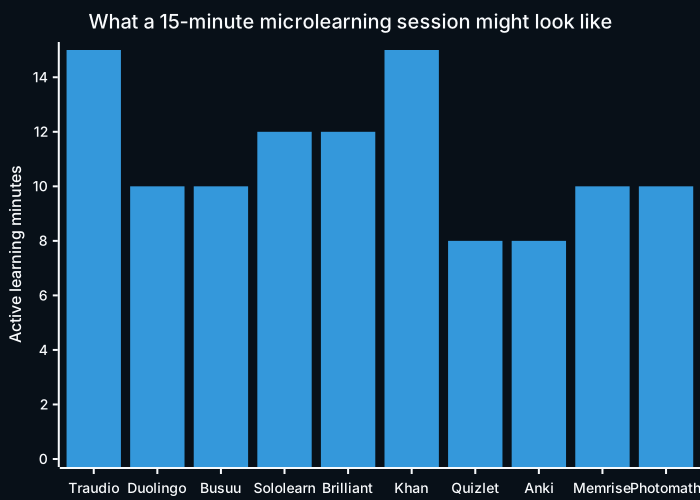
The interesting thing is that 15 minutes doesn’t have the same value in every context.
15 minutes while walking is suitable for audio.
15 minutes sitting at a desk is suitable for coding or math.
5 minutes before a meeting is suitable for flashcards.
Therefore, the best app doesn’t just depend on the goal.
It also depends on the type of time you have.
Choose Apps by Type of Free Time
| You have… | Suitable App |
|---|---|
| 5 minutes before a meeting | Quizlet / Anki |
| 10 minutes on the train | Duolingo / Busuu / Memrise |
| 15 minutes walking | Traudio |
| 15 minutes at your desk | Brilliant / Sololearn |
| 20 minutes in the evening | Khan Academy |
| Stuck on a math problem | Photomath |
| Indefinite waiting time | Duolingo / Anki |
| Long commute | Traudio + language app |
This is a more practical way to choose an app than asking which app has the most content.
Which Free Tier Is Actually the Best?
One should not judge all apps by the same standard.
A completely free app that doesn’t solve your needs is still worth zero.
However, if only evaluating the breadth of the free experience, it can be divided into three groups.
Group A: Free Enough to Be a Primary Tool
Khan Academy
Nearly the entire personal experience is free.
Sololearn
Course content is free indefinitely; paid tier focuses on limits, practice extras, and AI.
Duolingo
Courses can be learned for free; subscription primarily adds convenience and advanced features.
Group B: Good Free, Significantly Expanded Premium
- Busuu
- Memrise
- Quizlet
- Traudio
You can learn for free, but heavy users are likely to hit limits.
Traudio, for example, allows free users to listen to selected book titles with limited AI chat; VIP unlocks unlimited audiobooks and AI, along with offline and car integration.
Group C: Free Works Well If You Accept Quotas
Brilliant
Two lessons or practice sets per day.
Photomath
Basic step-by-step explanations are free, advanced explanations are paid.
Chart 3: Free Access Is Not Always the Same

This classification is more useful than simply attaching a Free badge to every app.
Should Microlearning for Adults Be Input or Output?
This is a question often overlooked.
There are two forms of microlearning.
Input Microlearning
You receive knowledge:
Listen
Read
Watch
Examples:
- Traudio
- Khan Academy
- Memrise native videos
Output Microlearning
You must produce a response:
Recall
Code
Solve
Speak
Examples:
- Anki
- Quizlet
- Brilliant
- Sololearn
- Duolingo
- Busuu
A good learning system should have both.
For example:
INPUT
Traudio
↓
Understand concept
↓
OUTPUT
Flashcards / Quiz
↓
REVIEW
Anki
or:
INPUT
Khan Academy
↓
Understand math concept
↓
OUTPUT
Brilliant
↓
APPLY
Real problem
Don’t Use Microlearning to Avoid Deep Work
Microlearning carries a risk.
It can easily create the feeling:
I study every day, so I must be making progress.
But 10 minutes a day cannot replace all types of learning.
If you want to become a developer:
Sololearn
+
Projects
not just:
Sololearn
If you want to speak English fluently:
Duolingo / Busuu / Memrise
+
Real conversation
If you want to become a financial expert:
Traudio
+
Full books
+
Research
+
Application
Microlearning is best when it:
reduces friction to start and sustain learning.
Not when it becomes a reason to avoid deeper learning work.
A 20-Minute Daily System for Working Professionals
You don’t need to use 10 apps.
You shouldn’t, even.
Choose:
1 app for new learning + 1 app for remembering.
For example:
Career learner
15 minutes
Sololearn or Khan Academy

+

5 minutes
Anki
Language learner
10 minutes
Busuu or Duolingo

+

10 minutes
Memrise / Anki
Book learner
15 minutes
Traudio

+

5 minutes
Quiz / Flashcard
Quantitative learner
10 minutes
Khan Academy

+

10 minutes
Brilliant
This is how to turn an app into a learning system.
A 7-Day Plan to Find Out Which App Is Right for You
Don’t buy Premium right away.
Try it this way.
Day 1
Choose a single goal.
Not:
I want to be smarter.
But:
I want to understand investing.
or:
I want to learn Python.
or:
I want to improve my Spanish.
Day 2
Choose the app that fits that job.
| Goal | App to Start With |
|---|---|
| Learn from books | Traudio |
| Python | Sololearn |
| Math | Khan Academy |
| Quantitative thinking | Brilliant |
| Language habit | Duolingo |
| Structured language | Busuu |
| Natural listening | Memrise |
| Memorization | Anki |
| Exam recall | Quizlet |
| Math problem | Photomath |
Day 3 to Day 6
Study for exactly 10–15 minutes each day.
Don’t increase the time just because you felt enthusiastic on the first day.
The goal of the experiment is to measure:
Does the app fit into my normal life?
Day 7
Ask four questions:
- Did I remember to open the app myself?
- Can I explain something new I learned?
- Do I feel like continuing?
- Is the free tier starting to get in the way?
If the answer to the first three questions is yes, you’ve found an app worth keeping.
Best Free Microlearning Apps for Adults by Goal
If you need a short answer:
Best overall free academic learning: Khan Academy.
Best for daily language habit: Duolingo.
Best for structured language microlearning: Busuu.
Best for real-world language exposure: Memrise.
Best for coding: Sololearn.
Best for math and logic practice: Brilliant.
Best for book-based audio microlearning: Traudio.
Best for fast active recall: Quizlet.
Best for long-term memory: Anki.
Best for just-in-time math help: Photomath.
So, which app is best for busy professionals?
If based solely on an adult’s daily schedule, there are three particularly useful types of apps.
1. Apps usable during downtime
Examples:
- Traudio
- Duolingo
- Memrise
They can fit into commutes, walks, or short breaks.
2. Apps that get you straight into practice
Examples:
- Sololearn
- Brilliant
- Quizlet
- Anki
No need to watch a long lecture before doing something.
3. Apps that address the exact problem you’re facing
Examples:
- Khan Academy
- Photomath
You can find the right concept or problem instead of starting a new course from chapter one.
Conclusion
There isn’t one best free microlearning app for adults that suits everyone.
What matters isn’t the number of courses.
Nor is it the app with the most AI features.
It’s the fit between:
Goal
+
Time
+
Context
+
Learning Style
+
Sustainability
If you want a powerful free academic platform, start with Khan Academy.
If you want to build a language habit, Duolingo reduces friction very well.
If you want a clearer language curriculum, try Busuu.
If you need to hear how native speakers actually talk, Memrise adds a useful layer of exposure.
If you want to code in short sessions, Sololearn is one of the easiest options to start with.
If you want to develop math and logic skills instead of passively watching videos, Brilliant is a better fit.
If the problem is memorization, choose Quizlet for quick Active Recall or Anki for long-term spaced repetition.
If you frequently get stuck on a specific math problem, Photomath works well as a just-in-time learning tool.
And if the goal is to learn ideas from books while commuting, walking, or doing housework, Traudio brings book-based learning into a microlearning format of about 15 minutes with audio, text, quizzes, flashcards, and AI review.
Ultimately, microlearning is effective not because lessons are short.
It’s effective when lessons are small enough for you to start, active enough for you to learn, and easy enough to sustain so you come back tomorrow.
Related Articles
Master Your Financial Mindset Today
Download the Traudio app for iOS & Android to listen to synchronized audiobook summaries and chat with StickWise AI.
Download Traudio App Free