Top 15 Trending Learning Apps 2026: The Most Noteworthy Learning Apps
The way we learn is changing very rapidly in 2026.
A modern learning app is no longer simply a repository for lecture videos. An AI tutor can explain a concept in a way that suits each individual. Microlearning transforms 10 to 15-minute breaks into short study sessions. Active Recall and spaced repetition help knowledge not disappear after a few days. Tools like Gemini Notebook can even turn your own PDFs, documents, and notes into a learning environment.
The trend is shifting from:
Unlock course
↓
Watch video
↓
Take quiz
↓
Complete
to:
Choose goal
↓
Learn relevant content
↓
Interact with AI
↓
Practice
↓
Active Recall
↓
Review
↓
Apply
Below are 15 noteworthy learning apps in 2026, focusing on global platforms or those with a clear strength for users learning in English.
Note: This is a list of noteworthy applications based on product trends and learning methods in 2026, not an official ranking by downloads, revenue, or number of users.
Top 15 Trending Learning Apps 2026
| # | App | Key Trend | Best For |
|---|---|---|---|
| 1 | Duolingo | AI + Gamification | Language learning |
| 2 | Gemini Notebook | AI-powered learning | Learning from personal documents |
| 3 | Coursera | Career learning + AI | Professional skills |
| 4 | Khan Academy | AI tutoring | Education and STEM |
| 5 | Quizlet | AI + Active Recall | Review and memorization |
| 6 | Brilliant | Interactive Learning + AI Tutor | Math, logic, and coding |
| 7 | Traudio | AI + Microlearning + Audio Learning | Learning knowledge from books |
| 8 | Udemy | Skills-based Learning | Practical skills |
| 9 | LinkedIn Learning | AI + Career Upskilling | Career development |
| 10 | Busuu | AI Conversation | Foreign languages |
| 11 | Babbel | Structured Language Learning | Foreign languages |
| 12 | Memrise | AI + Native Content | Foreign language communication |
| 13 | Anki | Spaced Repetition | Long-term memorization |
| 14 | Photomath | Step-by-step Learning | Mathematics |
| 15 | MasterClass | Expert-led Learning | Lifelong learning |
Learning Apps Trends Chart 2026
The chart below shows an editorial assessment of each app’s prominence in 2026 learning trends, not an official user rating score.
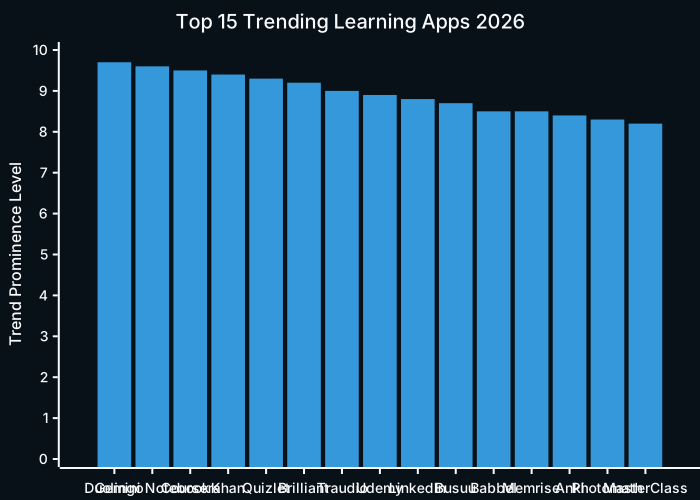
What’s noteworthy isn’t which app is absolutely at the top, but how each product represents a different development direction in EdTech:
- AI Tutor
- Microlearning
- Active Recall
- Personalized Learning
- Interactive Learning
- Language Learning
- Career Upskilling
- Spaced Repetition
- Learning from your own content
1. Duolingo
Trend: AI + Gamified Learning
Duolingo continues to be one of the clearest examples of how to turn learning into a habit.
Instead of requiring users to spend hours each day, Duolingo breaks down the learning process into short lessons, combining:
- Streaks
- XP
- Leaderboards
- Daily goals
- Personalized review
- Achievements
But the more significant change in recent years is AI.
Duolingo Max adds experiences like Video Call, Roleplay, and AI-powered explanation features. Video Call allows learners to chat directly with in-app characters, while Roleplay simulates real-life communication situations.
Why is Duolingo noteworthy in 2026?
Duolingo is taking language learning from:
Learn words
↓
Do exercises
↓
Test
to:
Learn
↓
Speak
↓
AI feedback
↓
Continue practicing
Suitable for
- New language learners
- Those who need to build a habit
- Those with only 10 to 20 minutes per day
- Those who enjoy gamification
2. Gemini Notebook
Trend: Learning from Your Own Documents with AI
If you know NotebookLM, the name has changed.
Google officially rebranded NotebookLM to Gemini Notebook in July 2026. The product continues to focus on research and learning based on user-provided source materials.
This is a very different model from traditional learning apps.
Typically:
App
↓
Provides content
↓
You learn that content
Gemini Notebook reverses the model:
You provide documents
↓
AI understands documents
↓
AI helps you learn
You can build notebooks from sources such as:
- PDFs
- Notes
- Research papers
- Websites
- Slides
- Videos
- Work documents
Then use AI to explore, connect, and analyze information within those sources.
Why is it noteworthy?
This could be one of the most important directions in EdTech:
Bring Your Own Content Learning.
Instead of asking the app:
Do you have a course on this topic?
learners can say:
Here is the material I need to learn. Please help me understand it.
3. Coursera
Trend: Career Learning + AI Upskilling
Coursera continues to be one of the most important platforms when learning goals are directly related to career.
The platform offers:
- Courses
- Specializations
- Professional Certificates
- Guided Projects
- Degree programs
- AI learning features
Coursera partners with hundreds of universities and businesses worldwide, from Google, IBM, and Meta to Yale and the University of Michigan.
A major change in 2026 is that Coursera and Udemy completed their merger into a single company in May 2026, creating a massive skills ecosystem. The two brands and learning experiences still retain their distinct characteristics.
Coursera is suitable for
- Those looking to change careers
- Data analysts
- Developers
- Product managers
- Digital marketers
- Those wanting to learn AI
- Those needing Professional Certificates
Why is it trending?
AI is changing the skills businesses need, and Coursera is strongly focusing on:
AI
Data
Technology
Business
Career transition
4. Khan Academy
Trend: AI Tutor
Khan Academy has long been one of the world’s most famous free educational platforms.
But Khanmigo is taking the platform in a new direction.
Khanmigo is an AI tutor and teaching assistant integrated with Khan Academy’s content system. Unlike a chatbot model that simply provides answers, Khan Academy designed Khanmigo to ask questions and guide learners to discover solutions themselves.
For example:
Student asks a math problem
↓
AI doesn't immediately give the answer
↓
AI asks a question
↓
Student thinks
↓
AI continues to guide
↓
Student finds the solution themselves
In August 2026, Khan Academy also announced new Khanmigo tools to visualize math and science concepts and provide more targeted practice exercises.
Suitable for
- Math
- Science
- Coding
- Writing
- Students
- Teachers
- Parents
5. Quizlet
Trend: AI + Active Recall
Quizlet was once known primarily as a flashcard app.
By 2026, it has become a suite of learning tools relying more heavily on AI.
Current tools include:
- AI Flashcard Maker
- AI Study Guide
- AI-generated Practice Tests
- PDF summarization
- Homework help
- Learn mode
Users can input notes, slides, or PDFs and turn them into structured study materials.
Key point
Quizlet still maintains a very valuable principle:
You don’t just read knowledge. You have to try to recall it.
That is Active Recall.
Read
↓
Close material
↓
Self-answer
↓
Incorrect
↓
Re-learn
↓
Try again
AI helps reduce the effort of creating materials.
Active Recall is the part that makes learning truly happen.
6. Brilliant
Trend: Interactive Learning + AI Tutor
Brilliant addresses a major drawback of online learning:
Watching someone else solve a problem doesn’t mean you know how to solve it.
Instead of relying primarily on videos, Brilliant uses:
- Interactive diagrams
- Problem solving
- Simulations
- Visual explanation
- Immediate feedback
In 2026, Brilliant also introduced Koji into the learning experience.
Koji is a personal tutor that can see the problem and interaction the learner is performing, then guide them step-by-step without simply providing the answer.
Brilliant is especially suitable for
- Mathematics
- Logic
- Computer Science
- Coding
- Quantitative thinking
Brilliant’s model is:
Don't watch the solution
↓
Solve it yourself
↓
Encounter difficulty
↓
AI Tutor assists
↓
Continue solving yourself
7. Traudio
Trend: AI + Microlearning + Audio Learning
Traudio represents another direction in learning apps: transforming knowledge from books into short microlearning sessions that can be listened to or read.
Instead of requiring users to spend many hours completing a book, Traudio focuses on:
Important ideas that can be learned in about 15 minutes each day.
Traudio currently boasts a library of over 2,000 book summaries and combines content with learning tools such as:
- Synchronized Audio & Text
- Interactive Quizzes
- Flashcards
- Bookmarks
- StickWise AI
- Guided Learning
- Personalized 7-day learning plans
- Offline listening
- Android Auto
- Short-form learning content
How is Traudio different from traditional audiobooks?
Traditional audiobooks often have the flow:
Choose book
↓
Listen for 8 to 15 hours
↓
Complete
Traudio aims for:
Choose goal
↓
Explore books
↓
Listen or read for about 15 minutes
↓
Grasp main ideas
↓
Quiz
↓
Flashcard
↓
Ask AI
↓
Review
↓
Apply
The difference lies in audio being only one part of the learning loop.
Microlearning instead of just audiobooks
Traudio is built around small pockets of time throughout the day:
- Commuting
- Waiting for transport
- Lunch break
- Exercising
- Doing housework
- Before sleep
Instead of having to create an extra hour specifically for learning:
Free time
+
Audio
+
Microlearning
=
Study session
Active Recall after listening
One of the problems with podcasts and audiobooks is that they can easily become passive consumption.
You listen a lot.
But a few days later, you remember very little.
Traudio adds Quizzes and Flashcards after the content to help users actively retrieve knowledge.
Listen
↓
Understand
↓
Recall
↓
Test
↓
Review
This is the difference between:
content consumption
and:
learning retention
StickWise AI
Traudio also integrates StickWise AI as a learning companion to help users:
- Revisit concepts
- Review book takeaways
- Understand complex content
- Continue to delve deeper after listening
Instead of the learning session ending when the audio stops:
Audio ends
↓
AI conversation begins
Guided Learning
Traudio is also combining book content into short, goal-oriented learning paths.
For example:
- Master Your Money
- Invest with Confidence
- Deep Focus in a Distracted World
- Habits That Stick
This shifts the experience from:
Which book should I listen to?
to:
What goal do I want to achieve?
↓
App builds learning path
Traudio is suitable for
- Busy professionals
- People who enjoy non-fiction
- People who want to learn from books
- People who often listen to content on the go
- People who like microlearning
- People who want to combine audio, text, quizzes, flashcards, and AI
Why is it noteworthy in 2026?
Traudio sits at the intersection of four trends:
          AI
           ↓
Audio → TRAUDIO ← Microlearning
           ↑
     Active Recall
Instead of just optimizing for listening more, the product aims for learning and remembering more.
8. Udemy
Trend: Skills-based Learning
Udemy is especially useful when your question is very specific:
I need to learn this technology or skill right now.
Popular topics include:
- Python
- JavaScript
- AWS
- Docker
- Kubernetes
- Generative AI
- Excel
- Marketing
- Design
- Photography
- Business
Unlike Coursera, which has many programs built with universities and businesses, Udemy has a marketplace model with a large number of independent instructors.
This creates an advantage in speed.
A new framework appearing today can quickly have a course on Udemy.
A major change in 2026 is that Coursera and Udemy have come together under one company, creating an ecosystem serving over 290 million learners, according to figures released by both parties upon completion of the deal.
Suitable for
- Developers
- Designers
- Marketers
- Freelancers
- People learning specific skills
- People who prefer self-paced learning
9. LinkedIn Learning
Trend: AI + Career Upskilling
LinkedIn Learning has an advantage that most learning apps don’t:
Career Graph.
LinkedIn knows:
- What job you do
- What industry you are in
- Which skills are relevant to your profession
- Which positions require which skills
AI can use that career data to bring learning closer to career goals.
LinkedIn Learning currently uses AI to support content personalization and provide experiences like role-play for workplace communication scenarios.
Suitable for
- Professionals
- Managers
- Project Managers
- Business professionals
- Developers
- Designers
- Sales
- Marketing
10. Busuu
Trend: AI Conversation
One of the biggest problems when learning a foreign language is:
I study a lot but have no one to talk to.
Busuu is using generative AI to solve that problem.
Busuu Conversations provides speaking scenarios tailored to the user’s proficiency level and lesson content.
After the conversation, learners receive personalized feedback.
The model becomes:
Learn vocabulary
↓
Learn grammar
↓
Speak with AI
↓
Receive feedback
↓
Correct
↓
Speak again
Suitable for
- People who want to practice speaking
- People who are shy about speaking with real people
- People who need a low-pressure practice environment
- People who want to learn along a structured path
11. Babbel
Trend: Structured Language Learning
If Duolingo is very strong in gamification, Babbel leans more towards a structured foreign language program.
Content focuses on:
- Grammar
- Vocabulary
- Listening
- Speaking
- Real-life conversations
Babbel is suitable for people who not only want to maintain a streak but want to understand how the language works.
Babbel vs Duolingo
It can be simply imagined as:
Duolingo
Gamification → Habit → Practice

Babbel
Structure → Understanding → Conversation
These two approaches are not mutually exclusive.
Some people even use both.
12. Memrise
Trend: AI + Native Speaker Content
Memrise has an interesting approach to language learning.
The platform focuses heavily on how language is actually used in real life through videos of native speakers.
By 2026, Memrise still combines:
- Native-speaker videos
- Spaced repetition
- Gamified tests
- AI speaking practice
Memrise has also brought back Mems and allows AI to generate images to aid in memorizing new words. The platform states that MemBot is used to simulate AI conversations.
Suitable for
- People who want to hear how native speakers actually talk
- Vocabulary
- Pronunciation exposure
- Speaking practice
- People who like learning through short videos
13. Anki
Trend: Spaced Repetition
Anki is not the flashiest app on the list.
But for those who truly need to memorize thousands of pieces of information, it remains very powerful.
The app is famous for its flashcard system and spaced repetition.
The idea is very simple:
Learn a piece of information
↓
About to forget
↓
Anki brings it back
↓
Recall
↓
Review interval lengthens
Instead of relearning everything every day, the system prioritizes content that needs review.
Anki has clients for desktop, Android, and iPhone/iPad, along with a highly customizable deck system.
Anki is best suited for
- Medical students
- Language learners
- Law
- Certification
- History
- Technical terminology
- Subjects requiring memorization of large amounts of information
14. Photomath
Trend: Step-by-step Learning
Photomath turns a phone camera into a math learning aid.
The process is very simple:
Scan math problem
↓
Get solution
↓
View step-by-step
↓
Understand method
Photomath supports many areas from basic math to:
- Algebra
- Geometry
- Trigonometry
- Statistics
- Calculus
The platform emphasizes step-by-step solutions so users can understand how to solve problems rather than just getting the final answer.
Important Point
Photomath can be used in two ways.
The less effective way:
Snap
↓
Copy answer
The better way:
Solve it yourself
↓
Stuck on a step
↓
Use Photomath
↓
Understand that step
↓
Close app
↓
Solve it yourself again
The tool does not determine the quality of learning.
How you use the tool determines that.
15. MasterClass
Trend: Expert-led Learning
MasterClass doesn’t try to turn every subject into a test.
The platform focuses on learning through the experience and mindset of prominent people in their fields.
The catalog has over 200 classes in areas such as:
- Writing
- Cooking
- Film
- Music
- Business
- Leadership
- Sports
- Photography
A particular strength of MasterClass is its production quality.
The experience sometimes feels more like a high-end documentary than a traditional online course.
Suitable for
- Lifelong learners
- Creative professionals
- Entrepreneurs
- People who want to broaden their perspectives
- People who enjoy learning through storytelling
5 Major Trends in Learning Apps in 2026
Looking at the 15 applications above, several common trends are emerging.
1. AI Tutors replacing simple answer chatbots
The first generation of educational AI worked like this:
Question
↓
AI
↓
Answer
But new products are trying to shift to:
Question
↓
AI understands proficiency
↓
AI provides hints
↓
Learner thinks
↓
AI adjusts
↓
Learner finds solution independently
Khanmigo and Brilliant Koji are clear examples. Both emphasize guidance rather than just providing answers.
2. Microlearning turning dead time into learning time
Not everyone can sit and study for two hours every evening.
But many people have:
10 minutes on the commute
+
15 minutes during lunch break
+
10 minutes waiting
+
15 minutes before bed
That’s almost an hour.
Products like Duolingo and Traudio are designed very well for this type of behavior.
Traudio specifically combines microlearning with audio so users can learn during times when it’s difficult to read a screen.
3. Active Recall returning to the center
AI can explain everything very quickly.
But there’s a problem:
Understanding while reading doesn’t mean remembering a week later.
That’s why Active Recall and spaced repetition are still important.
Quizlet focuses on practice tests, flashcards, and review tools. Traudio uses Quizzes and Flashcards after content. Anki makes spaced repetition its core mechanism.
A stronger learning loop is:
Consume
↓
Understand
↓
Recall
↓
Check
↓
Review
↓
Apply
4. Bring Your Own Content Learning
Gemini Notebook represents a completely new model.
Before:
Platform has courses
↓
You choose a course
↓
You learn
Now:
You have PDFs
+
Slides
+
Research
+
Notes
        ↓
AI Learning Workspace
        ↓
You learn from your own materials
This is especially a big step forward for:
- Students
- Researchers
- Knowledge workers
- Developers
- Analysts
5. Learning becoming personalized by goal
Another important trend is shifting from:
What subject do you want to learn?
to:
What do you want to achieve?
For example:
"I want to transition to Data Analytics"
instead of:
"I want to learn Excel."
Or:
"I want to invest with more confidence"
instead of:
"I want to read financial books."
Platforms are increasingly trying to build learning paths around outcomes, not just around content.
Which Learning Apps are right for you?
If you are a student
An effective stack could be:
Khan Academy
        +
Gemini Notebook
        +
Quizlet
        +
Anki
Khan Academy for understanding.
Gemini Notebook for processing materials.
Quizlet for practice.
Anki for memorization.
If you are a professional
Coursera
        +
LinkedIn Learning
        +
Traudio
        +
Gemini Notebook
Coursera for building professional skills.
LinkedIn Learning for quick upskilling.
Traudio for daily microlearning.
Gemini Notebook for processing real-world work documents.
If you want to learn a foreign language
Duolingo
      +
Busuu / Babbel / Memrise
      +
Anki
Duolingo for habit formation.
Busuu for AI conversation.
Babbel for structure.
Memrise for increased exposure to natural language.
Anki for long-term vocabulary retention.
If you are a developer
Coursera / Udemy
        +
Brilliant
        +
Gemini Notebook
        +
Anki
Udemy is suitable for quickly learning frameworks.
Coursera helps build a structured foundation.
Brilliant hones quantitative thinking and computer science.
Gemini Notebook helps work with documentation and technical materials.
If You Like Learning from Books
Traudio
↓
Listen or Read
↓
Quiz
↓
Flashcard
↓
AI
↓
Apply
This approach is suitable for those who don’t want learning to become a long list of unfinished books.
Comparison by Need
| I want to… | App to try |
|---|---|
| Learn a language daily | Duolingo |
| Speak a foreign language with AI | Busuu |
| Learn a language with structure | Babbel |
| Listen to real native speakers | Memrise |
| Learn from PDFs and documents | Gemini Notebook |
| Get professional certification | Coursera |
| Quickly learn a skill | Udemy |
| Develop professionally | LinkedIn Learning |
| Learn math and STEM for free | Khan Academy |
| Learn interactive math | Brilliant |
| Create flashcards and practice tests | Quizlet |
| Memorize long-term | Anki |
| Learn knowledge from books in a short time | Traudio |
| Understand how to solve math problems | Photomath |
| Learn from famous experts | MasterClass |
A Learning Stack is More Important Than a Single App
A common mistake is searching for:
What is the best learning app?
Perhaps this is no longer the right question.
An app rarely performs well at every step of the learning process.
A better system might be:
DISCOVER
Traudio
↓
IN-DEPTH STUDY
Coursera / Udemy
↓
RESEARCH
Gemini Notebook
↓
PRACTICE
Brilliant / Quizlet
↓
MEMORIZE
Anki
↓
APPLY
Real-world Project
Each app addresses a different part.
Can AI Replace Traditional Learning Apps?
Not entirely.
AI is very strong in:
- Explanation
- Personalization
- Summarization
- Question generation
- Conversation
- Feedback
- Information retrieval
But a good learning system still needs:
- Curriculum
- Practice
- Progression
- Active Recall
- Feedback
- Repetition
- Motivation
That’s why the most powerful learning apps don’t simply add an AI chat box to their product.
They are finding ways to integrate AI into the learning loop.
Which Learning Apps Are Most Worth Watching in 2026?
If categorized by trend, they can be summarized as follows:
AI Learning Workspace
Gemini Notebook
Learn directly from your own data and documents.
AI Tutor
Khan Academy and Brilliant
AI guides instead of just providing answers.
AI Language Learning
Duolingo, Busuu, and Memrise
AI transforms speaking practice into an activity that can be done anytime.
Career Learning
Coursera, Udemy, and LinkedIn Learning
Focuses on skills rapidly changing due to AI.
Microlearning
Traudio
Transforms knowledge from books into short learning sessions combining audio, text, Active Recall, and AI.
Memory Systems
Quizlet and Anki
Focuses on helping knowledge persist longer in memory.
Conclusion
Learning apps in 2026 are entering a new phase.
The previous generation focused on:
putting content online.
The current generation focuses on:
helping each individual truly learn that content.
Duolingo uses gamification and AI to sustain language learning.
Gemini Notebook transforms personal documents into a research and learning workspace.
Coursera and Udemy connect online learning with professional skill demands.
Khan Academy and Brilliant integrate AI tutors directly into the problem-solving process.
Quizlet and Anki focus on Active Recall and long-term memory.
Busuu, Babbel, and Memrise continue to change how we practice foreign languages.
Photomath turns phones into step-by-step math explanation tools.
MasterClass brings expert experience into the online learning experience.
And Traudio represents another development direction: combining microlearning, audio, text, Active Recall, and AI to turn short periods throughout the day into opportunities to learn from books.
The common thread among all these trends is very clear:
The learning app of the future doesn’t just ask what content you want to see.
It needs to understand who you want to become, what you already know, what you are forgetting, and what you should learn next.
That could be the most significant change in educational technology in 2026.
Related Articles
Master Your Financial Mindset Today
Download the Traudio app for iOS & Android to listen to synchronized audiobook summaries and chat with StickWise AI.
Download Traudio App Free