Comparison of Audiobook Apps: Which to choose: Audible, Spotify, Libby, Kobo, Apple Books, Everand, or Traudio?
Searching for comparison of audiobook apps seems simple: open a few apps, compare prices, see which library is larger, then choose.
But that’s no longer the best way to compare audiobook apps in 2026.
The market has now split into many very different models.
There are apps that sell individual books for you to own permanently.
There are platforms that allow listening to a catalog via subscription.
There are completely free library apps.
There are platforms that integrate audiobooks into the same music and podcast ecosystem.
And another direction is emerging: not optimized for listening to as many books as possible, but using audio to learn quickly, remember, and apply knowledge from books.
Therefore, the right question is no longer:
Which audiobook app is best?
But rather:
What do you want audiobooks to do for you?
In this article, we will compare seven typical approaches:
- Audible
- Spotify
- Libby
- Kobo
- Apple Books
- Everand
- Traudio
Traudio is included as a trending learning-first audiobook app, not because it has a full-length catalog as large as Audible or Spotify, but because it represents a different development direction for audio learning.
Audiobook Apps in 2026 Are No Longer the Same Type of Product
A more useful way to understand the market is to categorize apps by model.
| Model | Typical App | What are you actually paying for or using it for? |
|---|---|---|
| Ownership + credits | Audible | Own specific audiobooks + catalog subscription |
| Entertainment ecosystem | Spotify | Music + podcast + audiobook in the same ecosystem |
| Library borrowing | Libby | Borrow audiobooks for free from the library |
| Subscription + ownership | Kobo | Unlimited catalog + buy individual books |
| Pay-per-book | Apple Books | Buy individual audiobooks, no subscription needed |
| Reading subscription | Everand | Ebook + audiobook in one subscription |
| Learning-first audio | Traudio | Microlearning from books + quiz + flashcard + AI |
This is the most important distinction in the entire article.
Audible and Apple Books sell access to books.
Spotify sells listening time within a large ecosystem.
Libby lends you books.
Everand and Kobo sell subscription access to a catalog.
Traudio sells a learning experience centered around book content.
Chart 1: Where Do Audiobook Apps Stand in the Market?
The chart below is an editorial assessment of product positioning, not market share data.
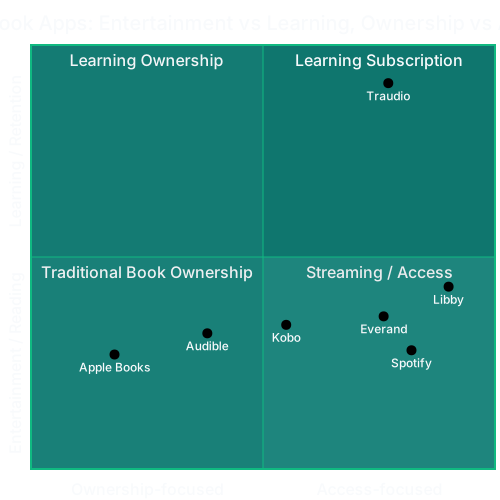
The chart shows that Traudio does not truly stand on the same competitive axis as Apple Books or Audible.
Audible is optimized for:
full-length audiobook consumption
While Traudio aims for:
book-based learning and retention
Quick Comparison Table of Audiobook Apps
| App | Full audiobook | Subscription | Purchase for ownership | Free | Ebook | Podcast/music | Learning tools |
|---|---|---|---|---|---|---|---|
| Audible | Yes | Yes | Yes | Trial / limited | Not primary focus | Podcast / Originals | Limited |
| Spotify | Yes | Yes | Yes, in some markets | Free app available | No | Very strong | Limited |
| Libby | Yes | No | No | Yes, with library card | Yes | No | Notes / bookmarks |
| Kobo | Yes | Yes | Yes | Trial | Yes | No | Limited |
| Apple Books | Yes | No | Yes | Some free books | Yes | No | Reading goals |
| Everand | Yes | Yes | Not primary focus | Trial | Yes | No | Limited |
| Traudio | Focus on summary/microlearning | Yes | Not primary focus | Selected content available | Accompanying text | No | Quiz, flashcard, AI, learning plan |
1. Audible: Best if Audiobooks Are Your Primary Reading Format
Audible remains one of the audiobook platforms with the strongest ecosystem.
The important point is that Audible doesn’t just use one type of subscription.
In the US, Audible currently offers multiple membership models, including Plus, Premium, and Standard. Premium provides credits to exchange for specific audiobooks, while the included catalog allows streaming of thousands of audiobooks, podcasts, and Audible Originals. Audiobooks purchased with money or credits are kept in your library.
This is a significant advantage if you don’t just want access, but want to build a personal audiobook library.
Audible Essentially Combines Two Models
Model 1: Subscription catalog
Pay membership
↓
Access included catalog
↓
Listen during valid membership period
Model 2: Ownership
Receive credit
↓
Redeem audiobook
↓
Audiobook added to library
↓
Keep
This makes Audible distinctly different from a pure Netflix-style subscription.
Who is Audible best for?
People who:
- Listen to many full-length audiobooks
- Like bestsellers and new releases
- Want to own some books long-term
- Listen to fiction
- Enjoy narrators and full-cast productions
- Are already in the Amazon ecosystem
Strengths
- Very large catalog
- Many new releases
- Audible Originals
- Credit model
- Offline listening
- Multi-device
- Very strong in full-length fiction and non-fiction
Weaknesses
If you only want to learn the main ideas of a book in 15 minutes, Audible is often too long.
A non-fiction book can last:
8 hours
10 hours
15 hours
While the amount of knowledge you truly want to retain is sometimes just a few frameworks.
This is the gap that learning-first apps try to address.
2. Spotify: Best if You Don’t Want Another Audio App
Spotify is becoming a notable audiobook competitor not because it only does audiobooks well.
But because millions of people already use Spotify every day.
Audiobooks are integrated into the same place as:
- Music
- Podcast
- Playlist
- Recommendations
Spotify states that its audiobook catalog has exceeded 700,000 titles and was rolled out in 22 markets by 2026.
In the US, eligible Premium plans now include 15 hours of audiobooks per month, with the option to purchase additional listening hours or subscribe to Audiobooks+.
Spotify Sells Time, Not Just Books
This is a very notable point.
Audible often makes you think:
Which book do I want to get with my credit?
Spotify makes you think:
How many listening hours do I have left this month?
Spotify Premium
↓
Monthly listening hours
↓
Listen to any eligible audiobook
↓
Hours run out
↓
Top-up / Audiobooks+
This is a completely different model.
Spotify is best if
You:
- Already pay for Spotify Premium
- Don’t listen to too many audiobooks each month
- Want music + podcasts + books in one app
- Like discovery algorithms
- Don’t want to manage multiple subscriptions
Spotify also continues to invest heavily in audiobook discovery, including charts, personalized audiobook playlists, and conversational discovery in 2026.
3. Libby: The Best Value Audiobook Option if You Have a Library Card
Libby has a completely different model.
You don’t buy books.
You also don’t subscribe to Libby.
You borrow books from your local library.
Libby by OverDrive allows users to borrow:
- Audiobooks
- Ebooks
- Magazines
for free through a library card from participating libraries.
Libby is currently used in libraries in dozens of countries and supports offline listening, CarPlay, Android Auto, and Bluetooth.
Why is Libby Different from Subscription Apps?
Subscription model:
You pay
↓
Platform owns catalog access
↓
You listen
Libby:
Library buys license
↓
You have a library card
↓
Borrow
↓
Listen
↓
Return automatically
No monthly bill from Libby.
Biggest Weakness: Availability
Libby cannot guarantee you’ll get the book you want immediately.
The collection depends on your library, and each library decides which titles they offer.
A new bestseller might have:
Available copies: 5
People waiting: 87
You have to place a hold.
This is the trade-off:
Free access in exchange for waiting time.
4. Kobo: Suitable if You Want Both Ebooks and Audiobooks
Kobo occupies a rather interesting position.
It has both:
- Ebook store
- Audiobook store
- Kobo eReaders
- Kobo Plus subscription
Kobo Plus allows users to read and listen to titles within the subscription catalog for a fixed monthly fee.
In some markets, such as the UK, Kobo currently advertises its Kobo Plus catalog with over 1.5 million ebooks and over 150,000 audiobooks. The catalog and pricing vary by country.
Kobo’s Strongest Point Isn’t Just Audiobooks
It’s the ecosystem:
Kobo eReader
+
Ebook
+
Audiobook
+
Subscription
If you like switching between reading and listening, Kobo has a more natural product logic than a pure audio app.
Best for
- Kobo eReader users
- Frequent ebook readers
- Those who want an ebook + audiobook subscription
- Those who don’t want to depend on Amazon
5. Apple Books: Simplest if You Hate Subscriptions
Not every user wants another monthly fee.
Apple Books addresses exactly that group.
Apple Books does not require a subscription. Users can purchase individual ebooks or audiobooks, and Apple states that its global catalog includes millions of books, bestsellers, new releases, and classics.
The model is very straightforward:
Find audiobook
↓
Purchase
↓
Listen
↓
Book in library
No:
Credits
Listening hours
Catalog tiers
Monthly quota
Who is Apple Books best for?
People who:
- Use iPhone, iPad, and Mac
- Only buy a few audiobooks per year
- Dislike subscriptions
- Want to pay only for the books they need
- Want Family Sharing
Apple states that audiobooks and ebooks can be shared with up to five eligible family members.
Weaknesses
If you listen to 5 to 10 audiobooks per month, buying each one individually can quickly become expensive.
6. Everand: For Audiobook Listeners as Part of a Reading Subscription
Everand leans more towards the “Netflix for reading” model.
The platform combines:
- Audiobooks
- Ebooks
- Other reading content
Everand currently promotes access to millions of ebooks and audiobooks through a subscription.
This is suitable if you’re not overly concerned with:
Will this book be mine forever?
But are more interested in:
I always want something new to read or listen to.
Everand vs Audible
Simply put:
Audible
Catalog access
+
Credits
+
Ownership
Everand
Subscription
↓
Browse
↓
Read / Listen
↓
Next
Audible is better suited for collectors.
Everand is better suited for explorers.
7. Traudio: A Trending Learning-First Audiobook App
Traudio doesn’t try to build a smaller copy of Audible.
That’s the most important point when including Traudio in a comparison of audiobook apps.
If you only compare:
- Total number of audiobooks
- Bestsellers
- Fiction catalog
- Celebrity narration
Traudio shouldn’t compete on the same criteria.
It addresses a different question:
If I listen to books to learn, why does the audiobook player stop at the Play button?
Traudio focuses on microlearning from books, especially on topics like personal finance, investing, productivity, business, and personal development.
The platform currently describes its product as an audiobook summary system combining:
- Synchronized audio & text
- Interactive quizzes
- Flashcards
- Bookmarks
- StickWise AI
- Offline listening
- Android Auto
- Short-form learning content
How Do Traditional Audiobooks and Learning-First Audiobooks Differ?
Traditional Audiobooks:
Open book
↓
Play
↓
Listen to Chapter 1
↓
Listen to Chapter 2
↓
Listen to Chapter 3
↓
Finish
Traudio:
Choose topic
↓
Listen or read condensed content
↓
Bookmark important ideas
↓
Quiz
↓
Flashcards
↓
Ask AI
↓
Review
This changes the metric for success.
With traditional audiobooks:
How many hours did you listen?
With learning-first audio:
How much did you remember and apply?
Chart 2: Audiobook Consumption vs Audiobook Learning
This chart is an editorial conceptual model, aiming to show which behaviors apps optimize for.
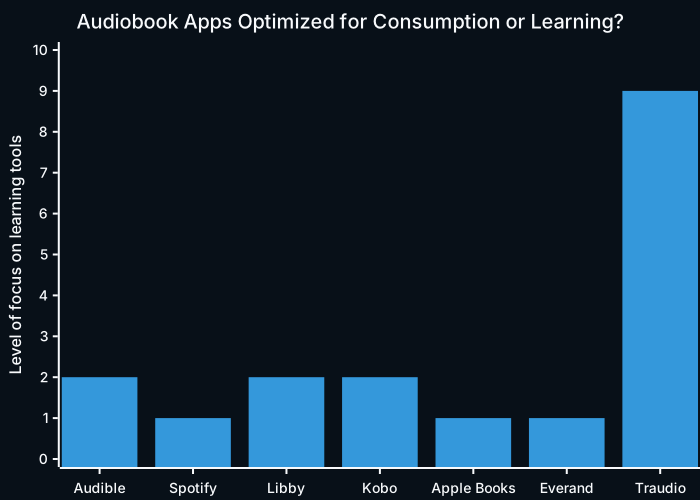
This doesn’t mean Traudio is a “better” audiobook app.
It means Traudio optimizes for a different job.
Full Audiobook or Summary-Based Learning?
This is an important trade-off.
A full-length audiobook retains:
- Story
- Writing style
- Arguments
- Examples
- Context
- Details
- Nuance
A summary-based experience prioritizes:
- Main ideas
- Frameworks
- Key takeaways
- Actionable concepts
- Speed
For example, if an audiobook is 10 hours long:
Full audiobook
████████████████████████████████████████
10 hours
A microlearning version might be:
Summary
████
~15 minutes
The two are not entirely interchangeable.
They serve two different questions:
Do I want to experience the book?
or:
Do I want to quickly learn the main ideas?
Chart 3: Time as Part of the Product
This is a hypothetical illustration for a non-fiction book with an audiobook of about 10 hours compared to a 15-minute microlearning session.
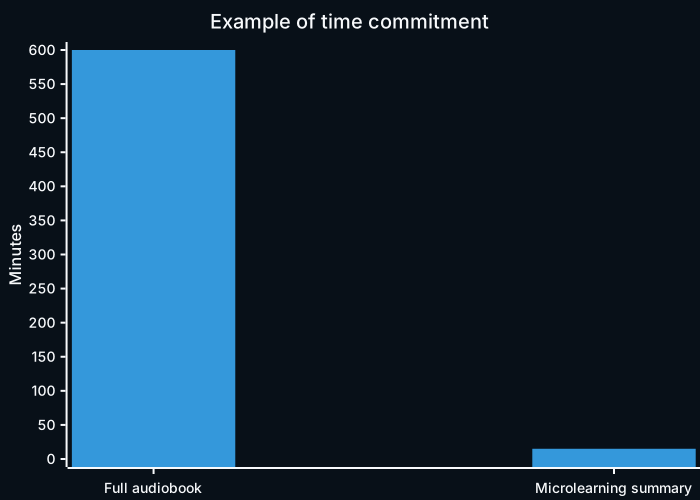
The chart doesn’t say 15 minutes is better than 600 minutes.
It simply shows the time cost is completely different.
If you want to read deeply, 600 minutes might be worthwhile.
If you’re exploring a new topic, 15 minutes might be more efficient.
Compare by How You Pay
This is often overlooked in comparisons of audiobook apps.
Apps don’t just have different prices.
They sell different things.
| App | What do you pay for? |
|---|---|
| Audible | Membership + credits + book ownership |
| Spotify | Premium + listening-hour allowance |
| Libby | Don’t pay Libby; use library card |
| Kobo | Subscription or individual book purchase |
| Apple Books | Purchase individual titles |
| Everand | Subscription access |
| Traudio | Learning subscription / premium learning features |
Does the Ownership Model Matter?
It matters greatly if you’re building a long-term library.
Suppose you spend money over 5 years.
There are two models:
Ownership
Pay
↓
Get audiobook
↓
Keep audiobook
Access
Pay subscription
↓
Get access
↓
Cancel subscription
↓
Lose access
Audible combines both.
Apple Books leans towards ownership.
Spotify and Everand lean towards access.
Libby is temporary borrowing.
Traudio leans towards access to a learning system.
This is why a monthly price isn’t enough to decide which app is cheaper in the long run.
Which App is Best if You Listen to Fiction?
Priorities:
- Audible
- Spotify
- Libby
- Kobo
- Apple Books
- Everand
Traudio is not a primary choice for fiction.
And that’s not an unusual drawback.
Fiction’s value lies in:
- Storytelling
- Character development
- Suspense
- Language
- Emotional journey
You don’t want to turn a 12-hour novel into a 15-minute summary if the goal is to enjoy the story.
Which App is Best if You Listen to Non-Fiction?
The answer depends on your goal.
Want to experience the entire book
Choose:
- Audible
- Spotify
- Libby
- Kobo
- Apple Books
- Everand
Want to gain knowledge quickly
Choose:
- Traudio
For example, a book about investing.
Full-length route
10-hour audiobook
↓
All examples
↓
All reasoning
↓
In-depth details
Learning-first route
15 minutes
↓
Core framework
↓
Quiz
↓
Flashcards
↓
AI follow-up
There is no single absolute “right” route.
There is only the route that fits your goal.
Which App is Best for Commuting?
Commuting is where audiobooks truly shine.
But there are many types of commutes.
20-minute commute
Traudio or Spotify might be suitable.
You can complete a learning session or a portion of an audiobook.
60-minute commute
Audible, Spotify, Libby, Kobo, or Everand start to have a clear advantage because you have enough time to delve deep into a full audiobook.
Driving
Prioritize apps with:
- CarPlay
- Android Auto
- Offline playback
- Simple controls
Libby supports CarPlay, Android Auto, Android Automotive, and Bluetooth.
Traudio also promotes Android Auto and offline listening as part of its learning-on-the-go experience.
Which App is Best if Your Budget is Zero?
Libby
If your local library supports OverDrive, this is a very hard option to beat.
You can borrow audiobooks for free with a library card.
Disadvantages:
- There can be waitlists
- Catalog depends on the library
- Loans have a time limit
Apple Books
Apple states it has thousands of free ebooks and audiobooks, though most bestsellers are still purchased individually.
Traudio
Suitable if the goal is book-based microlearning rather than full audiobooks; the platform currently offers some free content alongside its subscription.
Which App is Best if You Already Pay for Another Subscription?
This is where bundling becomes important.
If you already pay for Spotify Premium and only listen to one or two audiobooks per month, you might not need an additional dedicated audiobook subscription.
Spotify currently integrates listening hours into some eligible Premium plans in supported markets.
Conversely, if you listen to:
30 hours
40 hours
60 hours
per month
then hourly limits can become a source of friction.
Spotify had to introduce Audiobooks+ precisely because a group of heavy listeners frequently hit their monthly hour limits; Spotify states that over a million people have paid extra for Audiobooks+ in less than a year.
This is an important insight:
Bundling is great for casual listeners.
Dedicated audiobook apps are often better for heavy listeners.
Chart 4: Choosing an Audiobook App by Listening Frequency
This is a suggested framework, not an official limitation.

Discovery is Also Part of the Audiobook Experience
An audiobook app is not just a player.
A big problem is:
Which book should I listen to next?
Platforms address this in different ways.
Spotify
Benefits from its recommendation engine and behavioral data across music, podcasts, and books.
In 2026, Spotify continues to add audiobook charts and new discovery features.
Audible
Has a large amount of metadata, reviews, and purchase/listening history within the audiobook ecosystem.
Libby
Discovery is strongly influenced by curated library collections.
Kobo
Discovery is tied to its ebook ecosystem.
Traudio
Discovery can start from:
What do I want to improve?
instead of:
Which genre do I want to listen to?
This is the difference between:
Genre discovery
and:
Goal-based discovery
With a learning app, questions like:
- I want to understand investing
- I want to manage my money better
- I want to focus more
- I want to build habits
can be more useful than categories like “Business.”
The Future Audiobook App May Not Just Be a Player
Traditional audiobook apps primarily optimize:
Search
↓
Buy / Borrow
↓
Play
↓
Resume
But the market is expanding.
Spotify invests in discovery and a cross-media ecosystem.
Kobo combines ebooks and audiobooks.
Libby connects audiobooks with public library infrastructure.
Traudio experiments with the direction:
Listen
↓
Read
↓
Recall
↓
Ask AI
↓
Review
This could be a notable change, especially for non-fiction.
What Role Does AI Play in Audiobook Apps?
AI has not yet transformed audiobooks into an entirely new product category across all platforms.
But there are at least three clear directions.
1. AI for Discovery
Find the right content faster.
Spotify is expanding conversational audiobook discovery in 2026.
2. AI for Production
AI narration can reduce production costs for certain types of content.
3. AI for Comprehension
This is the learning-first approach.
After listening, users can ask:
What does this idea mean?
How does this framework apply?
Let me check what I remember.
Traudio places StickWise AI precisely in this part of the learning loop.
Comparison of Audiobook Apps by User Type
Fiction Lovers
Audible / Spotify / Libby
Prioritize full-length content and storytelling.
Listeners of New Bestsellers
Audible
Credits + ownership remain a strong proposition for new releases.
Those Who Want Free Content
Libby
If you have a suitable library card, you’d be hard-pressed to find better value.
Those Already Living in Spotify
Spotify
No need for an additional app and separate subscription if current listening hours are sufficient.
Those Who Enjoy Both Ebooks and Audiobooks
Kobo
Especially if you already use a Kobo eReader.
Those Who Dislike Monthly Subscriptions
Apple Books
Buy only the titles you want to listen to.
Continuous Book Consumers
Everand / Kobo Plus
Subscription models are suitable for exploratory consumption.
Busy People Who Want to Learn from Books
Traudio
Suitable for book-based microlearning, especially if you care more about knowledge retention than completion rate.
Which Audiobook App Offers the Best Value?
This cannot be answered by monthly price alone.
Actual value is closer to the formula:
Value
=
Books actually used
×
Usefulness
÷
Monthly cost
A 10-dollar subscription that you don’t open for three months is very expensive.
A 20-dollar audiobook you listen to five times can be very cheap.
A free library app where every book requires a six-week wait might not be suitable if you need books immediately.
A microlearning app with a smaller catalog that you actually use 15 minutes a day can create higher value than a giant catalog that is never explored.
Don’t Choose an Audiobook App Based on Catalog Size Alone
Catalog size is an easy metric to advertise.
But for users, it’s often overrated.
Suppose:
App A
1,000,000 books
You listen to: 8 books/year

App B
100,000 books
You listen to: 8 books/year
If all eight books you need are available on App B, a million titles don’t add direct value.
More important are:
- Does it have the exact books you need?
- Do new releases appear quickly?
- Is discovery good?
- Is the price suitable?
- Can you listen offline?
- Do you keep books after canceling?
- Does the app work well on your device?
And if the goal is learning:
- Are there quizzes?
- Are there notes?
- Are there flashcards?
- Is there AI follow-up?
- Is there a way to review?
An Audiobook App Can Be Good But Still Wrong for You
For example:
Audible
Very powerful.
But it might be wrong if you only listen to 30 minutes of audiobooks per month.
Spotify
Extremely convenient.
But it might be wrong if you frequently exceed your monthly hours.
Libby
Free.
But it might be wrong if you don’t accept waitlists.
Apple Books
No subscription.
But it might be wrong if you listen to dozens of books per year.
Everand
Subscription is very convenient.
But it might be wrong if you want to own your library long-term.
Traudio
Effective for microlearning.
But wrong if your goal is to listen to an entire 25-hour fantasy novel.
This is precisely why “best audiobook app” is a less useful question than:
best audiobook app for what?
Should You Use More Than One Audiobook App?
Absolutely.
In fact, a stack can be more effective than forcing every need into one platform.
Example 1: Frugal Reader
Libby
↓
Borrow books for free

+

Apple Books
↓
Buy books you don't want to wait for
Example 2: Heavy Listener
Audible
↓
New releases + ownership

+

Libby
↓
Free backlist
Example 3: Learning-Focused Listener
Traudio
↓
Explore frameworks in 15 minutes

↓

Which books are truly worth diving into?

↓

Audible / Libby / Kobo
↓
Listen to full audiobooks
This is a very logical workflow.
Traudio becomes the discovery + learning layer.
Full audiobook apps become the deep-dive layer.
A Better Audiobook Stack Model Than “Choose One App”
One can visualize:
graph TD
    A[DISCOVER] --> B(Spotify / Traudio)
    B --> C{DECIDE}
    C --> D(Is this book worth my time?)
    D --> E[LEARN FAST]
    E --> F(Traudio)
    F --> G[DEEP DIVE]
    G --> H(Audible / Libby / Kobo)
    H --> I[OWN]
    I --> J(Audible / Apple Books)
Not everyone needs the entire stack.
But this model better reflects how modern users actually consume books.
So, Which Audiobook App Is Best in 2026?
There is no single winner.
Choose Audible if:
You want full-length audiobooks, new releases, and the ability to own titles with credits.
Choose Spotify if:
You want music, podcasts, and audiobooks within the same ecosystem, and your listening allowance meets your needs.
Choose Libby if:
You have a library card and prioritize free value over immediate listening.
Choose Kobo if:
You want ebooks, audiobooks, and an eReader in one ecosystem.
Choose Apple Books if:
You don’t want an additional subscription and only want to buy the books you truly need.
Choose Everand if:
You prefer subscription access and continuously explore both ebooks and audiobooks.
Choose Traudio if:
You primarily use audio to learn from non-fiction, have limited time, and want to combine audio with text, quizzes, flashcards, and AI instead of just passive listening.
Conclusion
A useful comparison of audiobook apps in 2026 should not end with the statement:
Audible has more books, so Audible wins.
The market has become more complex than that.
Audible is a strong combination of catalog, subscription, and ownership.
Spotify turns audiobooks into part of a larger audio ecosystem.
Libby transforms public libraries into a free audiobook service.
Kobo connects ebooks, audiobooks, and eReaders.
Apple Books maintains a very simple per-book purchase model.
Everand suits those who want subscription access to both reading and listening.
And Traudio represents an emerging direction: audiobooks are not just a means of consuming books but can also become a learning system with microlearning, Active Recall, and AI.
The difference can be summarized as follows:
graph TD
    A[First-generation audiobook] --> B(Listen to books)
    C[Audiobook ecosystem] --> D(Discover + stream + own)
    E[Learning-first audio] --> F(Listen + understand + recall + apply)
Therefore, the best app is not the one with the largest catalog.
It’s the app that best fits why you press Play in the first place.
Related Articles
Master Your Financial Mindset Today
Download the Traudio app for iOS & Android to listen to synchronized audiobook summaries and chat with StickWise AI.
Download Traudio App Free