Deep Focus in a Distracted World Book: How to regain focus in an age of fragmented attention
Searching for the Deep Focus in a Distracted World book often stems from a very real problem:
You don’t lack things to do.
You lack enough quiet time to do truly important work.
The modern workday is fragmented by:
- Chat
- Meeting
- Notification
- App switching
- Social media
- Task switching
- Self-checking your phone
Microsoft reports that employees in Microsoft 365 data are interrupted on average every 2 minutes by meetings, emails, or pings; for high-notification users, this number is equivalent to about 275 interruptions per day.
In another study popularized by UC Irvine from Gloria Mark’s work, users only stay on one screen for an average of about 47 seconds before shifting their attention elsewhere. After an interruption, returning to the original project can take up to 25 minutes.
Therefore, deep focus today is no longer just a productivity trick.
It is becoming a competitive advantage.
What is Deep Focus in a Distracted World really about?
This phrase doesn’t necessarily refer to a single book.
It describes a broader topic:
How to create attention long enough to think, take notes, connect ideas, and produce meaningful output in an environment that constantly demands responses?
A good deep focus system typically has four layers:
ATTENTION
↓
CAPTURE
↓
THINKING
↓
OUTPUT
If attention is constantly fragmented, the three layers below it all weaken.
Chart: 47 seconds of focus and 25 minutes to return to task
These two numbers come from studies compiled by UC Irvine and clearly illustrate the asymmetry between interruption and recovery.
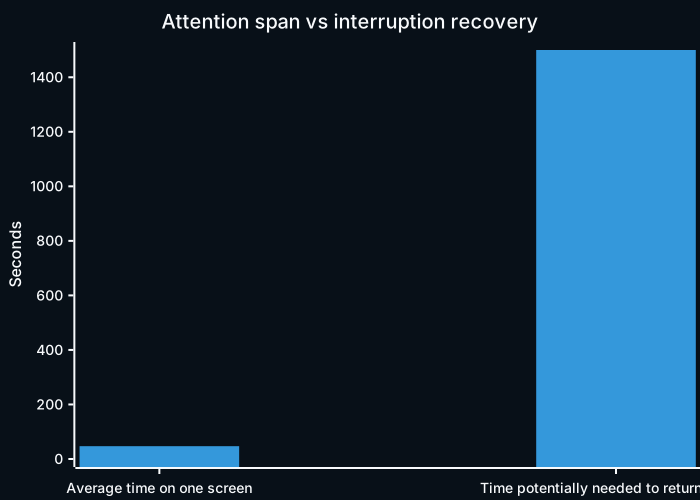
25 minutes is equivalent to about 1,500 seconds.
An interruption only takes a few seconds to occur.
But cognitive recovery can take much longer.
That’s why “I’ll just check messages for a bit” often isn’t really just a bit.
The problem isn’t just notifications
Interestingly, distraction isn’t solely imposed on us by technology.
Gloria Mark states that in her research data, about 49 percent of interruptions are self-interruptions.
This means nearly half of all focus loss can start with:
I open email myself
↓
I check my phone myself
↓
I switch tabs myself
↓
I switch tasks myself
That changes how we solve the problem.
It’s not enough to just:
turn off notifications.
You also have to change your habit loop.
Multitasking doesn’t help you do more
The American Psychological Association emphasizes that when people try to handle multiple complex tasks at once or switch constantly between tasks, performance decreases because each switch has a cognitive cost.
A fragmented workday might look like this:
Write report
↓
Slack
↓
Email
↓
Return to report
↓
Meeting
↓
Report
↓
Phone
↓
Email
↓
Report
You’re still “busy.”
But the actual time spent on sustained thinking is very small.
Chart: How an 8-hour day can be fragmented
Microsoft describes employees being interrupted on average every 2 minutes during core work hours.
If we take an 8-hour day:
8 hours
=
480 minutes
and one interruption every 2 minutes:
480 ÷ 2
=
240 opportunities for interruption
Microsoft’s official figure of 275/day is calculated over 24 hours for high-ping volume groups, but the 240 calculation here helps illustrate the degree of fragmentation in a core workday.
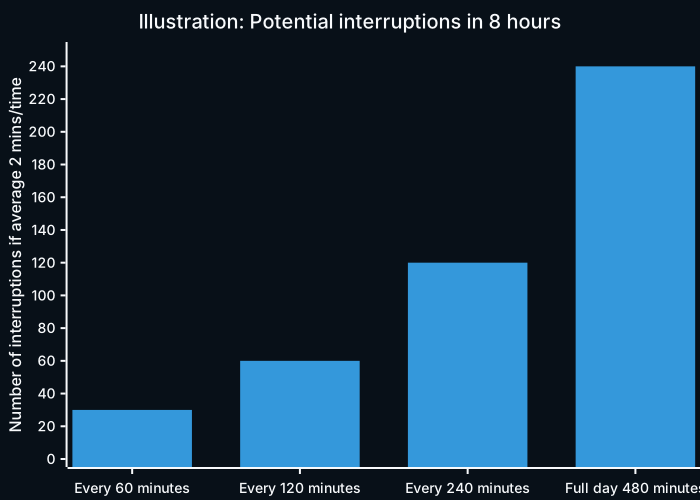
This is a mathematical illustration, not a separate statistic.
The main point is:
An 8-hour workday can still have very few uninterrupted blocks long enough for deep work.
How is deep focus different from “sitting and working for a long time”?
You can sit in front of a computer for 4 hours without 30 minutes of deep focus.
Deep focus requires:
- A clear goal
- A single task
- A protected time block
- Minimal switching
- A place to capture distractions
- A specific output
For example:
Shallow work
Open inbox
↓
Reply to 8 emails
↓
Check Slack
↓
Update spreadsheet
↓
Edit a few sentences
Deep work
One important question
↓
60 minutes no switching
↓
Research
↓
Thinking
↓
Draft
↓
Meaningful output
Both are necessary.
But they don’t create the same value.
Step 1: Protect attention before optimizing productivity
Many people start with:
- A new to-do app
- A Pomodoro timer
- An AI assistant
- A note-taking app
- A calendar template
But if attention remains fragmented, new tools only better organize a system that is losing focus.
A more logical order:
ATTENTION
↓
TIME BLOCK
↓
NOTES
↓
OUTPUT
↓
TOOLS
Tools should support the system.
They should not replace the system.
Step 2: Don’t start deep work with your inbox
If your workday begins like this:
Wake up
↓
Email
↓
Slack
↓
News
↓
Notifications
then others are deciding your attention priority before you do.
An alternative:
Open day
↓
Choose one important task
↓
Deep focus block
↓
Then inbox
Not everyone can apply this every day.
But even 30 to 60 minutes of protected focus before reactive work makes a big difference.
Step 3: Use a “distraction capture” instead of reacting immediately
During a deep focus block, a thought often appears:
I need to reply to that email.
Or:
I must remember to buy this.
Or:
Search for this for a bit.
If you handle it immediately:
Thought
↓
Switch
↓
New tab
↓
10 minutes disappear
Instead:
Thought
↓
Capture in note
↓
Continue task
↓
Process later
A simple distraction list can save an entire session.
Step 4: Better notes aren’t more notes
Traudio’s phrase Deep Focus in a Distracted World emphasizes three outputs:
Create more attention, better notes, and meaningful output.
The “better notes” part is especially important.
Many people take notes like this:
Highlight
Highlight
Highlight
Copy quote
Copy quote
Save
Result:
lots of data, little thinking.
Better notes should shift from:
What did others say?
to:
How do I understand this?
A good note might only need 3 parts
Idea
What is the main idea?
Connection
How does it relate to what I already know?
Application
Where will I use it?
Example:
IDEA
Task switching has a cognitive cost.

CONNECTION
I often switch between Slack and writing.

APPLICATION
Turn off Slack during writing block.
This is a note that creates behavior.
Not just archives.
Step 5: Define output before starting
A deep work session should not have the goal:
Work on the project.
Too broad.
Better goals:
Draft 500 words
or:
Finish architecture diagram
or:
Solve 3 unresolved questions
Specific output helps attention know where to go.
Chart: Longer focus blocks don’t always mean better
This is an illustrative model, not a scientific law.
Assume the quality of focus increases when the session is long enough to enter flow, but begins to decrease when fatigue appears.
| Focus block | Illustrative suitability level |
|---|---|
| 15 minutes | 4/10 |
| 30 minutes | 7/10 |
| 45 minutes | 9/10 |
| 60 minutes | 10/10 |
| 90 minutes | 9/10 |
| 120 minutes | 7/10 |
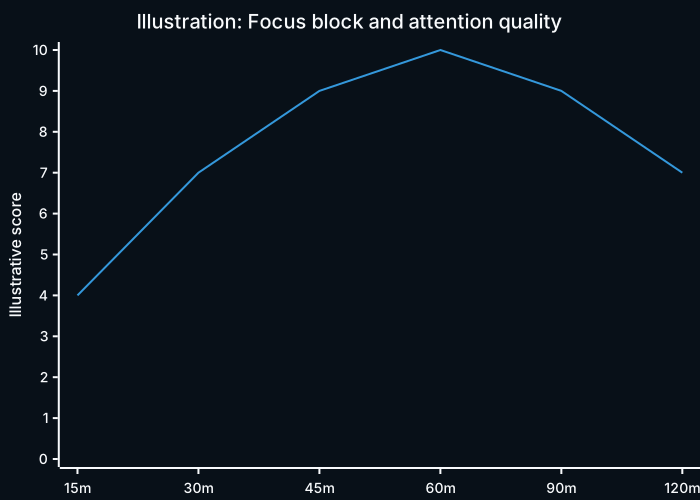
This is an illustrative framework, not research results.
The goal is to find a block long enough for deep thinking but not so long that you lose energy.
Step 6: Create a “focus environment”
Focus is often seen as a personal quality:
I lack discipline.
But environment is equally important.
An environment for deep focus can include:
- Phone out of reach
- Notifications off
- One main tab
- Full-screen writing
- Headphones if needed
- A drink ready
- Clear desk
- Distraction note
- Timer
Goal:
reduce the number of small decisions.
Step 7: Separate “communication time” from “creation time”
Microsoft reports that nearly half of employees surveyed feel their work is chaotic and fragmented; message activity also increases sharply mid-day.
If communication and creation are completely mixed:
Write
↓
Reply
↓
Write
↓
Meeting
↓
Reply
↓
Write
then deep work is very difficult to achieve.
An alternative:
08:30–10:00
Creation

10:00–10:30
Communication

10:30–12:00
Creation

Afternoon
Meetings / collaboration
This schedule isn’t suitable for all jobs.
The main point is to batch reactive work when possible.
From “Deep Focus in a Distracted World book” to a 7-day practice
Reading about focus is easy.
Practicing focus is harder.
You can read a book about:
- Deep work
- Attention
- Notes
- Productivity
- Digital minimalism
and still continue to:
Finish reading
↓
Open TikTok
↓
Check Slack
↓
Nothing changes
This is the gap between knowledge and practice.
Traudio currently offers a Guided Learning journey:
Deep Focus in a Distracted World — 7-day plan
Create more attention, better notes, and meaningful output.
The plan is part of Traudio’s Guided Learning system, where curated book summaries are organized around a specific goal instead of just letting users browse individual books.
Why is 7 days suitable for the topic of focus?
Focus doesn’t change just because you understand the concept.
It requires repetition.
A week is short enough to start but long enough to see patterns.
An illustrative framework could be:
Day 1
Audit distractions

Day 2
Build one focus block

Day 3
Reduce task switching

Day 4
Improve note-taking

Day 5
Turn notes into output

Day 6
Design your environment

Day 7
Build a repeatable focus system
This is a suggested framework for applying the plan, not Traudio’s official syllabus.
Chart: How does a 7-day focus sprint accumulate?
Assume you spend 15 minutes learning each day and add 30 minutes of focused practice.
Total:
15 minutes learning
+
30 minutes practice
=
45 minutes/day
After 7 days:
45 × 7
=
315 minutes
which is 5 hours 15 minutes.
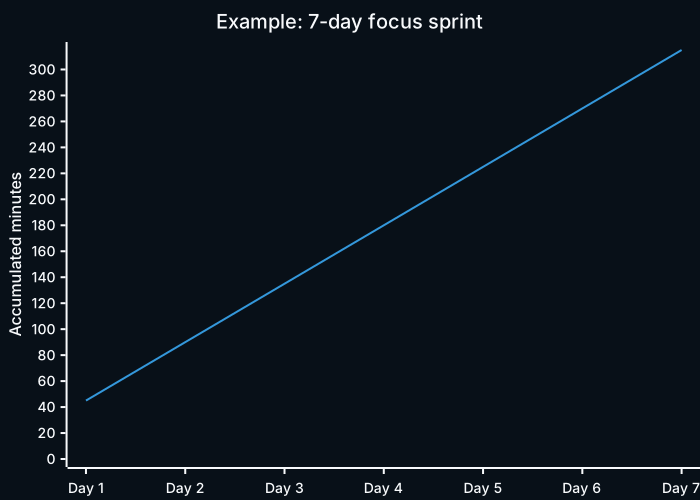
This is an illustration based on the assumption of 45 minutes per day, not an official requirement from Traudio.
5 hours and 15 minutes won’t change your life.
But it’s enough for you to try a system instead of just reading about it.
How to use Traudio’s plan to prevent it from becoming another source of distraction
This is a bit paradoxical.
An app designed to teach focus can also become an app you open and then get distracted by.
Therefore, when using Deep Focus in a Distracted World, set a rule:
Open Traudio
↓
One learning session
↓
One note
↓
One action
↓
Close app
Not:
Open app
↓
Browse
↓
Browse
↓
Browse
↓
Consume
The 1–1–1 Rule for Each Day
After each session:
1 insight
What is the most important thing I just learned?
1 note
Write it down in your own words.
1 output
Apply it immediately to your work.
Example:
Insight
Task switching fragments attention.
Note
I’m interrupting my writing with Slack.
Output
Tomorrow, block Slack for 45 minutes.
This is how to turn learning into behavior change.
Better notes must lead to meaningful output
Notes are not the end product.
They are an intermediate layer.
INPUT
↓
NOTES
↓
THINKING
↓
OUTPUT
If your workflow is:
INPUT
↓
NOTES
↓
MORE NOTES
↓
MORE NOTES
then you might be building a knowledge archive instead of creating work.
What is meaningful output?
It depends on the profession.
Developer
- Architecture decision
- Feature implementation
- Technical document
Writer
- Article
- Chapter
- Script
Designer
- Prototype
- Design system decision
Manager
- Strategy memo
- Decision
- Prioritized plan
Student
- Essay
- Solved problems
- Concept explanation
Focus is only meaningful when attention transforms into something valuable.
A simple focus scorecard
After each day, record four numbers:
| Metric | Example |
|---|---|
| Deep focus blocks | 2 |
| Total focused minutes | 90 |
| Major interruptions | 4 |
| Meaningful outputs | 1 |
You don’t need to measure:
- Every click
- Every minute
- Every notification
The goal is to see the trend.
Chart: Example of a week with reduced interruptions
This is illustrative data, not results from Traudio.
Assume the number of interruptions in focus blocks gradually decreases as the environment improves:
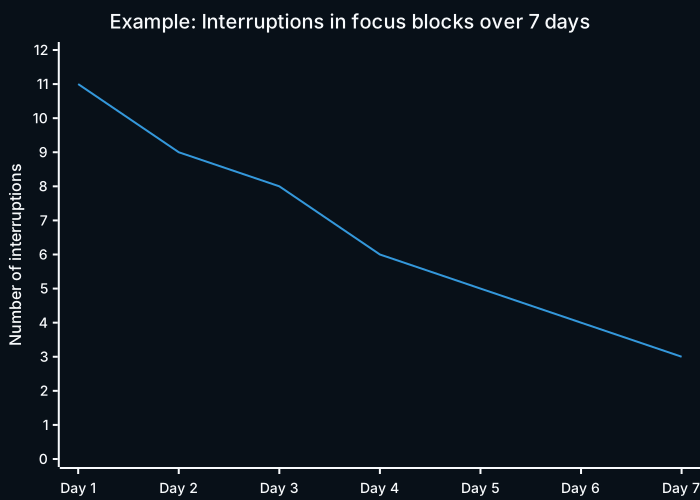
The goal is not to reach zero.
The goal is to reduce avoidable interruptions.
Deep Focus does not mean continuous work
A common mistake is to think deep work means:
8 hours without a break.
No.
High-quality attention requires recovery.
A reasonable rhythm might be:
Focus
↓
Break
↓
Focus
↓
Lunch
↓
Shallow work
↓
Recovery
Rest is not the opposite of productivity.
It is part of attention management.
Common mistakes when trying to focus
1. Using willpower to fight the entire environment
Phone right next to you.
Slack on.
Email pop-up.
10 tabs.
Then blame yourself:
I lack discipline.
Fix the environment first.
2. Deep work without output
Sitting for 90 minutes doesn’t mean being productive.
Define done.
3. Using Pomodoro as a rigid rule
25 minutes might be good for one person.
45 or 60 minutes might be better for another.
The tool must serve the work.
4. Taking too many notes
Capturing everything shifts attention from thinking to collecting.
5. Checking inbox during a break
If your break is:
Email
Slack
News
Social
your brain hasn’t truly disengaged.
Do you need Traudio to build deep focus?
No.
You can absolutely:
- Read books about attention
- Turn off notifications
- Use a notebook
- Time block
- Track interruptions
- Practice deep work
The strength of Deep Focus in a Distracted World — 7-day plan lies in its structure:
Goal
↓
Curated learning
↓
Daily progression
↓
Application
instead of:
YouTube video
↓
Blog
↓
Podcast
↓
Random productivity tip
Traudio describes Guided Learning as curated book summaries selected for the user’s next desired goal, with Deep Focus in a Distracted World being a seven-day journey.
Who is Deep Focus in a Distracted World suitable for?
The plan might be suitable if you:
- Do knowledge work
- Write a lot
- Code
- Study
- Are frequently interrupted by Slack/email
- Have many notes but little output
- Often multitask
- Find it hard to complete long-form work
- Feel busy but don’t know what you created by the end of the day
Especially if this sounds familiar:
I work all day but the most important task is still not done.
A checklist before starting a focus session
- I know the single task that needs to be done
- I know the output at the end of the session
- Phone is out of reach
- Notifications are off
- Inbox is not open
- There’s a place to capture distractions
- Only necessary documents are open
- There’s a defined end time for the session
- There’s a break after the session
If the first 5 boxes aren’t ticked, the problem might not be a lack of motivation.
It’s that the focus environment hasn’t been designed.
What a 7-day reset might look like?
Day 1 — Measure
Count interruptions.
Don’t fix anything.
Just observe.
Day 2 — Protect
Create a 30 to 45-minute focus block.
Day 3 — Remove
Turn off or batch notifications.
Day 4 — Capture
Use a distraction list.
Day 5 — Improve notes
Shift from copying to idea + connection + application.
Day 6 — Produce
Start the session with a clear output.
Day 7 — Systemize
Decide where the focus block will live in the coming week.
This is a suggested practical framework to supplement learning, not official content from Traudio’s plan.
What happens after 7 days?
Don’t try to live in a permanent productivity challenge.
The goal is to shift from:
7-day experiment
to:
repeatable weekly system
Example:
Monday–Friday
09:00–10:00
Deep Focus

10:00+
Communication
or:
Tuesday / Thursday
2 × 90-minute deep work blocks
A simple, repeatable system is better than a complex challenge that only lasts one week.
Conclusion: Deep focus is not about concentrating more, but about protecting attention better
If you’re looking for the Deep Focus in a Distracted World book, perhaps what you truly need isn’t another productivity book.
You might need a different perspective on attention.
Microsoft shows that the modern work environment can create an average interruption every two minutes, and nearly half of workers describe their work as chaotic or fragmented.
Research by Gloria Mark shows that average screen attention is only about 47 seconds, and nearly half of interruptions can be self-interruptions.
Therefore, deep focus is not just about:
trying to concentrate harder.
It is:
Reduce interruptions
↓
Protect attention
↓
Take better notes
↓
Think longer
↓
Create meaningful output
A book can help you understand the principles.
A calendar block can create space.
A distraction list can keep you from switching.
And if you want to turn this topic into a structured learning sprint, Traudio’s Deep Focus in a Distracted World — 7-day plan is built around the exact goal:
Create more attention, better notes, and meaningful output.
Seven days cannot eliminate distractions from life.
But they can be enough for you to discover:
- What is breaking your attention
- When you focus best
- Which notes are truly useful
- And what kind of work deserves your best focused hours
That’s a much better starting point than just trying to do more.
Related Articles
Master Your Financial Mindset Today
Download the Traudio app for iOS & Android to listen to synchronized audiobook summaries and chat with StickWise AI.
Download Traudio App Free