Habits That Stick Book: How to Turn Small Changes into Truly Sustainable Habits

Searching for the Habits That Stick book often begins with a very familiar question:
Why can I start a new habit with great enthusiasm, only to abandon it a few weeks later?
You buy a book.
Download a habit tracker.
Set a goal.
The first day is great.
The second day is still good.
Then a busy day comes along.
You skip one session.
Then another.
And finally:
Motivation
↓
Action
↓
Miss
↓
Guilt
↓
Give up
The problem might not be a lack of willpower.
It lies in how behavior is designed.
Research on habit formation shows that habits develop through repeating a behavior in a stable context, making the behavior gradually more automatic. This process often takes much longer than advice like “21 days to form a habit.”
Therefore, a more realistic goal isn’t:
How do I force myself to keep going?
But rather:
How do I turn a small enough behavior into a system that can continue even when motivation wanes?
What Does “Habits That Stick” Really Mean?
A habit “sticks” when its execution becomes less and less dependent on a conscious decision.
Initially:
Cue
↓
I remember my goal
↓
I convince myself
↓
Behavior
After many repetitions in a stable context:
Cue
↓
Behavior
The gap in between gradually shrinks.
That is automaticity.
A classic study by Phillippa Lally and colleagues tracked 96 people for 12 weeks. Participants chose an eating, drinking, or exercise behavior and performed it daily in the same context, such as “after breakfast.” Automaticity increased along a curve: faster at first, then gradually reaching a plateau.
Habit formation is therefore not like:
Day 1  ▂
Day 2  ▃
Day 3  ▄
Day 4  ▅
Day 5  ▆
Day 6  ▇
Day 7  █

DONE
It’s more like:
Repetition
↓
Automaticity increases
↓
Increase slows down
↓
Behavior becomes more natural
The 21-Day Habit Myth
One of the most common numbers on the internet is:
It takes 21 days to form a habit.
Current research does not support such a fixed rule.
A 2024 systematic review and meta-analysis synthesized 20 studies with 2,601 participants. In studies directly reporting habit formation time, the median was around 59 to 66 days, while the mean for some behaviors was around 106 to 154 days.
More notably, individual variation was very large:
4 to 335 days.
Chart: Habit formation has no fixed deadline
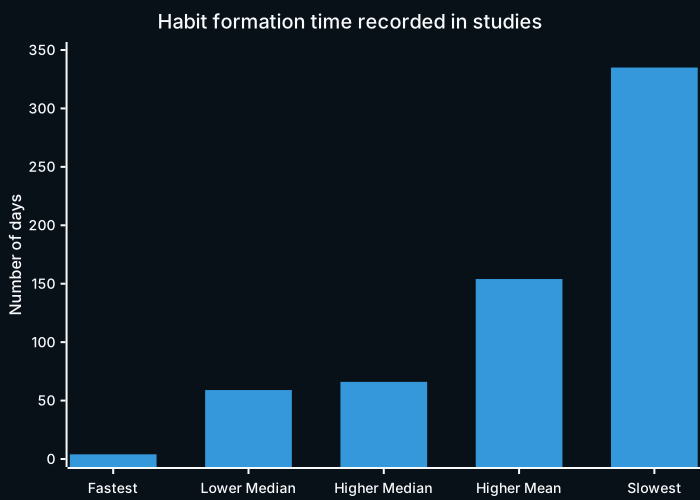
Source: 2024 systematic review on health-related habit formation. Numbers come from various studies and behaviors, not a progression everyone will experience.
This is an important distinction.
7 days can start a system.
But 7 days is not a promise that the behavior has become an automatic habit.
So, Is the “66 Days” Number Correct?
We also shouldn’t turn 66 into a new version of “21 days.”
Lally’s study showed a median of about 66 days to reach 95 percent of the final automaticity level in the analyzed sample, but the individual range was 18 to 254 days.
A newer systematic review found an even wider range, from 4 to 335 days across different studies.
Therefore:
21 days
≠ universal rule

66 days
≠ universal rule

7 days
≠ universal rule
The more scientific answer is:
It depends.
It depends on the behavior, context, frequency, timing, and the individual.
Chart: How Large Is Individual Variation?
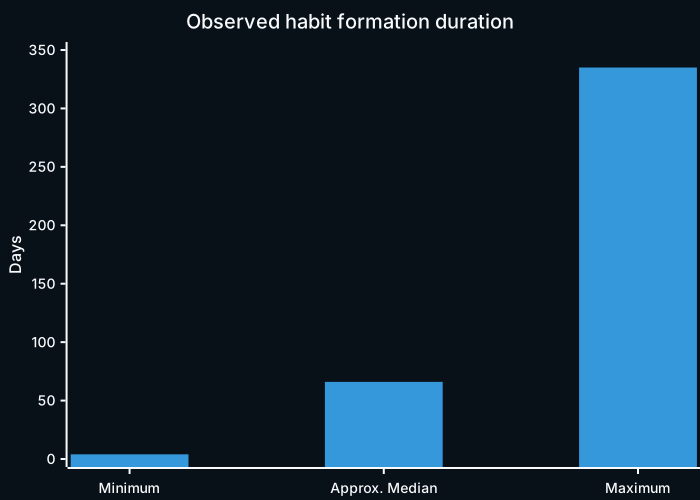
The notable point isn’t 66.
It’s the range from 4 to 335.
This suggests that asking:
How many days does this habit take?
might be less useful than:
What environment can I design so that the behavior continues to be repeated long enough?
Step 1: Start Smaller Than You Think Is Necessary
Suppose the goal is:
I want to read every day.
You might set the behavior:
Read 30 pages/day
Sounds great on a high-motivation day.
But on a bad day:
Busy
+
Tired
+
30 pages
=
Skip
Another version:
After morning coffee
↓
Read at least 2 pages
Good day?
You might read 20 pages.
Bad day?
Two pages are still doable.
The important point is to keep the behavior alive.
A Habit Should Have a “Minimum Viable Version”
Let’s take some common goals:
| Goal | Hard Version | Minimum Version |
|---|---|---|
| Exercise | Gym 60 minutes | 5 minutes movement |
| Reading | 30 pages | 2 pages |
| Writing | 1,000 words | 100 words |
| Meditation | 30 minutes | 2 minutes |
| Learning | 1 hour | 10 minutes |
| Saving | A large amount at month-end | Small automatic transfer |
| Walking | 10,000 steps | 10 minutes after a meal |
The minimum isn’t the final target.
It’s the:
behavioral floor.
On a good day, you do more.
On a bad day, the system still exists.
Step 2: Don’t Just Set a Goal — Define the Cue
“I will exercise more” is an intention.
But it lacks:
- When
- Where
- Trigger
A more specific habit:
After closing my laptop at 5:30 PM
↓
I change clothes
↓
Go for a 15-minute walk
A cue doesn’t necessarily have to be clock time.
It can be an existing behavior:
After brushing teeth
→ floss

After making coffee
→ read for 5 minutes

After lunch
→ go for a walk

After opening laptop
→ write the most important task
The more stable the context, the greater the chance the behavior will form an association with the cue.
The 2024 systematic review also identified frequency, timing, behavioral regulation, preparatory habits, and context as factors related to habit strength.
Step 3: Use “If–Then” Instead of Vague Promises
Behavioral science has a very useful concept:
implementation intention.
Instead of:
I will exercise more.
write:
IF
I finish dinner

THEN
I will walk for 15 minutes
A classic meta-analysis synthesizing 94 independent tests showed that implementation intentions had a medium to large positive impact on goal attainment, with an effect size of approximately d = 0.65.
A larger meta-analysis published in 2024 examining 642 independent tests also showed that implementation intentions were effective on cognitive, affective, and behavioral outcomes, with effect sizes ranging from 0.27 to 0.66. Contingent “if–then” plans tended to be stronger.
Chart: Scale of Evidence for Implementation Intentions
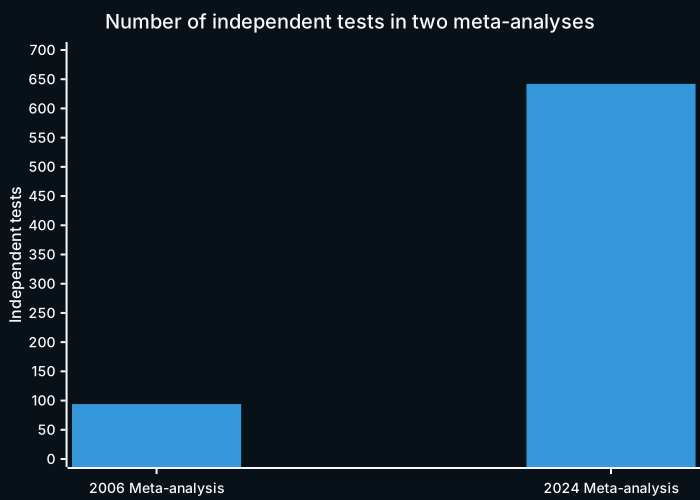
This is not an effect size chart.
It illustrates the scale of evidence synthesized in the two reviews.
A Simple Formula for a Habit
You can write:
When [CUE]
I will [BEHAVIOR]
at/in [PLACE].
For example:
When I finish breakfast
I will read 5 pages
on the chair by the window.
Or:
When I get paid
I will transfer 10% to my savings account
before discretionary spending.
Or:
When I open my laptop at the start of the workday
I will write 100 words
before opening my inbox.
The goal becomes a specific instruction.
Step 4: Environment Is Often Stronger Than Motivation
If you want to eat healthy but your kitchen always has:
Cookies
Chips
Candy
right in front of you, you have to constantly use self-control.
If you want to read but your:
Phone
is on top of the book, you’ve created competition for attention.
Change the environment:
Book
→ on the pillow

Phone
→ in another room
And the desired behavior becomes easier.
A useful principle:
GOOD HABIT
Reduce friction

BAD HABIT
Increase friction
Friction Can Be Very Small
Want to run in the morning?
High friction
Wake up
↓
Find clothes
↓
Find socks
↓
Find shoes
↓
Find headphones
↓
Maybe tomorrow
Lower friction
Night before
↓
Clothes ready
Shoes ready
Headphones charged
↓
Morning
↓
Go
You haven’t increased motivation.
You’ve reduced the number of steps between intention and action.
Step 5: Repetition Is More Important Than Perfection
This is one of the most useful findings from Lally’s research.
Missing an opportunity to perform a behavior did not significantly affect the habit formation process in the study.
This directly counters the mindset:
Miss one day
↓
Streak broken
↓
Everything ruined
↓
Quit
A better perspective:
Miss
↓
Resume
↓
Continue repetition
One day is not the system.
Habit Trackers Can Help, But Streaks Can Also Harm
Trackers are useful because they create visibility.
Mon ✓
Tue ✓
Wed ✓
Thu ✓
Fri ✓
But if the psychology becomes:
97-day streak
↓
Miss Day 98
↓
"I failed"
the tracker is serving the streak instead of the behavior.
A better metric might be:
How many times did I perform the behavior in 30 days?
For example:
26 / 30
=
86.7%
That’s still very high consistency.
Perfection is not needed.
Step 6: Don’t Build Five Habits at Once
A January reset often looks like:
Gym
+
Read
+
Meditate
+
Wake at 5
+
Journal
+
No sugar
+
Learn language
The first day is very exciting.
But each new habit adds another decision.
An alternative:
Habit A
↓
Stabilize
↓
Add Habit B
↓
Stabilize
↓
Add Habit C
You are building system capacity, not just a collection of goals.
Step 7: Create Identity Through Evidence, Not Affirmation
Instead of just saying:
I am someone who exercises regularly.
create evidence:
Monday
5 minutes

Wednesday
15 minutes

Friday
10 minutes
Each repetition is a data point.
Identity begins to be supported by behavior:
ACTION
↓
EVIDENCE
↓
IDENTITY
↓
NEXT ACTION
You don’t need to wait to “feel disciplined” before acting.
Behavior can precede that feeling.
Non-linear Habit Formation
Another misconception:
Day 1  10%
Day 2  20%
Day 3  30%
...
Day 10 100%
Lally’s research shows that automaticity aligns better with an asymptotic curve: initial repetitions create relatively large changes, after which the rate of increase gradually slows as the habit approaches a plateau.
A simple illustration:
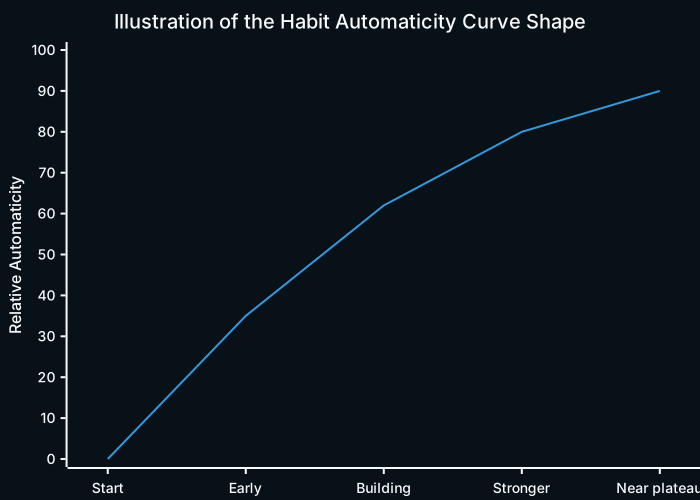
This is a conceptual chart illustrating the curve shape, not direct data from a participant.
This explains why the initial phase is crucial.
You are building associations.
Subsequently, each repetition continues to strengthen the system, but the perceived change may be smaller.
So what’s the point of a 7-day habit plan if habits take about two months or longer?
This is an important question.
If research shows that many health-related habits require a median of about 59 to 66 days, why create a 7-day plan?
Because the goal of the first week should not be:
Habit formed.
The goal should be:
System designed and started.
One week can be enough to:
Choose behavior
↓
Shrink behavior
↓
Choose cue
↓
Design environment
↓
Repeat
↓
Observe friction
↓
Adjust system
Then comes the harder part:
continuing.
From the “Habits That Stick book” to a 7-day system
Reading books about habits presents a paradox.
You can read about:
- Habit formation
- Motivation
- Willpower
- Behavior design
- Productivity
and still not change any behavior.
The workflow becomes:
Read
↓
Feel motivated
↓
Highlight
↓
Close book
↓
Old behavior
Another approach is to start with a behavior change goal.
Traudio currently offers a Guided Learning journey:
Habits That Stick — 7-day plan
Turn small behavior changes into a system that lasts.
This plan is part of Traudio’s Guided Learning, where book summaries are curated around specific learner goals. Traudio currently features Habits That Stick alongside other seven-day journeys such as Master Your Money, Invest with Confidence, and Deep Focus in a Distracted World.
Explore Habits That Stick on Traudio
What Traudio should help you do in 7 days is not to “finish forming a habit”
A more appropriate positioning is:
7 DAYS
=
DESIGN PHASE

60+ DAYS
=
REPETITION PHASE
The 60+ figure here is merely a simplification from research; it’s not a personal deadline.
One person might be faster.
Another behavior might require many months.
That’s why Traudio’s description is quite fitting:
Turn small behavior changes into a system that lasts.
The focus is on the system, not a seven-day miracle.
What might a 7-day habit reset look like?
You can combine Guided Learning with a simple experiment.
Day 1 — Pick One
Choose one behavior.
Don’t choose five.
Example:
Read daily
Day 2 — Make It Smaller
Change:
Read 30 pages
to:
Read at least 2 pages
Day 3 — Attach a Cue
After morning coffee
↓
Read 2 pages
Day 4 — Design Environment
Place the book right where you drink coffee.
Phone in another location.
Day 5 — Create an If–Then Plan
IF
I'm too busy to read normally

THEN
I still read a minimum of 2 pages
Day 6 — Observe Friction
What makes the behavior difficult?
Time?
Place?
Energy?
Cue?
Is the behavior too big?
Day 7 — Build the Next 30 Days
Don’t celebrate by adding five new habits.
Maintain a system:
Cue
+
Small behavior
+
Stable context
+
Repetition
This is a suggested practical framework, not Traudio’s official syllabus.
Chart: 7 Days Are Just the Beginning of the Habit Journey
If we take the median of 66 days from Lally’s research as an illustrative benchmark, the first seven days only account for approximately:
7 ÷ 66 × 100
≈ 10,6%
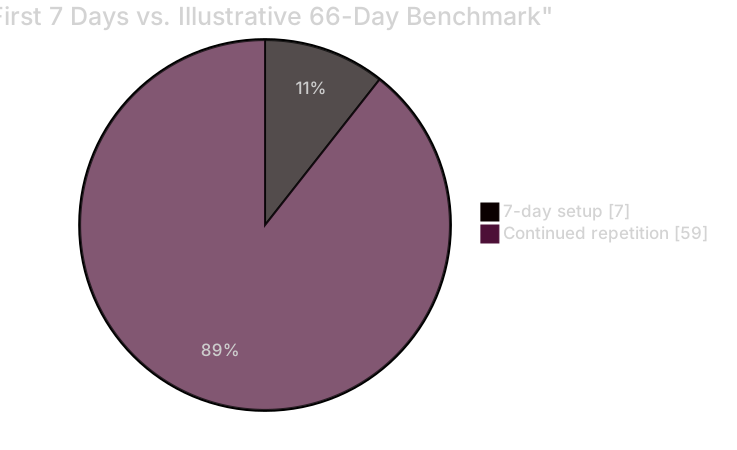
This actually makes the 7-day plan more logical, not less.
Traudio can help you kickstart the right system.
But the repetition after the plan is what makes the behavior increasingly automatic.
How to Use Traudio’s Habits That Stick More Effectively
Don’t just listen.
After each learning session, create a behavioral output.
| Learning focus | Action |
|---|---|
| Small changes | Shrink habit |
| Cues | Choose trigger |
| Environment | Reduce friction |
| Consistency | Choose minimum version |
| Planning | Write if–then rule |
| Recovery | Write rule after missing |
| Systems | Plan to continue |
This is not Traudio’s official curriculum.
This is how to use learning content to transition from:
KNOW
to:
DO
A Practical Habit Experiment
Suppose you want to build a daily learning habit.
Goal
Learn more
Too vague.
Behavior
Learn at least 10 minutes/day
Better.
Cue
After lunch
Even better.
Environment
Headphones ready
Traudio ready
Phone notifications off
Implementation intention
IF
I finish lunch

THEN
I listen to a learning session before returning to social media.
Minimum version
Too busy day
→ 5 minutes still counts.
Now you don’t just have a goal.
You have a system.
Chart: How Does 10 Minutes Per Day Really Accumulate?
A small behavior is often underestimated because the daily result is almost negligible.
Assume:
10 minutes/day
After one week:
70 minutes
After 30 days:
300 minutes
=
5 hours
After 365 days:
3,650 minutes
≈
60.8 hours
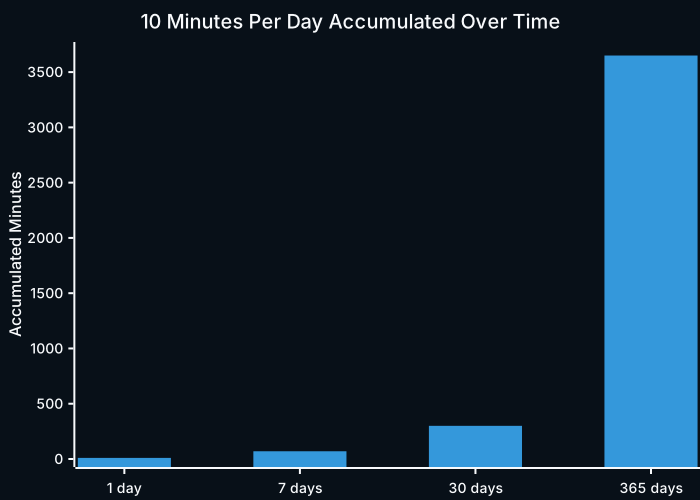
This is just an illustrative calculation.
But it demonstrates the important logic of habits:
small × repeated ≠ small.
Don’t Confuse Intensity with Consistency
Two people want to exercise.
Person A
Day 1
120 minutes

Day 2
0

Day 3
0

Day 4
0

Day 5
0
Person B
Day 1
20 minutes

Day 2
20 minutes

Day 3
20 minutes

Day 4
20 minutes

Day 5
20 minutes
After five days:
A = 120 minutes
B = 100 minutes
A still has more.
But B is creating more repetitions in context.
Habit formation is concerned not only with volume.
It also cares about repetition and context stability.
Is “Never miss twice” a scientific law?
It should not be considered a scientific law.
But it is a quite useful heuristic:
Miss once
=
Life

Miss repeatedly
=
Pattern forming
Lally’s research is particularly useful here because missing one opportunity does not significantly impact the habit formation process.
Therefore, after missing:
Don’t compensate.
Don’t punish.
Don’t restart the challenge.
Just:
resume at the next reasonable cue.
A Good System Must Survive Bad Days
Test your habit with the question:
What version of this behavior can I do when I’m tired, busy, or have low motivation?
If the answer is:
I can’t.
the habit might be too big.
Examples:
GOOD DAY
Run 5 km

BAD DAY
Walk 10 minutes
or:
GOOD DAY
Read 30 pages

BAD DAY
Read 2 pages
or:
GOOD DAY
Study 45 minutes

BAD DAY
Review 5 flashcards
A durable system is not one that only works under perfect conditions.
Common Mistakes That Prevent Habits from Sticking
1. Starting too big
Initial motivation makes the behavior seem easier than it actually is.
2. No cue
“Later” is not a trigger.
3. Environment works against the behavior
You are using willpower to compensate for bad design.
4. Tracking streaks instead of repetitions
One miss becomes a failure.
5. Changing too many things at once
You don’t know which part is truly effective.
6. No minimum version
Busy days mean zero.
7. Expecting automaticity too soon
Still finding the behavior difficult on day 14?
That doesn’t mean the habit has failed.
Research shows that many behaviors require months, not just weeks.
Simple Habit Scorecard
Instead of just ✓ or ✗, you can track:
| Metric | This Week |
|---|---|
| Opportunities | 7 |
| Completed | 6 |
| Completion rate | 86% |
| Minimum versions | 2 |
| Missed | 1 |
| Consecutive misses | 0 |
The last metric is very useful.
One miss is not scary.
Drift is what’s noteworthy.
Who is Habits That Stick suitable for?
Traudio’s plan might be suitable if you:
- Often start habits but quickly give up
- Rely heavily on motivation
- Set goals that are too big
- Want to build a morning or evening routine
- Want to read or learn more consistently
- Want to exercise regularly
- Often abandon the entire plan after one missed day
- Have read many productivity books but applied little
Traudio describes Guided Learning as curated book summaries for the goals users want to achieve next, and Habits That Stick is built as a 7-day plan.
Do you need Traudio to build habits?
No.
You can absolutely do it yourself:
Choose behavior
↓
Make it small
↓
Choose cue
↓
Reduce friction
↓
Repeat
↓
Measure
↓
Adjust
The benefit of Guided Learning is that it reduces another type of friction:
learning friction.
Instead of:
Search Google
↓
Watch video
↓
Buy book
↓
Read article
↓
Save another article
↓
Never build habit
Traudio organizes learning around an outcome:
Turn small behavior changes into a system that lasts.
That’s the difference between a content library and a goal-oriented learning path.
What to do after 7 days?
This is the part that determines whether the habit sticks or not.
Don’t add new habits immediately.
Continue with the current behavior.
A more realistic progression:
DAY 1–7
Design

↓

WEEK 2–4
Repeat

↓

MONTH 2+
Strengthen

↓

LONG TERM
Automaticity + maintenance
There’s no guarantee that Month 2 is when the habit is “complete”.
Research shows that individual variation is too great to set such a deadline.
One Final Framework: CUE
You can remember the habit system with three letters:
C — Cue
What triggers the behavior?
U — Ultra-small
What’s the smallest version you can still perform?
E — Environment
Does the environment make the behavior easier or harder?
Then add the most important thing:
CUE
+
SMALL BEHAVIOR
+
ENVIRONMENT
+
REPETITION
No need for a motivational speech every morning.
Conclusion: Habits That Stick is Not a Streak Competition
If you’re looking for Habits That Stick book, the most valuable lesson might not be a new “secret.”
It’s about letting go of a few false expectations.
Habits don’t necessarily form in 21 days.
66 days isn’t a magic number either.
A 2024 systematic review of 20 studies and 2,601 participants showed that the median in studies directly measuring habit formation time ranged from 59 to 66 days, but individual variation stretched from 4 to 335 days.
Lally’s research also showed that missing an opportunity doesn’t necessarily derail the process.
Therefore, a more useful way to think is:
SMALL
↓
SPECIFIC
↓
REPEATABLE
↓
RECOVERABLE
↓
AUTOMATIC
A book can help you understand behavior science.
A habit tracker can help you see consistency.
An if–then plan can bridge the gap between intention and action; meta-analysis on hundreds of tests shows that this type of planning has a significant effect on goal pursuit.
And if you want to start with a structured learning sprint, Habits That Stick — Traudio’s 7-day plan is built around the right goal:
Turn small behavior changes into a system that lasts.
Discover Guided Learning on Traudio
Don’t use seven days to prove you have enough discipline.
Instead, use seven days to design a behavior small enough to continue on day eight, day thirty, and beyond.
That’s when a small change begins to have the chance to become a habit that sticks.
Related Articles
Master Your Financial Mindset Today
Download the Traudio app for iOS & Android to listen to synchronized audiobook summaries and chat with StickWise AI.
Download Traudio App Free