Speak with Confidence Book: How to Communicate More Clearly at Work and in Important Conversations
Searching for Speak with Confidence book is often not just about finding a book on public speaking.
Behind that keyword are often more practical questions:
- How to articulate ideas clearly in meetings?
- How to present without getting nervous?
- How to talk to your boss about a difficult issue?
- How to disagree without turning the conversation into a conflict?
- How to speak concisely yet still have impact?
- How to communicate better with loved ones?
Confidence in communication doesn’t just appear on stage.
It appears when you say:
I disagree, and here's why.
When you present an idea in 3 minutes.
When you ask a difficult question.
When you give feedback.
When you ask for a raise.
Or when you have to say something important to someone you care about.
That’s why “speak with confidence” should be understood more broadly than public speaking.
It’s the ability to turn thoughts into words that are clear, appropriate, and intentional.
What Skills Does Speak with Confidence Really Involve?
A confident communicator doesn’t necessarily talk a lot.
They usually do four things well:
THINK CLEARLY
↓
STRUCTURE THE MESSAGE
↓
DELIVER CALMLY
↓
LISTEN AND ADAPT
Skip one step, and the conversation can weaken.
If thoughts aren’t clear, speech will be rambling.
If the structure is poor, listeners won’t know the main point.
If delivery is too fast or too tense, the message loses impact.
If there’s no listening, communication turns into a monologue.
Communication Remains One of the Most Valued Skills by Employers
Data from the National Association of Colleges and Employers’ Job Outlook 2025 shows that 69.3 percent of surveyed employers look for verbal communication skills on candidates’ resumes. Written communication even reached 77.1 percent.
In the same survey, when competencies were rated on a 5-point scale, Communication scored 4.57/5, higher than Critical Thinking, Teamwork, and Professionalism.
Chart: Communication Skills Employers Seek
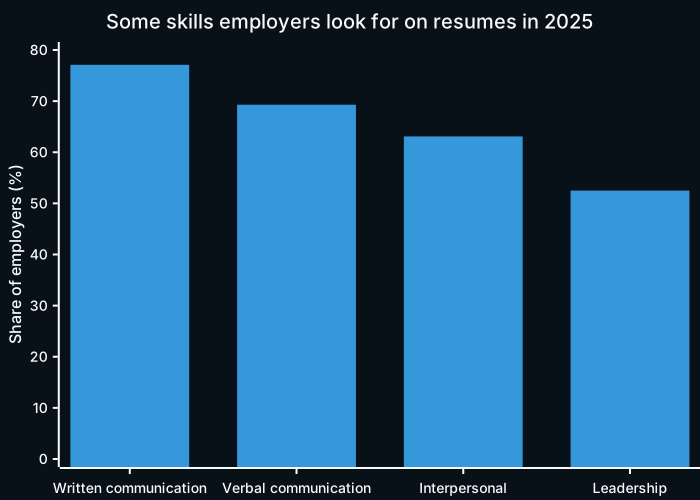
Source: NACE Job Outlook 2025.
This is highly noteworthy.
In the age of AI, technical ability increases in value.
But the ability to explain ideas to others still doesn’t disappear.
Job Market Data Also Shows Communication Appears Very Frequently
A 2025 analysis by Jobscan of approximately 4.6 million job listings showed communication to be the most common skill in the group they analyzed, present in nearly 55 percent of job postings. Management followed with 52 percent.
Chart: Common Skills in 4.6 Million Job Listings
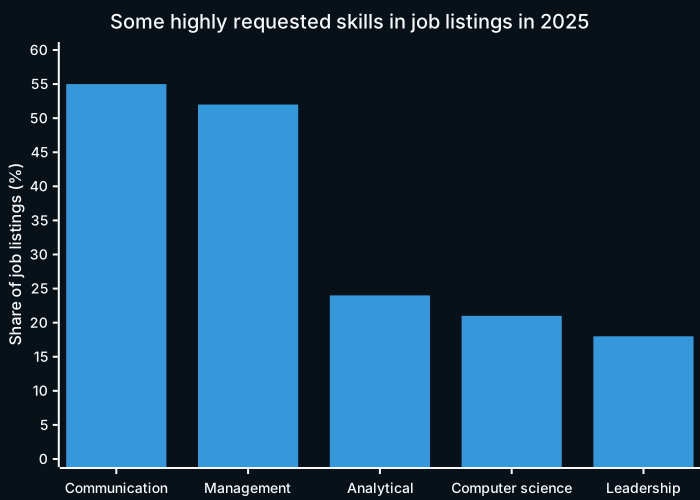
Source: Jobscan, State of the Job Search 2025.
That explains why communication isn’t a “secondary soft skill.”
For many roles, it’s the delivery system for hard skills.
You might have a good idea.
But if you can’t:
- present it,
- defend it,
- explain it,
- adapt it for the audience,
then the value of that idea is easily diminished.
Confidence Doesn’t Mean No More Anxiety
A common mistake is to think:
Confident speakers don’t feel nervous.
Not true.
A study published in 2026 on 1,049 working adults examined public speaking anxiety and individual characteristics. Results showed anxiety was related to many factors, including self-esteem and courage. The study’s model explained approximately 15 percent of the variance in public speaking anxiety.
The important point is:
anxiety is a real phenomenon, not proof that you “lack communication aptitude.”
Confidence is better understood as:
Anxiety still exists
+
I know what to say
+
I have a structure
+
I have practiced
=
I can still communicate effectively
Step 1: Articulate a Point Before Trying to Speak Well
Many communication problems start before you open your mouth.
You haven’t determined:
What do I really want this person to understand?
Result:
Context
↓
Background
↓
Another detail
↓
Side story
↓
Caveat
↓
Main point at minute 4
A better structure:
POINT
↓
WHY
↓
EVIDENCE
↓
NEXT STEP
Example in a meeting:
Point
We should delay the launch by one week.
Why
The bug rate is currently above the threshold.
Evidence
Three critical issues are still unresolved.
Next step
Fix by Thursday and re-run regression tests.
Much clearer.
The PREP Formula for Short Answers
An easy-to-remember framework:
P — Point
State the main idea.
R — Reason
Explain the reason.
E — Example / Evidence
Provide an example or evidence.
P — Point
Conclude with the main message.
Example:
I think we should keep onboarding shorter. Users currently have to make too many decisions before seeing the product’s value. For instance, the current flow has many preference screens before the first content. I propose reducing the number of steps before first value.
No complex vocabulary needed.
Structure builds confidence.
Step 2: Don’t Equate Confidence with Speed
When nervous, many people:
Speak fast
↓
No pause
↓
Lack of breath
↓
Speak even faster
↓
Feeling of losing control
Pausing is not a mistake.
Pausing can:
- give you time to think,
- help the listener process information,
- create emphasis,
- make delivery calmer.
A sentence with a pause:
The most important thing here...

is that we are solving the wrong problem.
often carries more weight than:
Themostimportantthinghereisthatwearesolvingthewrongproblem...
Step 3: Reduce Filler by Fixing Thinking, Not Just Fixing “Um”
Filler words like:
- um
- uh
- like
- you know
- basically
aren’t always bad.
The problem occurs when they obscure the message.
If you just force yourself:
Don’t say “um.”
the brain still needs time to formulate a sentence.
The result can be more stress.
A better solution:
Thought complete?
↓
No
↓
Pause
↓
Form next phrase
↓
Speak
A silent pause is often better than a vocal filler.
Step 4: An Important Conversation Needs a Clear Outcome
Before a difficult conversation, write one sentence:
After this conversation, what do I want to be clearer?
Examples:
- Role ownership
- Deadline
- Boundary
- Expectation
- Feedback
- Decision
Without an outcome, a conversation can easily turn into:
Emotion
↓
Old examples
↓
Defensiveness
↓
More examples
↓
No resolution
Framework for Difficult Conversations
A simple structure:
Observation
What actually happened?
Impact
How did it affect things?
Need
What do you need to change?
Request
What is the specific action?
Example:
The last two deadlines were both changed on the delivery day. That forced the team to rework plans and increased overtime. I need scope changes to be communicated earlier. Starting next sprint, can we freeze the scope two days before the deadline?
Compared to:
You always change everything at the last minute.
The first version is more likely to create dialogue.
Step 5: Active Listening Is Part of Confident Speaking
Someone trying to prove they are confident can often make the mistake of:
talking more.
But good communication is a loop:
SPEAK
↓
LISTEN
↓
INTERPRET
↓
ADAPT
↓
RESPOND
In GMAC’s Corporate Recruiters Survey 2025, among employers concerned about communication skills, 54 percent considered verbal communication important, 46 percent emphasized presentation skills, 32 percent active listening, and 27 percent conflict resolution.
Chart: Emphasized Communication Skills
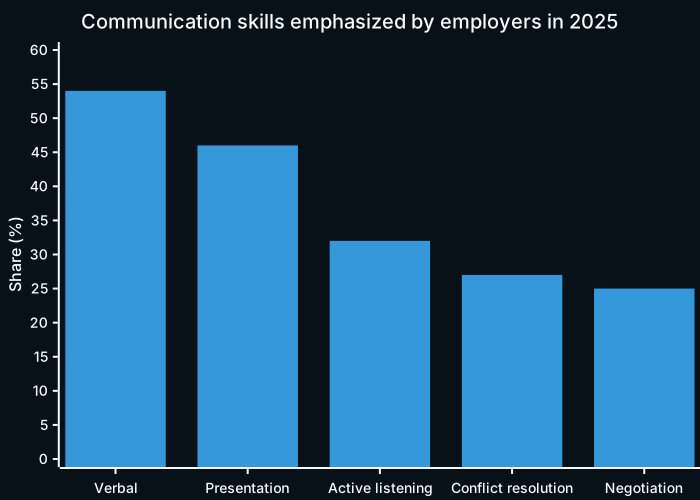
Source: GMAC Corporate Recruiters Survey 2025, group of employers concerned about communication skills.
What’s noteworthy:
speaking confidence isn’t just about speaking.
Listening is also a part of it.
Step 6: Adapt Message for Audience
You can convey the same idea to three different people.
But you shouldn’t use the same version.
Speaking to an Engineer
Architecture
Trade-off
Latency
Failure mode
Speaking to a Manager
Risk
Timeline
Resources
Decision
Speaking to a Customer
Problem
Outcome
Experience
Value
The idea doesn’t change.
The packaging changes.
This is one of the most important skills in workplace communication.
Step 7: Small Practice Is Better Than Waiting for a Big Presentation
If you only practice when:
Quarterly presentation
appears, you get too few repetitions.
You can practice communication every day:
Meeting
↓
Explain one idea clearly

Slack call
↓
Summarize in 30 seconds

Dinner
↓
Listen without interrupting

1:1
↓
Ask one direct question
Confidence is built through repeated exposure, not just preparation before a big speech.
A Simple Communication Ladder
Instead of jumping from:
Avoid speaking
to:
Speak to 500 people
gradually increase difficulty:
Level 1
State a point in a 1:1

↓

Level 2
Speak in a small meeting

↓

Level 3
Present for 3 minutes

↓

Level 4
Lead a discussion

↓

Level 5
Difficult conversation

↓

Level 6
Formal presentation
You are building evidence:
I can do this.
From “Speak with Confidence book” to a 7-Day Practice
Reading about communication is very useful.
But communication is a performance skill.
You can’t just:
Read
↓
Understand
↓
Become confident speaker
It requires:
Learn
↓
Try
↓
Notice
↓
Adjust
↓
Repeat
This is where a guided plan can be helpful.
Traudio currently offers a Guided Learning journey:
Speak with Confidence — 7-day plan
Communicate clearly at work, at home, and in important conversations.
The plan is part of Traudio’s Guided Learning system, where book summaries are organized around the learner’s improvement goals rather than just browsing individual titles.
7 Days Won’t Make You a Professional Public Speaker
That shouldn’t be the promise.
One week isn’t enough to:
- completely eliminate speaking anxiety,
- become a keynote speaker,
- master negotiation,
- handle every conflict,
- speak perfectly without fillers.
But one week can be enough to create seven deliberate repetitions.
For example:
Day 1
Clarify your message

Day 2
Speak more concisely

Day 3
Practice pauses and delivery

Day 4
Listen better

Day 5
Handle disagreement

Day 6
Practice an important conversation

Day 7
Build a repeatable communication system
This is a suggested practice framework, not an official syllabus published by Traudio.
Chart: How much practice do seven small repetitions create?
Assume each day:
- 15 minutes of learning
- 10 minutes of deliberate speaking practice
Total:
25 minutes/day
×
7 days
=
175 minutes
Equivalent to nearly 3 hours of deliberate learning + practice.
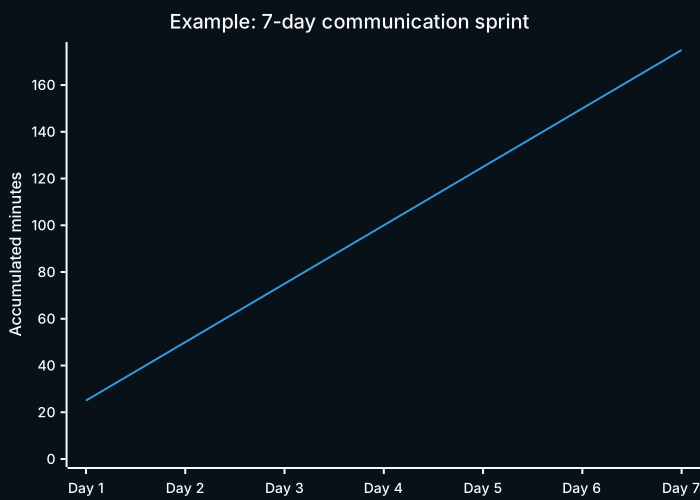
This is an illustration based on the assumption of 25 minutes per day, not a mandatory duration for the Traudio plan.
The important thing isn’t 175 minutes.
It’s 7 consecutive practice sessions.
How to use Traudio’s Speak with Confidence more effectively
After each learning session, don’t just bookmark the idea.
Create a communication rep.
| Learning focus | Practice |
|---|---|
| Clear thinking | Summarize an idea in 30 seconds |
| Structure | Use Point → Reason → Evidence |
| Delivery | Record 1 minute and listen back |
| Listening | Ask follow-up before giving an opinion |
| Difficult conversations | Write observation + request |
| Presentation | Explain a topic in 3 minutes |
| Confidence | Repeat a situation you usually avoid |
This is how to transform:
CONTENT
into:
SKILL
A very effective exercise: 60-second explanation
Choose a topic you know.
For example:
Your current project.
Record yourself answering:
What’s the most important thing others need to know?
Limit:
60 seconds.
Then listen back and ask:
- How long until the main point appeared?
- Did I repeat myself?
- Was there too much background?
- Were there fillers?
- Was the ending clear?
Do it again.
Round 2 is often immediately better than Round 1.
Chart: How can you measure communication progress?
This is an illustrative scorecard example over 7 days, not data from Traudio.
Assume you self-rate the clarity of a 60-second speech from 1 to 10:
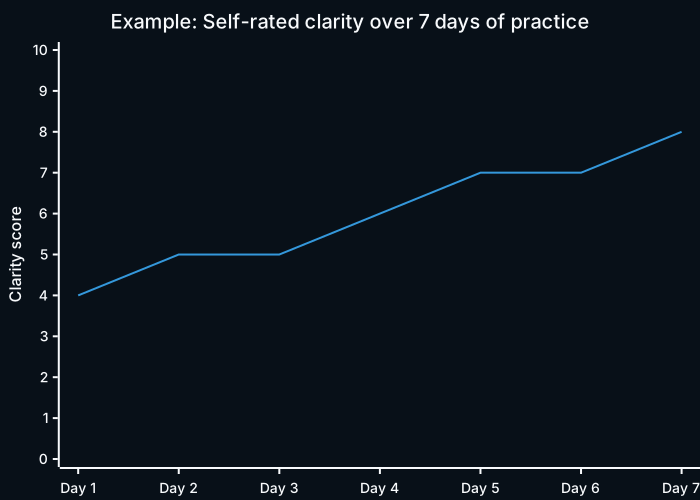
Self-rating is not a scientific measurement.
But it can help you see:
Practice
↓
Feedback
↓
Adjustment
instead of just feeling:
I think I don’t speak well.
Better notes also help you speak better
Confidence is sometimes not a speaking problem.
It’s a thinking problem.
If your notes are messy:
15 ideas
No hierarchy
No conclusion
it’s very difficult to speak clearly.
Before a meeting, instead of writing a page of notes, try:
MAIN POINT:
...

3 SUPPORTING POINTS:
1.
2.
3.

ASK / NEXT STEP:
...
That might be all the preparation you need.
How to prepare for an important conversation in 5 minutes
Write four lines.
1. Outcome
What do I want this conversation to achieve?
2. Fact
What happened without interpretation?
3. Meaning
What do I want the other person to understand?
4. Request
What specific action am I proposing?
For example:
OUTCOME
Agree on ownership.

FACT
Two tasks were assigned to two different people.

MEANING
The team doesn't know who makes the final decision.

REQUEST
Choose one owner for each task before the sprint begins.
Structure reduces anxiety because you no longer have to improvise the entire conversation.
Confidence at home is different from confidence at work
In the workplace, clarity often prioritizes:
Decision
Ownership
Evidence
Next step
In personal relationships:
Emotion
Understanding
Boundary
Connection
If you apply workplace mode at home:
I’ve analyzed the problem, and here are three action items.
it might not be effective.
Conversely, if you bring a personal communication style into an executive meeting, the message might lack structure.
This is why Traudio’s description is noteworthy:
Communicate clearly at work, at home, and in important conversations.
The goal isn’t just presentation.
It’s adaptive communication.
When do you need to speak less?
Speak with confidence doesn’t mean:
always speak.
Sometimes the most confident response is:
I don’t have enough information to answer yet. I’ll check and get back to you.
Or:
I need to think about that before deciding.
Or:
I understand your point. Let me rephrase to see if I’ve understood correctly.
Confidence doesn’t require bluffing.
Common mistakes that make speakers seem less confident
1. Overexplaining
The point is clear, but you keep talking.
2. Qualifying every sentence
Maybe...
I guess...
Kind of...
I'm not sure but...
Sometimes uncertainty is needed.
But excessive hedging makes the message lose weight.
3. Unnecessary apologizing
Sorry, just one thought...
Sorry if this is stupid...
You can simply say:
I have a different perspective.
4. No ending
Sentences turn into multiple sub-sentences until they just stop.
5. Preparing words but not structure
You memorize a script.
After an interruption:
Script lost
↓
Panic
Structure is more flexible than memorization.
A confident communication checklist
Before an important conversation:
- I know the main point
- I know what the audience needs
- I have a maximum of 3 supporting points
- I know the desired outcome
- I have a specific request
- I am ready to pause
- I will listen before rebutting
- I don’t need to speak perfectly
- I know the closing statement
If most are ticked, you’ve significantly reduced cognitive load before speaking.
Who is Speak with Confidence for?
Traudio’s plan might be suitable if you:
- Are hesitant to speak in meetings
- Have ideas but struggle to express them concisely
- Often overexplain
- Feel anxious before presentations
- Want to improve workplace communication
- Find it hard to give feedback
- Avoid difficult conversations
- Want to communicate better with your partner or family
- Have technical expertise but want to communicate more clearly
- Want to practice in short sessions instead of reading a long communication book
Traudio currently introduces Speak with Confidence as a 7-day Guided Learning plan within its goal-oriented journeys.
Do you need Traudio to speak more confidently?
No.
You can build your own system:
Learn one framework
↓
Record yourself
↓
Practice in low-risk situations
↓
Get feedback
↓
Increase difficulty
↓
Repeat
The value of Guided Learning lies in reducing decision friction.
Instead of:
Search "communication tips"
↓
Open 10 tabs
↓
Watch random video
↓
Save 5 books
↓
Practice nothing
the plan gives you a clear goal:
Speak with Confidence
and a timeframe small enough to start:
7 days.
What to do after 7 days?
Don’t stop at the learning plan.
Communication is a skill that requires long-term repetitions.
A progression could be:
WEEK 1
Learn + practice

↓

WEEK 2–4
Use one framework repeatedly

↓

MONTH 2
Seek feedback

↓

ONGOING
Increase conversation difficulty
For example:
First week:
Clearly state your point in a meeting.
Then:
Present for 5 minutes.
Later:
Lead a disagreement.
Even later:
Negotiate or handle conflict.
Confidence grows with real-world evidence.
A simple weekly communication system
You only need three repetitions per week.
Rep 1 — Explain
Explain an idea in 60 seconds.
Rep 2 — Listen
Have a conversation where you ask at least two follow-up questions before giving your opinion.
Rep 3 — Difficult
Say something you usually postpone, using a clear and respectful structure.
Three repetitions/week:
3 × 52
=
156 deliberate communication reps/year
No speech contest needed.
Chart: How do small practices accumulate?
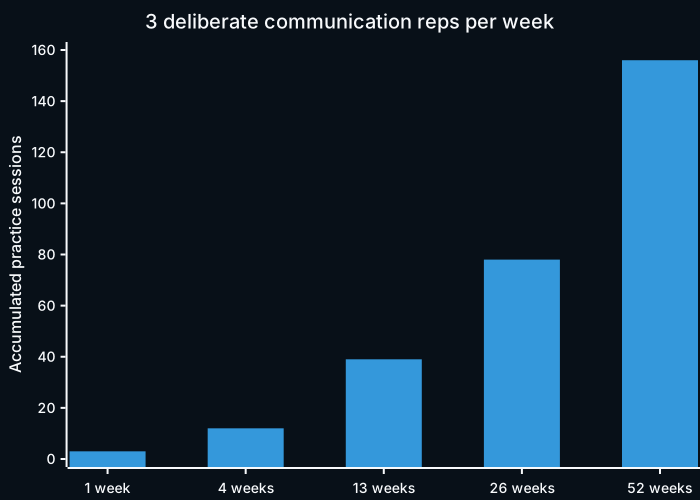
This is a simple calculation, not an outcome study.
But it illustrates an important point:
confidence is built from the number of times you actually communicate, not the number of pages you read about communication.
Conclusion: Speak with Confidence doesn’t mean becoming the most talkative person
If you’re looking for a Speak with Confidence book, you probably don’t actually need to learn how to “listen more confidently.”
You need a system to:
THINK CLEARLY
↓
STRUCTURE
↓
SPEAK
↓
LISTEN
↓
ADAPT
↓
REPEAT
NACE data shows that 69.3 percent of surveyed employers look for verbal communication skills, and communication is rated 4.57 out of 5 in importance for career readiness.
Jobscan’s analysis of millions of job postings also shows communication appearing in nearly 55 percent of listings studied.
Meanwhile, a 2026 study of over a thousand working adults shows public speaking anxiety remains a significant phenomenon and is linked to factors such as self-esteem and courage.
Therefore, the goal shouldn’t be:
I will never be nervous again.
But rather:
I can convey what’s important clearly even if I’m a little nervous.
A communication book can provide a framework.
Practice builds skill.
Feedback creates adjustment.
And if you want to start with a structured week, Speak with Confidence — Traudio’s 7-day plan is built around a very practical goal:
Communicate clearly at work, at home, and in important conversations.
Seven days won’t turn you into a professional speaker.
But they can be enough to help you start:
- stating your main point sooner,
- using pauses instead of fillers,
- listening better,
- preparing difficult conversations more clearly,
- and performing communication reps you previously avoided.
That’s a more realistic way to speak with confidence.
Related Articles
Master Your Financial Mindset Today
Download the Traudio app for iOS & Android to listen to synchronized audiobook summaries and chat with StickWise AI.
Download Traudio App Free