Brain and Body Boost Books: Daily Foundations for a Healthier Brain and Body
The search for Brain and Body Boost books often begins with a very broad desire:
I want a clearer mind, a healthier body, and more energy — but I don’t know where to start.
The problem is that health content on the internet is often fragmented:
- Sleep
- Exercise
- Nutrition
- Stress
- Focus
- Supplements
- Longevity
- Brain health
Each topic has thousands of pieces of advice.
The result:
Read more
↓
Save more
↓
Try too many things
↓
Stay inconsistent
A more helpful approach is to return to the foundations that repeat every day.
Not complex biohacks.
Not an 18-step routine.
But rather:
SLEEP
+
MOVEMENT
+
FOOD
+
RECOVERY
+
ATTENTION
=
BETTER BRAIN + BODY FOUNDATION
This is also a reasonable way to understand the keyword Brain and Body Boost: not a “hack” for immediate performance increase, but a system that helps the body and brain function better over time.
Brain Health and Body Health Are Actually Hard to Separate
A common mistake is to think:
Brain health is solely a matter of the brain.
In reality, factors related to:
- movement,
- blood pressure,
- cholesterol,
- diabetes,
- sleep,
- diet,
- social connection,
can all be related to long-term brain health.
The 2024 report by the Lancet Commission on dementia suggests that approximately 45% of dementia cases could be delayed or prevented if 14 modifiable risk factors are addressed throughout the lifespan. These factors include physical inactivity, hypertension, diabetes, smoking, social isolation, untreated hearing loss, high LDL cholesterol, and other factors.
This does not mean that lifestyle can guarantee the prevention of dementia.
But it shows:
brain health is not just a “brain training” problem.
Chart: Nearly Half of Dementia Risk Is Linked to Modifiable Factors
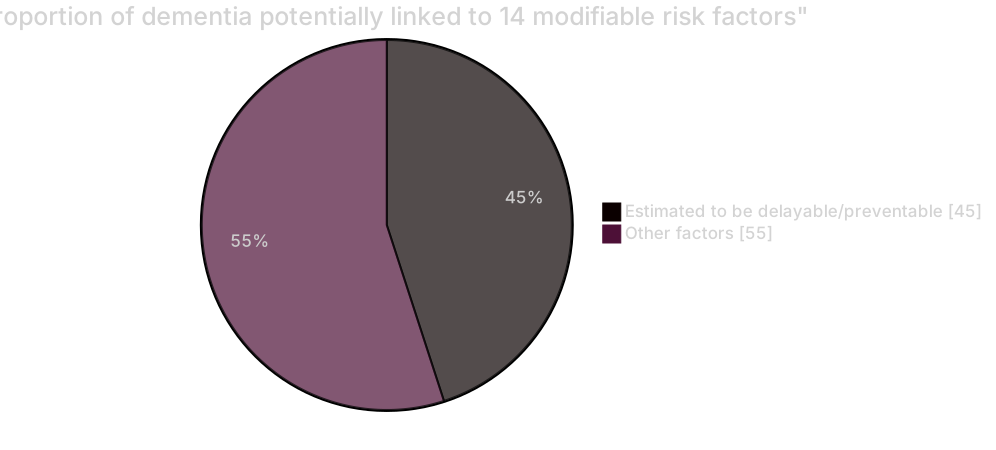
Source: Lancet Commission 2024. This is a population-level estimate, not individual probability.
The important point is not 45%.
But rather:
The body’s daily behaviors can be related to long-term brain health.
Foundation 1: Sleep Is Not “Doing Nothing”
Sleep is often the first thing cut when:
- Deadlines increase
- Young children
- Long commutes
- Streaming
- Social media
- Work late
But sleep is not just about feeling sleepy.
The CDC states that adults should get at least 7 hours of sleep per day. Data from the 2024 National Health Interview Survey shows that 30.5% of US adults sleep less than 7 hours on average in a 24-hour period.
Chart: About 3 in 10 Adults Sleep Less Than 7 Hours
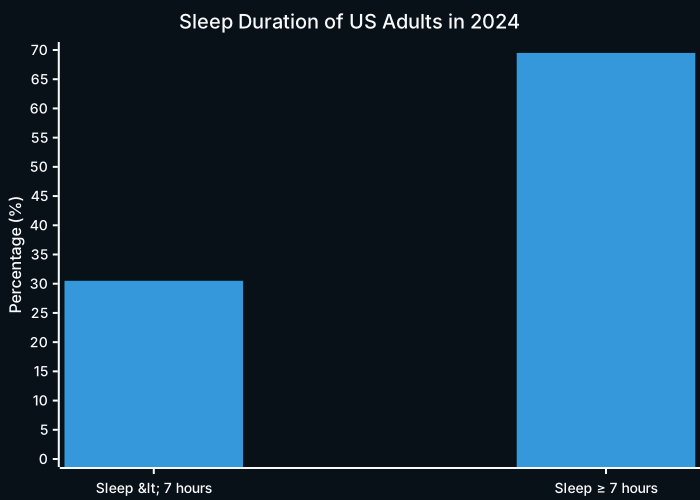
Source: CDC/NCHS, National Health Interview Survey 2024.
If nearly one-third of adults are lacking sleep by this threshold, then a “brain boost” sometimes doesn’t need to start with a supplement.
It can start with:
Going to bed earlier.
Sleep Foundation Is Simpler Than You Think
Instead of trying to “optimize sleep” with too many gadgets, you can start with:
- Relatively consistent bedtime
- Relatively consistent wake-up time
- Reduce caffeine too late
- Less bright light before bedtime
- Cooler and quieter bedroom
- Don’t bring work into bed
A good sleep routine often looks very boring.
That’s a good thing.
Foundation 2: Movement Is a Brain Intervention, Not Just Fitness
The WHO recommends that adults engage in approximately 150–300 minutes of moderate-intensity aerobic activity per week, or 75–150 minutes of vigorous-intensity activity, along with strength training for major muscle groups at least 2 days per week.
But the WHO also reported that in 2022, 31% of adults globally — approximately 1.8 billion people — did not meet the recommended levels of physical activity.
Chart: Global Physical Inactivity
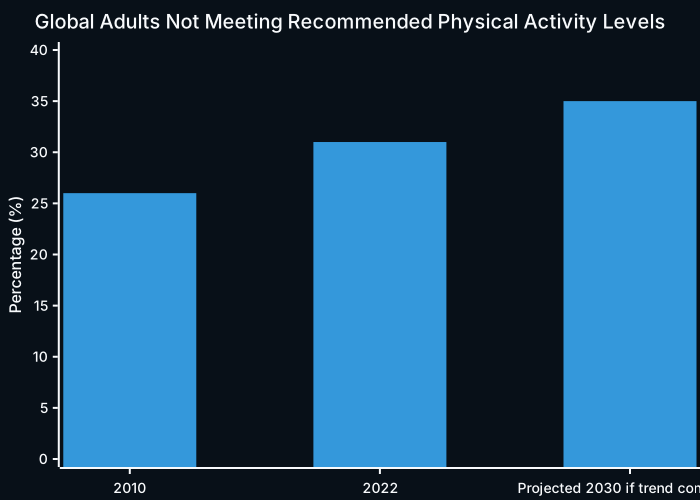
The WHO states that inactivity increased by approximately 5 percentage points from 2010 to 2022 and could reach 35% by 2030 if the trend continues.
How Is Exercise Related to Cognition?
An umbrella review and meta-meta-analysis published in 2025 synthesizing evidence from multiple systematic reviews showed that exercise has a statistically significant positive impact on:
- General cognition: SMD 0,42
- Memory: SMD 0,26
- Executive function: SMD 0,24
The study also noted benefits across various types of exercise, including light-intensity activity.
Chart: Exercise and Cognitive Outcomes
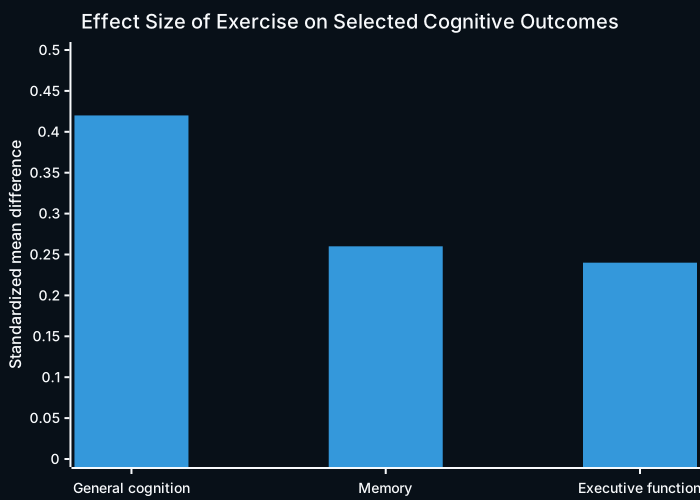
Source: systematic umbrella review and meta-meta-analysis, 2025.
This doesn’t mean a 20-minute walk will “boost IQ”.
It means regular physical activity is one of the behaviors with fairly strong evidence for both physical health and cognitive health.
You Don’t Need to Start with 6 Days a Week at the Gym
The WHO particularly emphasizes:
Some physical activity is better than none.
And if recommendations are not yet met, adults should start with small amounts and gradually increase.
A simple progression:
Week 1
10-minute walk

↓

Week 2
15-minute walk

↓

Week 3
20 minutes + 1 strength session

↓

Build gradually
Behaviors can be small.
Consistency is the important part.
Foundation 3: Food Is Not Just Calories
Nutrition content easily falls into two extremes:
Everything is toxic
or:
Calories are all that matter
A more practical approach is to start with patterns.
The WHO recommends that carbohydrates primarily come from:
- whole grains,
- vegetables,
- fruits,
- pulses,
and people over 10 years old should aim for at least 400 grams of vegetables and fruits per day, along with at least 25 grams of natural dietary fiber per day for adults.
What Does 400 Grams Look Like?
400 grams is equivalent to about five portions according to the WHO’s common interpretation.
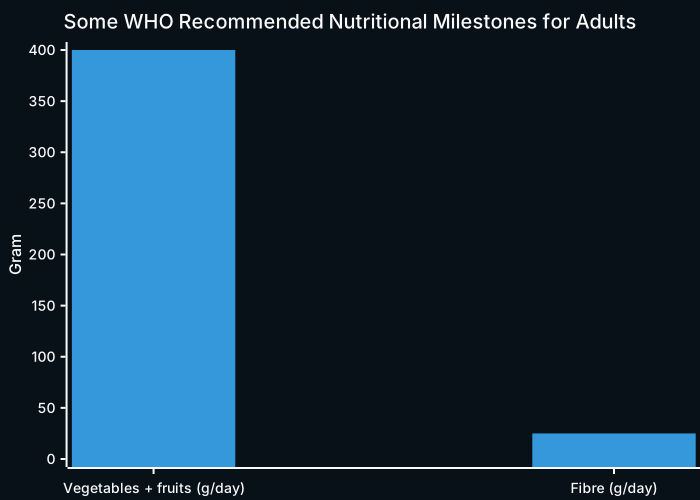
Source: WHO.
These two numbers do not represent an entire healthy diet.
But they give you a much more specific anchor than:
Eat clean.
A Simple Way to Build a Meal
No need to turn every meal into a macro problem.
You can start with:
1 protein source
+
1 portion of vegetables / fruits
+
1 less-refined carbohydrate source
+
appropriate fat
Then adjust according to:
- energy needs,
- eating culture,
- personal goals,
- health status.
If you have a medical condition, dietary restrictions, or treatment needs, personalized guidance from a healthcare professional is more important than a general framework.
Foundation 4: Recovery Is Not “Laziness”
One person might:
- get enough sleep,
- exercise regularly,
- eat well,
but still live in a state of:
Work
↓
Phone
↓
Work
↓
Notifications
↓
Streaming
↓
Sleep
↓
Repeat
Recovery is not just sleep.
It can also include:
- Screen-free walks
- Social connection
- Breaks between work blocks
- Time outdoors
- Activities not tied to performance
- Periods of no input
The brain doesn’t need “optimization” 24/7.
It needs rhythm:
STRESS
↓
RECOVERY
↓
ADAPTATION
Foundation 5: Attention Is Also a Health Behavior
If every free minute is filled with:
- feed,
- notification,
- short video,
- email,
the brain has almost no space left.
Attention management is not a cure.
But it clearly affects:
- the ability to learn,
- the ability to do deep work,
- feelings of mental fatigue,
- going to bed on time,
- the ability to maintain healthy behaviors.
A simple principle:
Less switching
↓
More sustained attention
↓
Better quality work
↓
More room for recovery
Brain and body foundations, therefore, are not just in the gym and kitchen.
They are also in how you distribute your attention throughout the day.
Foundation 6: Don’t Look for One “Brain Food” or a Supplement to Save the Entire System
If sleep is low, movement is low, diet is poor, and stress is high:
Supplement
is unlikely to become the main foundation.
This doesn’t mean supplements are never useful.
Some cases of deficiency or medical indication may require supplementation.
But the first questions should be:
Sleep?
Movement?
Food?
Recovery?
Medical basics?
before:
What nootropic should I buy?
Brain and Body Boost Doesn’t Have to Be a “Health Transformation”
This is where many wellness plans fail.
Day 1:
Wake 5 AM
Meditate
Run
Cold shower
No sugar
Meal prep
Read 30 pages
Sleep at 9 PM
Day 4:
Quit everything
A more realistic plan:
Build foundations, not a new personality.
A Simple Health Foundation Scorecard
You can track 5 things in a week:
| Foundation | Question |
|---|---|
| Sleep | Do I create enough opportunities to sleep ≥ 7 hours? |
| Movement | Do I move most days? |
| Food | Do my meals frequently include whole foods, vegetables, and fruits? |
| Recovery | Do I have real breaks? |
| Attention | Do I have at least one period not dominated by feeds/notifications? |
No wearable needed.
No 50 metrics needed.
Just enough visibility to see which foundation you’re neglecting.
From “Brain and Body Boost books” to a 7-day plan
Reading health books often has a very familiar failure mode:
Read about sleep
↓
Read about exercise
↓
Read about nutrition
↓
Read longevity book
↓
Save 40 tips
↓
Don't change routine
Knowledge doesn’t automatically translate into behavior.
This is where a goal-based learning plan can be useful.
Traudio currently offers a Guided Learning journey:
Brain and Body Boost — 7-day plan
Learn the everyday foundations of a healthier brain and body.
The plan is part of Traudio’s Guided Learning system, where curated book summaries are organized around a specific goal instead of letting learners browse the entire health library themselves.
The key point lies in the word:
foundations.
Not:
Become perfectly healthy in seven days.
What can 7 days accomplish?
Not enough to:
- completely change body composition,
- cure a medical condition,
- optimize biomarkers,
- reverse years of lifestyle,
- create lifetime habits.
But one week is enough to:
NOTICE
↓
LEARN
↓
CHANGE ONE THING
↓
OBSERVE
↓
ADJUST
That is the reasonable role of a 7-day plan.
What might a Brain and Body Boost week look like?
The framework below is a practical suggestion, not Traudio’s official syllabus.
Day 1 — Sleep
Audit:
- bedtime,
- wake time,
- total sleep opportunity.
Action:
Choose a sustainable bedtime window.
Day 2 — Movement
Audit:
How much do I actually move?
Action:
Add a short walk.
Day 3 — Food
Audit:
How many whole foods are in my meals?
Action:
Add vegetables or fruit to one meal.
Day 4 — Strength
Action:
Try a short strength session suitable for your fitness level.
Day 5 — Attention
Audit:
What time is lost to my phone?
Action:
Create a phone-free block.
Day 6 — Recovery
Action:
20–30 minutes of no work and no feed.
Day 7 — Build the system
Choose:
- one sleep behavior,
- one movement behavior,
- one food behavior,
to continue next week.
Don’t keep 17 habits.
Keep 3 things that are likely to survive.
Chart: A small week can accumulate quite a bit of movement
Suppose you add 20 minutes of walking each day for 7 days:
20 × 7
=
140 minutes
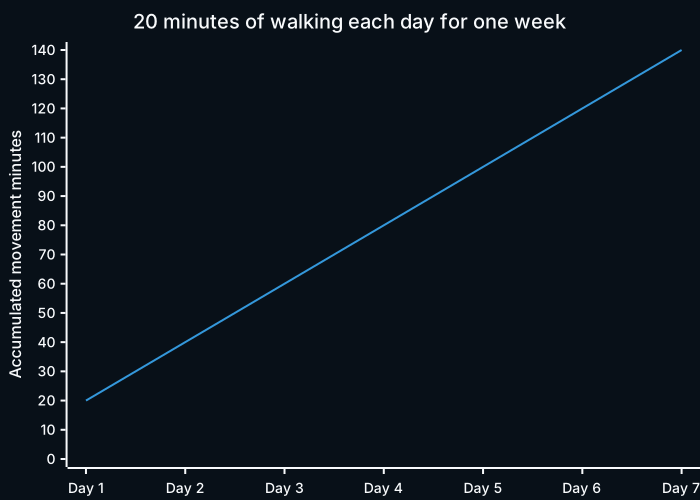
140 minutes is very close to the 150 minutes of moderate activity per week threshold in WHO’s common minimum recommendation.
This is an illustrative calculation.
The specific walking intensity determines whether that time counts as moderate activity.
The most important thing: don’t try to “meet the standard” immediately
If you currently move:
0 minutes/week
the first week’s goal doesn’t necessarily have to be:
300 minutes
+
4 gym sessions
WHO recommends that people who are not active enough should start with small amounts and gradually increase over time.
Progression:
0
↓
50
↓
100
↓
150
is often more realistic than:
0
↓
300
↓
0
How to use Traudio’s Brain and Body Boost without turning health into another chore
Traudio builds microlearning around short sessions, typically about 15 minutes, and Guided Learning is designed to take learners through a specific goal in 7 days.
A good rule:
1 learning session
↓
1 takeaway
↓
1 action
For example:
Takeaway
Sleep consistency matters.
Action
Set an alarm to remind you to go to bed, not just a wake-up alarm.
Or:
Takeaway
Some movement is better than none.
Action
Walk 10 minutes after lunch.
No need for:
Learn 20 health ideas
↓
Change 20 things
Chart: How recommendations can be broken down?
WHO recommends 150–300 minutes of moderate physical activity per week for adults.
Some illustrative ways to achieve 150 minutes:
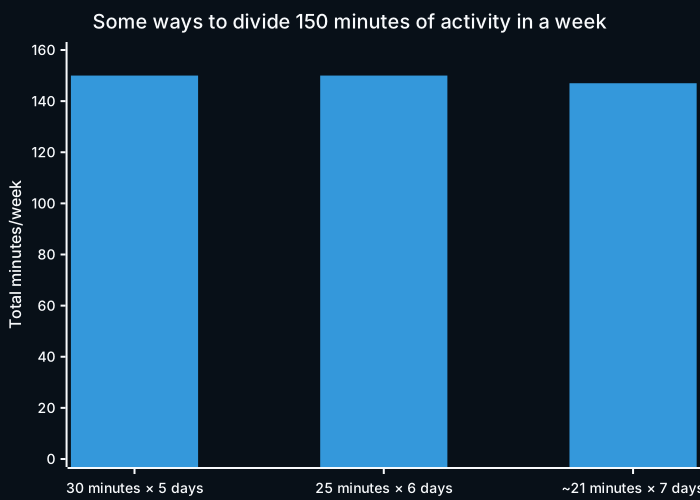
There is no single way.
This aligns well with the mindset of a foundational plan:
fit health into life, not life into a perfect routine.
Should “brain boost” focus on dementia prevention?
Brain health should not be narrowed down entirely to dementia.
But Lancet Commission data helps illustrate a principle:
Long-term brain health is related to many systemic factors.
The 14 risk factors in the 2024 report include:
- lower education,
- hearing loss,
- high LDL cholesterol,
- depression,
- traumatic brain injury,
- physical inactivity,
- diabetes,
- smoking,
- hypertension,
- obesity,
- excessive alcohol,
- social isolation,
- air pollution,
- untreated vision loss.
This list shows:
BRAIN HEALTH
≠
Only puzzles + memory games
It relates to whole-body health and the living environment.
Common mistakes when trying to “boost brain and body”
1. Seeking optimization before foundation
Cold plunge
Supplements
Wearables
Advanced protocol
before:
Sleep
Movement
Food
Reverse it.
2. Changing too much at once
If sleep, training, diet, and caffeine all change in the same week:
You’ll struggle to know what made a difference.
3. Turning health into all-or-nothing
One less-than-ideal meal doesn’t ruin a healthy diet.
One day without exercise doesn’t break the system.
4. Using exercise to compensate for sleep
More training is not a replacement for recovery.
5. Using wearable scores instead of feeling and context
Data can be useful.
But it’s not the entirety of health.
6. Confusing education with medical care
A book summary or 7-day plan can help you understand foundational health ideas.
It does not diagnose:
- sleep apnea,
- depression,
- diabetes,
- cardiovascular disease,
- hormone disorders,
- nutrient deficiencies,
or other health issues.
Persistent or concerning symptoms require evaluation from a suitable healthcare professional.
Who is Brain and Body Boost suitable for?
Traudio’s plan might be suitable if you:
- Want to understand health fundamentals but don’t know where to start
- Read a lot of wellness content but lack structure
- Often lack sleep
- Are less active
- Want to improve energy and daily routine
- Are interested in long-term brain health
- Want to learn via audio in a short time
- Don’t want to start with a complex protocol
Traudio describes the plan very simply:
Learn the everyday foundations of a healthier brain and body.
That’s a pretty reasonable positioning.
Do you need Traudio to do this?
No.
You can absolutely learn from:
- WHO
- CDC
- Books
- Healthcare professionals
- Exercise guidelines
- Nutrition guidelines
The value of Guided Learning lies in the sequence.
Instead of:
Sleep podcast
↓
Random nutrition video
↓
Longevity thread
↓
Workout reel
↓
Supplement ad
you start with:
ONE GOAL
↓
CURATED IDEAS
↓
SHORT DAILY LEARNING
↓
ACTION
Traudio currently places Brain and Body Boost among its 7-day Guided Learning plans, alongside journeys on finance, focus, habits, communication, and leadership.
What to do after 7 days?
Don’t add 10 habits.
Keep the behaviors that create the biggest leverage.
For example:
Sleep
Maintain your bedtime window.
Movement
Maintain daily walks + gradually build toward WHO recommendations.
Food
Maintain a better default meal.
Then:
Week 1
Foundation

↓

Week 2–4
Consistency

↓

Month 2+
Adjust and build
No need for a transformation challenge.
A simple 30-day foundation
You can choose three metrics:
Sleep opportunity
Number of nights dedicated to at least about 7 hours of sleep.
Movement
Total minutes of movement per week.
Whole-food meals
Number of meals meeting a simple criterion you set yourself.
No need for a scale.
No need for body photos.
No need for daily guilt.
Just:
Measure
↓
Notice
↓
Adjust
A minimalist daily scorecard
Each day, mark:
Sleep   ✓ / ✗
Move    ✓ / ✗
Food    ✓ / ✗
Recover ✓ / ✗
After seven days:
Don't ask:
"Is it perfect?"

Ask:
"What patterns emerged?"
This mindset is more suitable for long-term health.
Conclusion: Brain and Body Boost starts with very ordinary things
If you’re looking for Brain and Body Boost books, it’s easy to be drawn in by promises of:
- sharper brain,
- more energy,
- better memory,
- longevity,
- peak performance.
But strong evidence often brings us back to less exciting foundations.
The CDC shows that 30.5% of US adults sleep less than 7 hours.
The WHO states that 31% of global adults did not meet recommended physical activity levels in 2022, equivalent to about 1.8 billion people.
The WHO recommends that adults aim for 150–300 minutes of moderate aerobic activity per week and at least 400 grams of fruits and vegetables daily as part of a healthy diet.
And the Lancet Commission 2024 estimates that approximately 45% of dementia cases could be delayed or prevented by addressing 14 modifiable risk factors throughout life.
The general message is quite clear:
SLEEP
↓
MOVE
↓
EAT WELL
↓
RECOVER
↓
REPEAT
Not flashy.
But foundational.
A health book can help you understand part of the system.
Public-health guidance provides reliable anchors.
And if you want to start with a structured week of learning, Traudio’s Brain and Body Boost — 7-day plan is built around the exact goal:
Learn the everyday foundations of a healthier brain and body.
Seven days cannot “optimize” overall health.
But they can be enough for you to transition from:
I should be healthier
to:
I know which foundation
I am improving first.
And with health, that’s often a much better starting point.
Related Articles
Master Your Financial Mindset Today
Download the Traudio app for iOS & Android to listen to synchronized audiobook summaries and chat with StickWise AI.
Download Traudio App Free