Lead Like a CEO Book: Building the Mindset, Habits, and Communication Skills of a Better Leader

Searching for “Lead Like a CEO book” often doesn’t mean you want to become a CEO immediately.
Most people looking for this topic are actually trying to understand:
- How do good CEOs make decisions?
- How do you lead when information is incomplete?
- How do you communicate clearly without micromanaging?
- How do you build trust within a team?
- How do you distinguish between what you should do and what you must delegate?
- How do you stay calm when everything seems urgent?
The key point is:
Leading like a CEO doesn’t mean acting like someone with the title of CEO.
It means building capabilities that often become crucial as the scope of responsibility increases:
JUDGMENT
↓
PRIORITIZATION
↓
COMMUNICATION
↓
DELEGATION
↓
TRUST
↓
REVIEW
Someone might not yet manage an entire company but still needs these skills when:
- leading a project,
- managing a team,
- acting as a product owner,
- running a startup,
- leading a function,
- or simply having to make decisions that affect many other people.
What Does “Lead Like a CEO” Really Mean?
A CEO isn’t paid just to:
do more tasks than everyone else.
At a high leadership level, leverage changes.
Value increasingly comes from:
- deciding on the right problems,
- allocating resources,
- creating clarity,
- hiring and developing good people,
- building trust,
- creating alignment,
- communicating in uncertainty.
It can be visualized as:
INDIVIDUAL CONTRIBUTOR
Value ≈ Work personally produced

↓

MANAGER
Value ≈ Work produced through team

↓

EXECUTIVE
Value ≈ Quality of decisions + systems + people + direction
This is why technical excellence alone is not enough when the scope increases.
Trust in Leadership Remains a Major Issue
Gallup currently tracks the extent to which U.S. employees trust their organization’s leadership.
The latest data shows that only 20 percent of employees strongly agree that they trust their organization’s leadership as of May 2026. (gallup.com)
This number is not an approval rating for a specific CEO.
It measures a broader issue:
organizational trust.
Chart: Percentage who strongly agree they trust leadership
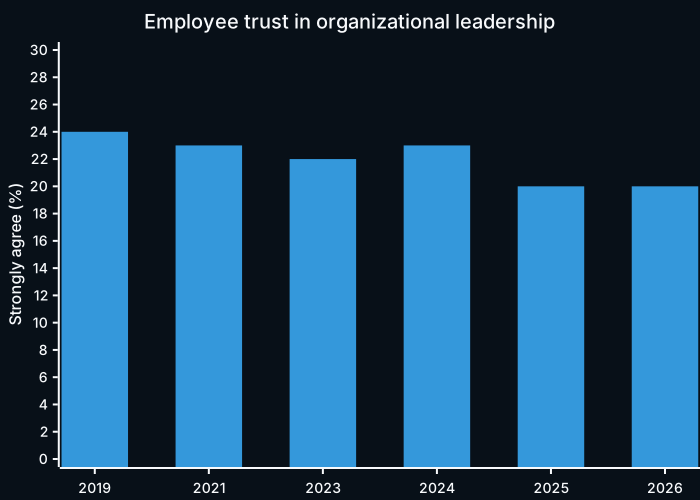
Source: Gallup Leadership & Management Indicator. Selected points from Gallup’s published data series. (gallup.com)
The notable point isn’t just the 20 percent level.
It’s the gap between:
Having a leadership title
and:
Being trusted by others to lead
The two don’t automatically go hand-in-hand.
Step 1: Judgment Is More Important Than Decision Speed
A common misconception:
A strong leader is someone who makes decisions very quickly.
Not necessarily.
A good decision requires knowing:
- what the real problem is,
- which data is reliable,
- which assumptions are untested,
- what the downsides are,
- whether this decision is reversible,
- who will be affected.
A simple framework:
WHAT DO WE KNOW?
↓
WHAT DO WE ASSUME?
↓
WHAT COULD GO WRONG?
↓
IS THIS REVERSIBLE?
↓
WHO OWNS THE DECISION?
↓
WHEN DO WE REVIEW?
Judgment is not pure intuition.
It is the ability to combine data, experience, and uncertainty.
CEOs Increasingly Must Decide in Uncertainty
PwC surveyed CEOs in 2025 and found that 58 percent of CEOs said they actively gather multiple perspectives and encourage internal debate when dealing with macroeconomic uncertainty. Half also use external advisors to challenge their thinking. (pwc.com)
Chart: CEOs changing decision-making in uncertainty
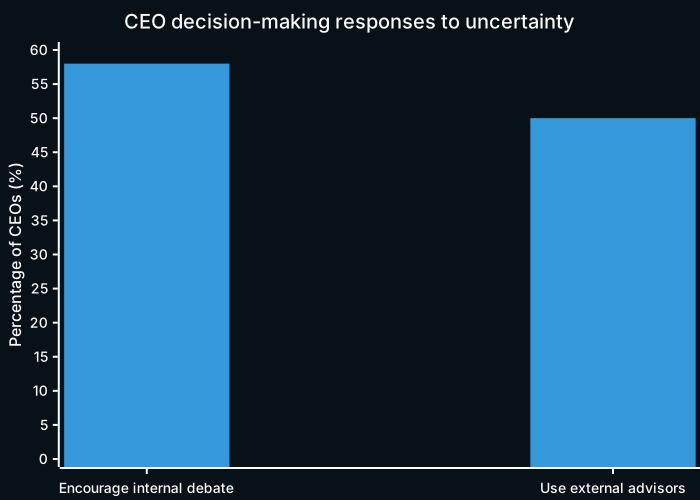
Source: PwC Pulse Survey, May 2025. (pwc.com)
This suggests an important lesson:
Strong leadership doesn’t mean always having the answers yourself.
Sometimes good leadership is:
building a process so that better answers can emerge.
Step 2: Distinguish Between Reversible and Irreversible Decisions
Not every decision deserves the same amount of attention.
A useful distinction:
Reversible decision
Can be tried, measured, and reversed.
Examples:
- changing meeting format,
- trying a small pricing experiment,
- changing onboarding copy,
- running a pilot.
Hard-to-reverse decision
Costly or difficult to undo.
Examples:
- acquisition,
- hiring a key executive,
- major reorganization,
- changing the core business model.
Weak leaders often make one of two mistakes:
Mistake A
Analyzing for 3 weeks a decision that could be reversed tomorrow

Mistake B
Deciding in 10 minutes on a hard-to-reverse decision
CEO-style judgment requires matching:
decision speed ↔ reversibility.
Step 3: Don’t Optimize for “Being Right Every Time”
If you only make decisions when you are certain:
100% information
it’s very likely the decision is already too late.
Leadership often occurs in:
Incomplete information
+
Time pressure
+
Conflicting incentives
+
Uncertain future
A good leader doesn’t need to be certain.
They need to:
- know the level of uncertainty,
- state clear assumptions,
- choose appropriate actions,
- set checkpoints for review.
Example:
Decision
↓
Assumption
↓
Metric
↓
Review date
↓
Continue / adjust / stop
This is disciplined judgment.
Step 4: Communication Is Not a Secondary Part of Leadership
McKinsey in 2025 described CEOs as increasingly needing to act as a chief storyteller, helping employees, investors, customers, and other stakeholders understand context, risks, and direction in an uncertain environment. (mckinsey.com)
A strategy that isn’t clearly understood often looks like:
Strategy deck
↓
Leadership understands
↓
Managers interpret differently
↓
Teams execute different versions
Communication is the part that transforms:
decision → coordinated action.
The Communication Gap in Management Is Still Very Large
Gallup shows that only about 27 percent of employees strongly agree that their direct manager communicates effectively in data from August 2025. (gallup.com)
Chart: Manager communication still has many gaps
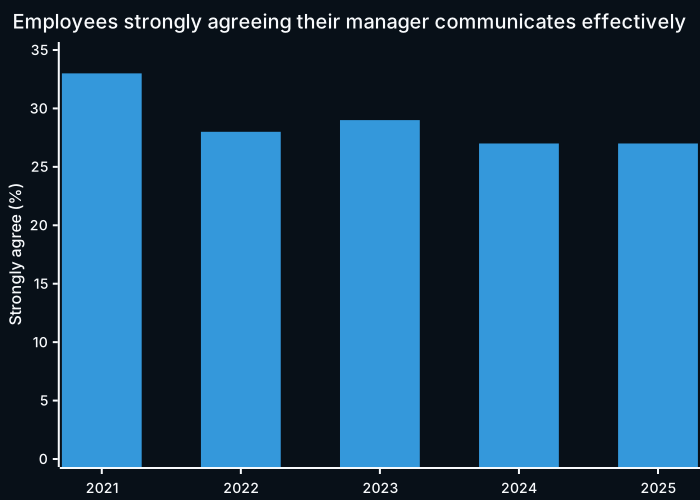
Source: Gallup Leadership & Management Indicator. (gallup.com)
This shows that communication doesn’t automatically improve just because someone gets promoted.
Step 5: Leaders Should Create Clarity Before Creating Urgency
Poor leadership:
Everything is urgent
↓
Everything becomes priority
↓
Nothing is actually priority
Better leadership:
WHAT MATTERS MOST?
↓
WHY NOW?
↓
WHAT ARE WE NOT DOING?
↓
WHO OWNS WHAT?
↓
HOW DO WE KNOW IT WORKED?
A good strategy must include both:
choice and non-choice.
If a leader says:
This is the top priority.
but still maintains 14 other top priorities, the team will create their own priorities by guessing.
A Leadership Memo Can Be Just 5 Lines
Context
What is changing?
Decision
What will we do?
Why
Why?
Owner
Who is responsible?
Measure
What does success look like?
Example:
CONTEXT
Activation is below target.

DECISION
Focus on onboarding in the next sprint.

WHY
The biggest drop-off occurs before first value.

OWNER
Growth team.

MEASURE
Activation +10%.
Clarity often has higher leverage than another meeting.
Ineffective Communication Is Actually Very Costly
Axios HQ published data in 2025 showing that senior employees can lose the equivalent of 63 workdays per year due to ineffective communication. The report also estimated a cost of approximately $54,860 per senior employee with a salary over $200,000. (axioshq.com)
Chart: Some consequences of ineffective communication
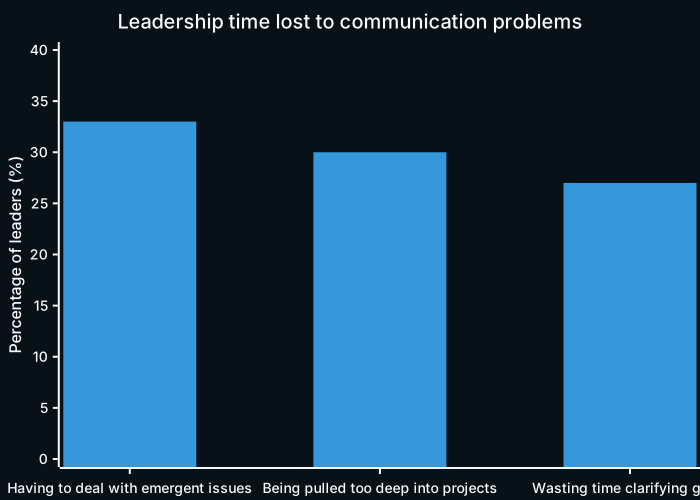
Source: Axios HQ 2025 internal communications findings. (axioshq.com)
This is an important insight:
Poor communication doesn’t just make people unhappy.
It creates operational cost.
Step 6: Delegate Outcomes, Not Just Tasks
Micromanagement often starts as:
Leader doesn't trust the outcome
↓
Leader maintains control
↓
Team has less autonomy
↓
Team has less ownership
↓
Leader trusts even less
A vicious cycle.
Task delegation:
Follow these exact steps.
Outcome delegation:
Here’s the outcome, constraints, deadline, and standard. Please propose how to achieve it.
A good delegation brief might include:
- Outcome
- Why it matters
- Constraints
- Deadline
- Decision rights
- Checkpoint
Example:
OUTCOME
Reduce onboarding support tickets by 20%.

CONSTRAINT
No increase in engineering scope this sprint.

DEADLINE
2 weeks.

DECISION RIGHTS
Team chooses copy and UI changes.

CHECKPOINT
Friday review.
You still maintain accountability.
But you don’t hold every decision.
Step 7: CEO-style leadership needs systems, not heroics
Bad leadership is often romanticized:
Leader
↓
Knows everything
↓
Does everything
↓
Saves every crisis
But if an organization needs a leader to show up to solve every problem:
that’s not scale.
That’s dependency.
A better system:
Clear goals
+
Good people
+
Decision rights
+
Feedback loops
+
Operating cadence
When the system is strong, the leader doesn’t need to be a bottleneck.
The habits of a good leader are often quite boring
Not:
reading at 5 AM then running a marathon.
But it could be:
- Weekly priorities
- Regular 1:1s
- Decision review
- Writing before meetings
- Listening before deciding
- Asking what changed
- Reviewing talent
- Saying no
- Following up consistently
Leadership quality often comes from repeatable operating habits.
Not occasional inspiration.
A weekly CEO-style operating rhythm
For example:
Monday
Top 3 priorities
Risks
Decisions needed
Midweek
Customer / team signal
What changed?
Friday
What worked?
What failed?
What did we learn?
What changes next week?
Simple.
But creates a feedback loop.
Leadership is not just for the CEO
You can lead like a CEO even if your title is:
- Product Manager
- Engineering Lead
- Team Lead
- Founder
- Project Manager
- Department Head
- Individual contributor leading an initiative
Not by:
acting important.
But by:
Think beyond your task
↓
Understand trade-offs
↓
Create clarity
↓
Own outcomes
↓
Communicate early
↓
Help others succeed
From the “Lead Like a CEO book” to a 7-day leadership practice
Leadership books often have a problem.
You read about:
- Strategy
- Decision making
- Communication
- Culture
- Delegation
- Execution
and everything makes sense.
Then Monday comes:
Inbox
↓
Meetings
↓
Urgent issue
↓
Slack
↓
No behavioral change
Knowledge doesn’t automatically become leadership behavior.
This is where a structured learning sprint can be helpful.
Traudio currently offers a Guided Learning journey:
Lead Like a CEO — 7-day plan
Build the judgment, habits, and communication of a better leader. (traudio.net)
The plan is part of Traudio’s Guided Learning system, where book summaries are curated around a goal instead of requiring users to browse the entire catalog themselves. (traudio.net)
7 days won’t turn you into a CEO
And that shouldn’t be the promise.
One week is not enough to:
- build complete executive judgment,
- become an excellent strategic thinker,
- build a strong culture,
- become a master communicator,
- manage crises like a veteran CEO.
But seven days can be enough to:
change how you view leadership.
A practical framework might look like:
Day 1
Audit how you make decisions

Day 2
Clarify priorities

Day 3
Improve one communication loop

Day 4
Delegate one outcome

Day 5
Seek dissent before a decision

Day 6
Review one leadership habit

Day 7
Build a weekly operating system
This is a suggested application framework, not Traudio’s official syllabus.
Chart: How much deliberate practice can a 7-day leadership sprint create?
Assume each day you spend:
- 15 minutes learning
- 15 minutes reflection/application
Total:
30 minutes/day
×
7
=
210 minutes
which is 3 hours 30 minutes of deliberate leadership practice.
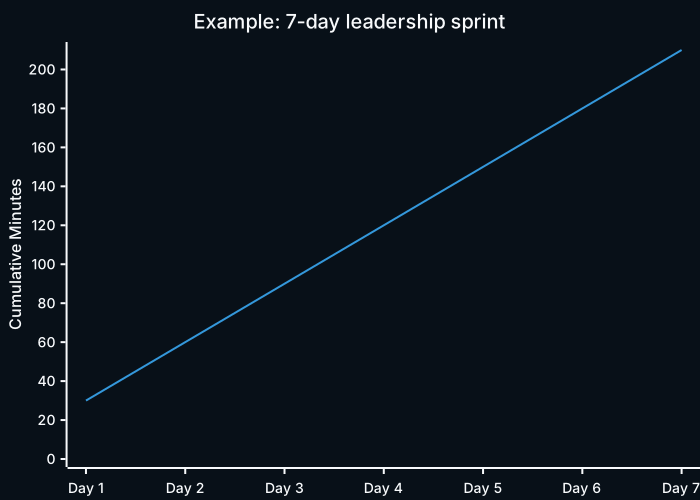
This is an illustration with the assumption of 30 minutes per day, not the mandatory duration of the Traudio plan.
The main point is not 210 minutes.
It’s:
7 opportunities to change leadership behavior.
How to use Lead Like a CEO more effectively
After each learning session, create an output.
| Learning area | Leadership output |
|---|---|
| Judgment | Write assumptions for a decision |
| Priorities | Choose 3 priorities and 3 non-priorities |
| Communication | Write a one-page clarity memo |
| Delegation | Delegate an outcome instead of a task |
| Trust | Ask the team what you’re missing |
| Habits | Create a weekly review |
| Strategy | Identify a current trade-off |
This is not Traudio’s official curriculum.
This is how to transform:
LEADERSHIP CONTENT
into:
LEADERSHIP BEHAVIOR
A very powerful exercise: Decision Journal
For every important decision, record:
Decision
What am I deciding?
Assumptions
What must be true for this decision to succeed?
Evidence
What data am I relying on?
Risks
What’s the biggest downside?
Confidence
E.g., 70%.
Review date
When will I re-evaluate?
After three months:
Expected
vs
Actual
You start learning from the quality of judgment, not just the outcome.
A good decision can still have a bad outcome due to uncertainty.
A bad decision can still get lucky.
Leaders need to distinguish between the two.
Chart: Outcome is not the only measure of decision quality
GOOD PROCESS + GOOD OUTCOME
→ Great

GOOD PROCESS + BAD OUTCOME
→ Learn from uncertainty

BAD PROCESS + GOOD OUTCOME
→ Dangerous luck

BAD PROCESS + BAD OUTCOME
→ Expected failure
If you only reward outcome:
the team might learn the wrong lesson.
A framework for leaders to speak more clearly
Before an announcement or meeting, write:
What
What is changing?
Why
Why?
Now
Why now?
Impact
What does this mean for the team?
Next
Who does what next?
For example:
WHAT
Stop feature X.

WHY
Low adoption, high maintenance.

NOW
Q4 needs to focus on retention.

IMPACT
Two engineers will move to onboarding.

NEXT
Migration plan complete by Friday.
Leaders don’t need to speak at length.
Leaders need to reduce ambiguity.
Trust is not built by charisma
Trust is often built by consistency:
Say
↓
Do
↓
Repeat
If a leader says:
Feedback is welcome.
but punishes someone for disagreeing:
the actual system is:
Don't disagree.
PwC found that 58 percent of CEOs in their 2025 survey actively encourage internal debate amidst uncertainty. (pwc.com)
But asking for dissent is only useful when others feel dissent is safe.
A question CEOs should ask more often
Not:
Is everything okay?
Because the easy response is:
It’s okay.
Ask:
- What am I missing?
- If this plan fails, what might be the reason?
- Which part do you disagree with?
- If you could only solve one bottleneck, what would you choose?
- What am I doing that is slowing the team down?
These questions create better information flow.
Communication is an increasingly important human skill in the age of AI
GMAC’s 2026 survey of over 600 corporate recruiters in 39 countries, mostly from Global Fortune 500 companies, found communication, problem-solving, and adaptability among the top capabilities valued by employers when recruiting business talent; strategic thinking and AI-tool skills are expected to increase sharply in the coming years. (gmac.com)
This creates an interesting leadership formula:
AI capability
+
Strategic judgment
+
Communication
+
Adaptability
=
Modern leadership leverage
AI can help generate analysis.
But leaders still have to:
- choose trade-offs,
- take responsibility,
- build trust,
- explain direction.
CEO communication is not about talking more
McKinsey notes that CEOs need to set communication standards and speak clearly during critical moments. (mckinsey.com)
That doesn’t mean:
More messages
=
Better communication
Better communication can be:
Less noise
+
More context
+
Clear decisions
+
Consistent repetition
The team doesn’t need 50 updates.
They need to understand:
What is most important?
Common mistakes when trying to “lead like a CEO”
1. Copying the personality of a famous CEO
Leadership style must fit:
- company,
- team,
- context,
- personality.
Copying charisma doesn’t create judgment.
2. Trying to have an answer for everything
Leaders who don’t know can say:
I don’t know yet. Here’s how we’ll find out.
That can be a stronger response than bluffing.
3. Holding onto every decision
If every decision has to go through you:
you don’t scale.
4. Stating strategy but not trade-offs
If everything is a priority:
the strategy isn’t clear.
5. Confusing visibility with leadership
Showing up to every meeting doesn’t mean creating leverage.
6. Only reviewing results, not the decision process
You miss out on learning.
A CEO-style weekly scorecard
No need for 30 metrics.
It could just be:
| Question | Review |
|---|---|
| Is the top priority clear? | Yes / No |
| Most important decision? | … |
| Biggest risk? | … |
| Biggest bottleneck? | … |
| Who needs clarity? | … |
| What should be delegated? | … |
| What was learned this week? | … |
This creates a leadership loop:
DECIDE
↓
COMMUNICATE
↓
EXECUTE
↓
LEARN
↓
ADJUST
Who is Lead Like a CEO suitable for?
Traudio’s plan may be suitable if you:
- Are new to management
- Lead projects or products
- Are building a startup
- Want to transition from IC to leadership
- Tend to micromanage
- Struggle with prioritization
- Have to make decisions in uncertainty
- Want to communicate more like an executive
- Have too many meetings but little clarity
- Want to learn leadership through short sessions
Traudio introduces Lead Like a CEO as a 7-day Guided Learning plan with the goal of:
Build the judgment, habits, and communication of a better leader. (traudio.net)
Do you need Traudio to learn leadership?
No.
You can learn from:
- books,
- mentors,
- executive coaching,
- real management experience,
- feedback,
- decision journals.
No app can replace actually leading people.
The useful aspect of Guided Learning is structure.
Instead of:
Leadership podcast
↓
Random article
↓
CEO biography
↓
Another productivity book
↓
No application
you start with an outcome:
I want to become a better leader.
and a learning sprint small enough to execute:
7 days. (traudio.net)
What happens after 7 days?
Leadership is truly built when:
Idea
↓
Situation
↓
Decision
↓
Feedback
↓
Reflection
↓
Better next decision
A logical progression:
WEEK 1
Learn + audit

↓

MONTH 1
Practice one leadership behavior

↓

QUARTER
Review decisions and team feedback

↓

YEAR
Build judgment through repetitions
Seven days is the start line.
Not the finish line.
A 30-day continuation plan
After the 7-day plan, you can choose a single behavior.
For example:
Week 2
Every decision gets a clear owner.
Week 3
Every major decision records assumptions.
Week 4
Every team update follows What → Why → Next.
Week 5
Every Friday review:
What did I decide?
What happened?
What did I miss?
You are transforming leadership from:
concept
into:
operating system.
Chart: Cumulative leadership repetitions over time
Assume you deliberately review 3 leadership decisions per week.
3 × 52
=
156 decision reviews/year
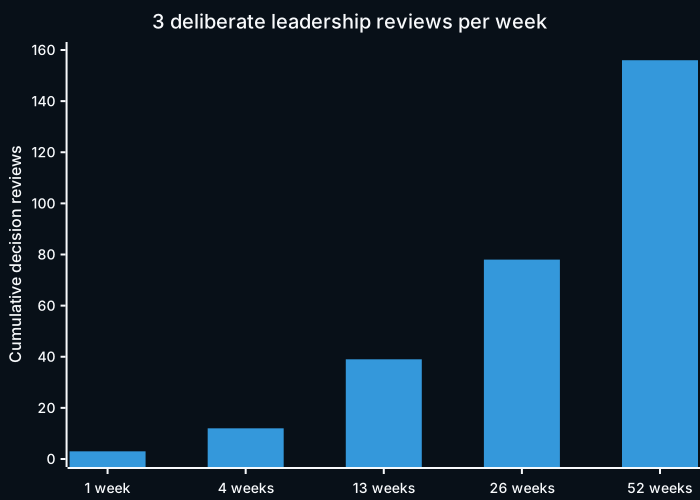
This is just an illustrative calculation.
But the logic is very important:
Judgment is built through reviewed experience, not just seniority.
Conclusion: Lead Like a CEO is not about learning to look like a CEO
If you search for a Lead Like a CEO book, the most valuable things to learn are not:
- what time CEOs wake up,
- how many books they read,
- what they wear,
- what morning routines they have.
Those things might be interesting but are rarely core leadership leverage.
The core is usually closer to:
JUDGMENT
↓
PRIORITY
↓
COMMUNICATION
↓
DELEGATION
↓
TRUST
↓
LEARNING
Gallup shows that only about 20 percent of employees strongly agree that they trust organizational leadership, while only about 27 percent strongly agree that their direct manager communicates effectively. (gallup.com)
PwC, on the other hand, shows that 58 percent of CEOs in their survey are trying to improve decision quality by broadening perspectives and encouraging internal debate. (pwc.com)
These numbers say something quite clear:
Leadership is not just authority.
It is the quality of how you think, decide, and help others understand what to do next.
A leadership book can provide a framework.
Experience provides context.
Feedback provides correction.
Decision review creates judgment.
And if you want to start with a structured learning sprint, Traudio’s Lead Like a CEO — 7-day plan focuses precisely on three elements:
Build the judgment, habits, and communication of a better leader. (traudio.net)
Seven days won’t turn you into a CEO.
But they can be enough for you to start asking questions like a better leader:
What truly matters?

What am I assuming?

Who should own this decision?

Where is the team lacking clarity?

And am I creating leverage...
or becoming a bottleneck?
That is a much more realistic starting point for leading like a CEO.
Related Articles
Master Your Financial Mindset Today
Download the Traudio app for iOS & Android to listen to synchronized audiobook summaries and chat with StickWise AI.
Download Traudio App Free