Calm and Happy Mind Books: Practical ideas on resilience, meaning, and happiness
Searching for Calm and Happy Mind books often doesn’t just mean you want a book to “help you think more positively.”
Behind that keyword are often more practical needs:
- How to be less stressed?
- How to not be carried away by emotions?
- How to feel that life has more meaning?
- How to be happier without being entirely dependent on achievements, money, or circumstances?
- How to recover faster after failure or a difficult period?
That’s why “calm and happy mind” should not be understood as:
No sadness
+
No worry
+
Always positive
A more practical definition is:
CALM
=
Having the ability to return to a stable state

HAPPY
=
Having many positive experiences and a sense that life has value

RESILIENT
=
Able to recover when things don't go as planned
The goal is not to eliminate unpleasant emotions.
The goal is to build a way of life where unpleasant emotions do not control your entire behavior.
Calm and happy are not the same thing
You can be calm but not happy.
For example:
No major stress, but also no meaningful goals or connections.
You can also be happy in a moment but not calm.
For example:
An exciting event brings excitement, but overall life remains chaotic.
A more durable mental foundation requires many components:
EMOTIONAL REGULATION
+
SOCIAL CONNECTION
+
MEANING
+
RECOVERY
+
ATTENTION
+
DAILY POSITIVE EXPERIENCE
There is no single “happiness hack” that can replace this entire system.
How common is current stress, really?
The Stress in America 2025 survey by the American Psychological Association, involving over 3,000 US adults, shows the average reported stress level is about 5 out of 10. 62% reported social division as a significant source of stress, while 76% said the future of the nation was a major source of stress.
Technological factors are also rapidly increasing:
- 69% consider misinformation a major source of stress, up from 62% the previous year.
- 57% consider the development of AI a major source of stress, up from 49%.
Chart: Some sources of stress reported by US adults
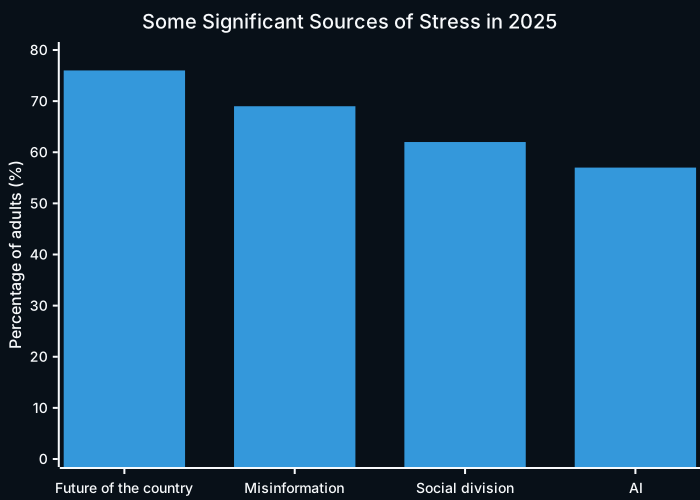
Source: APA Stress in America 2025.
This helps explain why a “calm mind” today is not just about breathing techniques.
The information environment also affects mental state.
Step 1: Don’t make calm a goal of “never being stressed”
Stress is not always bad.
It can appear when:
- important deadlines,
- exams,
- presentations,
- family care,
- job changes,
- facing uncertainty.
A more realistic goal:
STRESS
↓
NOTICE
↓
REGULATE
↓
RESPOND
↓
RECOVER
instead of:
STRESS
↓
PANIC ABOUT BEING STRESSED
↓
MORE STRESS
Resilience is not about being unaffected.
It is the ability to return to a well-functioning state after being affected.
Step 2: Social connection is part of mental health
One of the most remarkable data points in recent years comes from the WHO.
The 2025 report by the WHO Commission on Social Connection states that about 1 in 6 people worldwide experience loneliness. Among adolescents and young adults, the number is nearly 1 in 5. The WHO also estimates that loneliness is linked to approximately 871,000 deaths per year, equivalent to about 100 deaths per hour.
Chart: Loneliness on a global scale
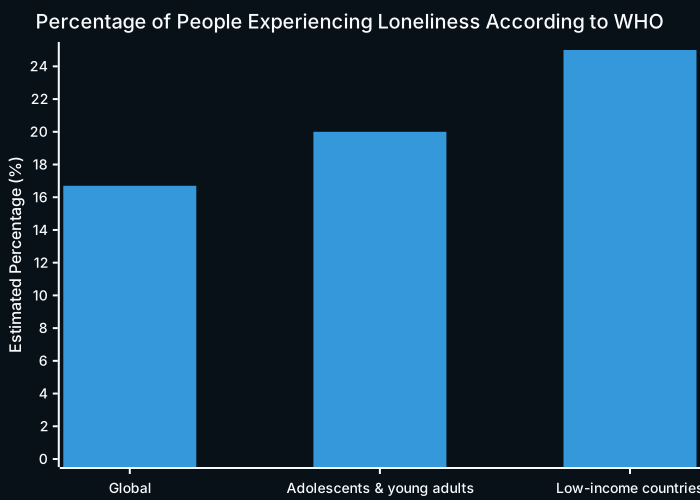
Source: WHO Commission on Social Connection 2025. The ratios 1/6, approximately 1/5, and nearly 1/4 are converted to percentages for illustration.
A “happy mind” is therefore not just about what’s inside your head.
It also depends on:
- who is with you,
- whether you feel understood,
- whether you can ask for help,
- whether you have enough quality relationships.
APA also shows emotional disconnection is very common
In Stress in America 2025:
- 54% of adults say they feel isolated at least sometimes,
- 50% feel left out,
- 50% feel a lack of companionship.
Chart: Emotional disconnection in APA survey
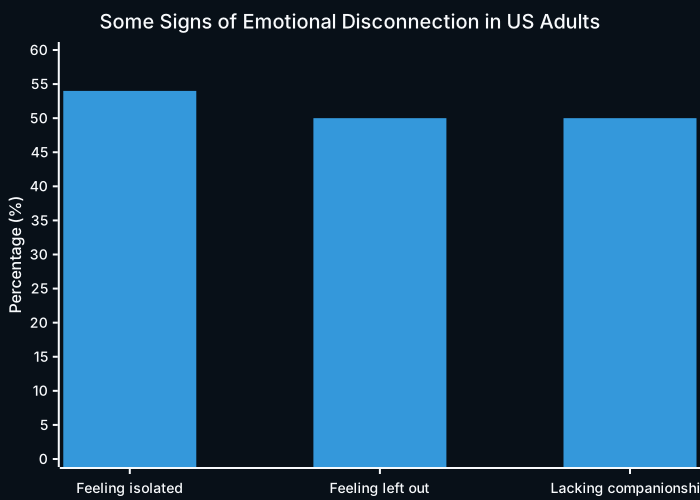
These are not three independent groups, so they should not be added together.
But the pattern is very clear:
sustainable happiness is hard to separate from connection.
Step 3: Don’t outsource all happiness to achievement
A very common pattern:
When I get promoted
→ I will be happy

When I earn enough money
→ I will be happy

When I buy a house
→ I will be happy

When I hit my target
→ I will be happy
Then:
Achievement
↓
Relief / excitement
↓
Adaptation
↓
Next target
This does not mean ambition is bad.
It means if happiness only exists at the end of an achievement cycle, you might spend most of your life in a state of:
not enough.
Books like The Happiness Track by Emma Seppälä take the opposite approach: calm, presence, gratitude, compassion, and connection can be the foundation that supports performance, rather than just a reward after success. (traudio.net)
Step 4: Happiness is related to how we treat others
The World Happiness Report 2025 focuses strongly on “caring and sharing.”
The report notes that benevolent behaviors, which increased during the pandemic, decreased in 2024 but remained more than 10% higher than 2017–2019 levels in almost every region. Specifically, helping strangers remained about 18% higher than pre-pandemic levels globally.
The report also shows that the expectation that others will be kind is a stronger predictor of happiness than many types of actual or expected harm.
Chart: Helping strangers remains higher than pre-pandemic levels
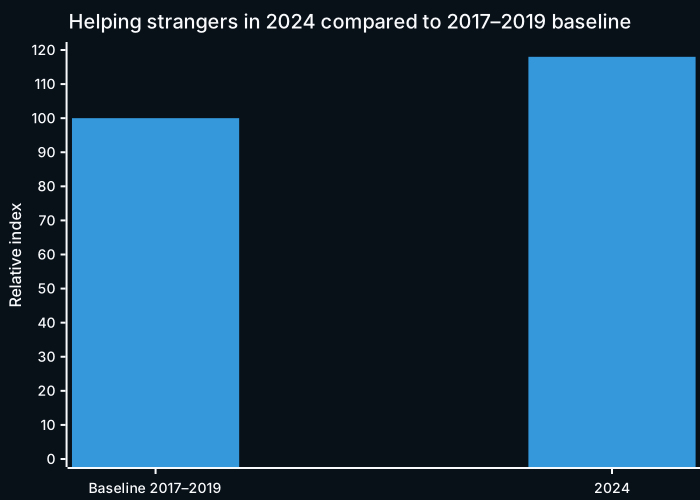
The baseline is set to 100 to illustrate the 18% average global increase reported by the World Happiness Report.
Interesting point:
Happiness doesn’t just come from:
What do I receive?
But also from:
Who do I create value for?
Step 5: A meal with others can also be important
The World Happiness Report 2025 also dedicates a chapter to meal sharing.
The report states that the number of meals shared with others is a strong indicator of subjective well-being, with the correlation described as comparable to major factors like income and unemployment. Those who share more meals report higher life satisfaction and positive affect, along with lower negative affect.
In the United States, about 1 in 4 people reported eating all meals alone on the previous day in 2023. This number increased by 53% compared to 2003.
Chart: Americans eating all meals alone
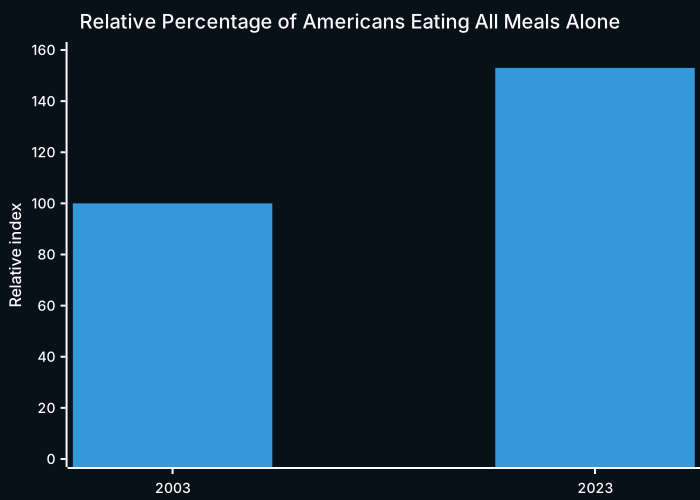
The World Happiness Report states this level increased by 53% from 2003 to 2023; the chart uses 2003 = 100 for illustration.
An intervention for happiness is sometimes very ordinary:
Eating dinner with someone instead of watching another self-help video.
Step 6: Meaning is different from pleasure
A pleasant day is not necessarily a meaningful day.
And a meaningful day is not necessarily pleasant.
For example:
- Caring for young children can be tiring but meaningful.
- Learning a difficult skill can be frustrating but meaningful.
- Helping others can be time-consuming but meaningful.
One can imagine:
PLEASURE
=
Feels good now

MEANING
=
Feels worth doing
A good life often needs both.
If you only chase pleasure:
Comfort
↓
More comfort
↓
Less challenge
↓
Possible emptiness
If you only chase purpose without recovery:
Mission
↓
Work
↓
More work
↓
Burnout
Balance is more important than extremes.
Step 7: Calm requires the ability to bring attention to the present
A lot of mental suffering occurs in two directions:
PAST
Regret
Rumination

FUTURE
Fear
Prediction
What-if
While the actual experience happens:
NOW
This does not mean abandoning planning or not learning from the past.
It means recognizing when the mind is replaying or predicting without creating value.
Works like The Happy Mind by Kevin Horsley and Louis Fourie and Happiness by Matthieu Ricard all emphasize attention, perspective, and the ability to bring the mind back to the present as part of well-being. (traudio.net) (traudio.net)
A tiny practice: Name → Notice → Return
When you realize you’re overthinking:
Name
I am worrying.
Notice
What does the body feel?
- tension,
- shallow breathing,
- racing thoughts?
Return
Bring attention back to:
- your breath,
- the task at hand,
- the conversation happening.
THOUGHT
↓
NOTICE
↓
NO NEED TO FIGHT
↓
RETURN
The goal is not an “empty mind.”
The goal is less automatic capture.
Step 8: Gratitude is valuable when specific
“Be grateful” can easily become a cliché.
A more specific exercise:
Don’t write:
I am grateful for my family.
Write:
Today I am grateful that my mom called to ask if I had eaten dinner.
Specificity makes memories more vivid.
A format:
WHAT?
A good thing.

WHY?
Why is it important?

WHO?
Who contributed to it?
This also helps gratitude connect with social connection instead of becoming a checkbox.
Step 9: Resilience is not suppressing emotion
A poor response:
Bad event
↓
"Don't feel bad"
↓
Suppress
A healthier response:
Bad event
↓
Feel
↓
Name
↓
Understand
↓
Choose response
Resilience is not:
I am unaffected.
It is:
I am affected, but I have a way to return.
A Simple Resilience Framework
When facing a setback, ask:
What happened?
Fact.
What am I telling myself?
Interpretation.
What can I control?
Agency.
Who can help?
Connection.
What is the next small action?
Movement.
Example:
FACT
Project rejected.

STORY
"I'm not good enough."

CONTROL
Review feedback.

CONNECTION
Talk to a mentor.

ACTION
Rewrite one section tomorrow.
You don’t deny disappointment.
You prevent disappointment from becoming identity.
From “Calm and Happy Mind books” to a 7-day practice
There’s a very familiar failure mode with happiness books:
Read
↓
Highlight
↓
Feel inspired
↓
Close book
↓
Return to same inputs
You learn new ideas.
But your environment, attention, and behavior don’t change.
Traudio now offers a Guided Learning journey:
Calm and Happy Mind — 7-day plan
A practical week of ideas for resilience, meaning, and happiness.
The plan is part of Traudio’s Guided Learning system, where curated book summaries are organized around goals learners want to develop. Traudio currently publishes over 2,000 book summaries in its app.
The key point lies in the phrase:
practical week.
Not:
Become happy in seven days.
What can 7 days accomplish?
One week is not enough to:
- cure depression,
- eliminate anxiety,
- resolve trauma,
- completely change circumstances,
- build permanent happiness.
Serious or prolonged mental health issues may require appropriate professional support.
But seven days are enough to create a well-being audit:
Where am I directing my attention?
↓
Am I getting recovery?
↓
Do I have connection?
↓
What is creating meaning?
↓
What is draining my energy?
That’s a useful starting point.
What a Calm and Happy Mind week might look like
The framework below is a suggested practice, not Traudio’s official syllabus.
Day 1 — Attention
Observe:
What takes up most of my attention?
Action:
Create a 15-minute period without feeds and notifications.
Day 2 — Calm
Notice a stress response.
Action:
Pause before reacting.
Day 3 — Connection
Text or call a friend you genuinely want to talk to.
Don’t just react to stories.
Day 4 — Gratitude
Write three specific things.
Not generic.
Day 5 — Meaning
Ask:
What work do I do that, even if difficult, still feels worthwhile?
Day 6 — Resilience
Choose a recent setback.
Separate:
FACT
from:
STORY
Day 7 — Design
Choose three behaviors to continue:
- one behavior for calm,
- one for connection,
- one for meaning.
Chart: A small week still creates significant deliberate practice
Suppose each day you dedicate:
- 15 minutes to learning,
- 10 minutes to reflection or action.
Total:
25 minutes/day
×
7 days
=
175 minutes
That’s nearly 3 hours of deliberate learning + reflection.
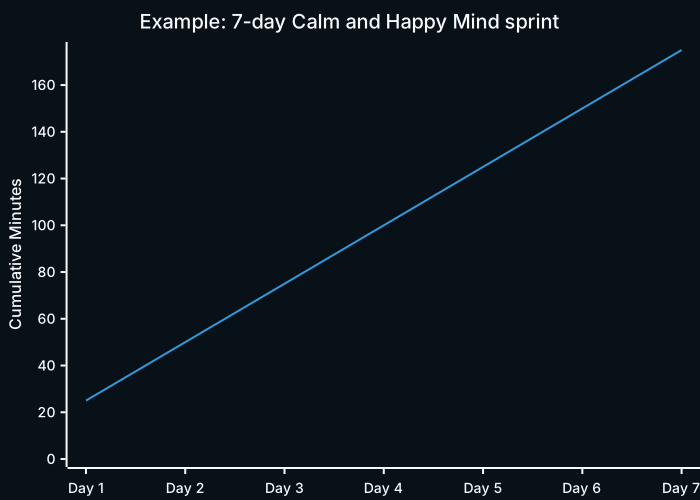
This is an illustration based on the assumption of 25 minutes per day, not a mandatory duration from Traudio.
The important thing is that you create 7 instances of deliberate attention for well-being instead of just thinking:
I should be less stressed.
How to use Traudio’s Calm and Happy Mind more effectively
After each learning session, create a small output.
| Topic | Action |
|---|---|
| Calm | Create 5 minutes without input |
| Attention | Turn off a group of notifications |
| Happiness | Record a specific positive experience |
| Connection | Proactively contact someone |
| Meaning | Write down one worthwhile thing to continue |
| Resilience | Reframe a setback |
| Integration | Choose 3 habits for the next week |
This is how to transform:
WELL-BEING CONTENT
into:
WELL-BEING PRACTICE
A very useful rule: Consume less, notice more
Wellness content can become another type of distraction.
Podcast about happiness
↓
Book about happiness
↓
Video about happiness
↓
Thread about happiness
↓
No time to live
A rule:
1 IDEA
↓
1 DAY
↓
1 EXPERIMENT
Example:
Idea
Social connection matters.
Experiment
Have dinner with someone without putting your phone on the table.
Simple.
But that’s behavior.
Chart: Social connection deserves to be considered a health foundation
The WHO states that loneliness affects approximately 1/6 of the global population and is linked to about 871,000 deaths per year.
If you divide 871,000 by 365 days:
≈ 2,386 deaths/day
and approximately:
≈ 99 deaths/hour
consistent with how the WHO describes it as about 100 deaths per hour.
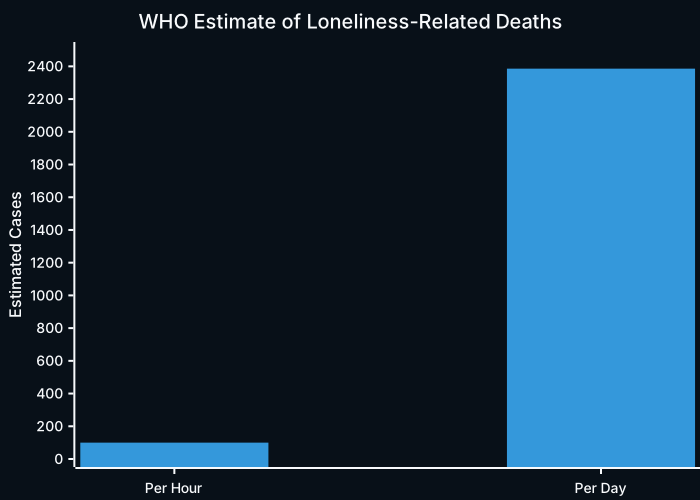
This is a conversion from the WHO’s annual estimate, not a direct hourly count.
It clarifies a point:
connection is not a luxury.
Happiness does not mean “feel good all the time”
A life with meaning will still contain:
- grief,
- stress,
- failure,
- responsibility,
- uncertainty.
If the definition is:
Happy = no negative emotion.
then almost no one will succeed.
A more useful model:
GOOD LIFE
=
Positive emotion
+
Meaning
+
Connection
+
Agency
+
Capacity to handle difficulty
This makes resilience a part of happiness.
Not its opposite.
Meaning can be found in very ordinary things
Meaning doesn’t necessarily mean:
Changing the world.
It can be:
- raising children well,
- helping your team,
- caring for parents,
- building a useful product,
- learning a trade,
- becoming a trustworthy friend.
A useful question:
If this task were still difficult, would I still think it’s worth doing?
If the answer is yes, you might be touching on meaning.
A simple “happiness audit”
Instead of rating:
How happy am I /10?
look at multiple dimensions.
| Dimension | Question |
|---|---|
| Calm | Can I recover after stress? |
| Connection | Do I have someone I can truly talk to? |
| Meaning | Do I have work that feels worthwhile? |
| Joy | Do I have moments I genuinely enjoy? |
| Agency | Do I feel like I can impact my life? |
| Recovery | Do I have time to truly rest? |
Not every column needs to be 10/10.
The goal is to see which dimension is being neglected.
Common mistakes when seeking a calm and happy mind
1. Forcing positivity
Bad feeling
↓
"I shouldn't feel this."
You’ve just added a new problem.
2. Waiting for perfect circumstances
I’ll be calm when work gets better.
Perhaps work will never be perfectly stable.
3. Using social media as connection
Digital interaction can support relationships.
But the quantity of interactions doesn’t always equal the quality of connection.
4. Only optimizing oneself
Happiness isn’t just self-improvement.
Caring, sharing, and connection also play a significant role. The World Happiness Report 2025 dedicates its entire focus that year to these topics.
5. Turning every activity into productivity
Walk:
Must listen to a podcast.
Meal:
Must read emails.
Rest:
Must optimize recovery.
A calm mind sometimes needs:
no optimization.
6. Confusing self-help with mental-health treatment
A book, audiobook summary, or Guided Learning plan can provide:
- ideas,
- reflection,
- practical habits.
It does not replace assessment or treatment when someone is experiencing depression, severe anxiety, suicidal thoughts, trauma symptoms, or other serious mental health issues.
Who is Calm and Happy Mind suitable for?
Traudio’s 7-day plan might be suitable if you:
- feel overstimulated,
- often overthink,
- want to build resilience,
- want to find balance between achievement and happiness,
- feel a lack of meaning,
- want to improve connection,
- prefer learning through audio or book summaries,
- have read self-help but find it hard to turn ideas into routine.
Traudio describes the plan with a clear statement:
A practical week of ideas for resilience, meaning, and happiness.
Not:
Seven days to permanent happiness.
That’s a good distinction.
What types of books are suitable for the Calm and Happy Mind topic?
A good learning path can combine multiple perspectives instead of seeking one “ultimate happiness book.”
For example:
Happiness from within
The Happy Mind by Kevin Horsley and Louis Fourie focuses on attention, perspective, gratitude, and reducing reliance on external conditions. (traudio.net)
Mind training
Happiness by Matthieu Ricard views happiness as a state that can be cultivated through awareness and how one relates to thoughts and emotions. (traudio.net)
Success and well-being
The Happiness Track by Emma Seppälä positions calm, presence, compassion, and happiness as factors that can support success rather than merely following it. (traudio.net)
Mindfulness and simplicity
A Cup of Zen focuses on attention, acceptance, humility, and letting go as paths to greater calm. (traudio.net)
Connection and compassion
Into the Magic Shop by James R. Doty connects relaxation, attention, compassion, and meaningful success. (traudio.net)
The combination of multiple perspectives is precisely the strength of a Guided Learning plan rather than relying on a single book.
Do you need Traudio to build calm and happiness?
No.
You can absolutely use:
- Books
- Therapy
- Meditation
- Journaling
- Exercise
- Time with friends
- Nature
- Community
- Professional mental-health support when needed
The value of a guided plan lies in its structure.
Instead of:
Search happiness
↓
10 books
↓
20 videos
↓
30 saved posts
↓
Overwhelm
you have:
ONE GOAL
↓
CURATED IDEAS
↓
ONE WEEK
↓
REFLECTION
↓
SMALL ACTIONS
Traudio currently places Calm and Happy Mind within its group of 7-day Guided Learning journeys, alongside plans on money, investing, focus, habits, communication, leadership, startup, and health.
What happens after 7 days?
Should not transition to:
Plan completed
↓
Problem solved
A more realistic progression:
WEEK 1
Notice patterns

↓

WEEK 2–4
Repeat useful practices

↓

MONTH 2+
Adjust environment

↓

LONG TERM
Build relationships, meaning, recovery
Well-being is often maintenance.
Not a one-time achievement.
A Simple Weekly Reset
Every weekend, ask five questions:
Calm
What made me lose my calm the most?
Connection
Did I have a meaningful conversation?
Meaning
What felt worthwhile this week?
Joy
What moments did I truly enjoy?
Next week
What small thing do I want to protect?
5 questions.
10 minutes.
No need for a complex life dashboard.
Chart: A Small Practice Still Accumulates Significantly
Suppose you spend 10 minutes each day on reflection, connection, or a calm practice.
After:
- 7 days: 70 minutes
- 30 days: 300 minutes
- 365 days: 3,650 minutes
Equivalent to over 60 hours per year.
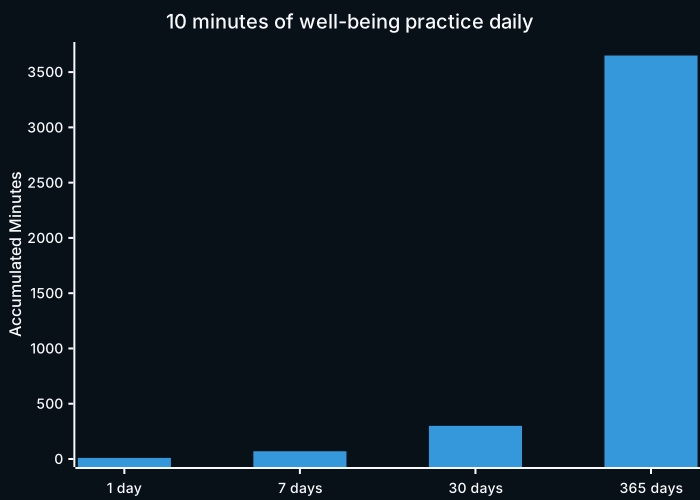
This is just a calculation.
It doesn’t say 60 hours will create a specific level of happiness.
It illustrates a principle:
small practices can become a significant part of life if truly repeated.
Conclusion: A Calm and Happy Mind Is Not Living Without Difficulties
If you’re looking for Calm and Happy Mind books, perhaps the best goal isn’t to find a book promising “happiness forever.”
Data shows challenges are real.
APA in 2025 recorded an average stress level of about 5/10, 54% of US adults say they feel isolated at least sometimes, and half report a lack of companionship.
WHO states that about 1 in 6 people worldwide experience loneliness, with social disconnection having significant impacts on both physical and mental health.
Meanwhile, the World Happiness Report 2025 emphasizes a rather simple point: caring, sharing, trust, and connection are strongly linked to happiness.
Therefore, a healthier mind can be built around:
CALM
↓
CONNECTION
↓
MEANING
↓
RESILIENCE
↓
REPEAT
A book can give you perspective.
A meaningful conversation can create connection.
A difficult week can build resilience.
A few minutes of reflection can help attention return to what truly matters.
And if you want to start with a short, structured learning journey, Calm and Happy Mind — Traudio’s 7-day plan is built around the goal:
A practical week of ideas for resilience, meaning, and happiness.
Seven days cannot guarantee a happy life.
But they can be enough to help you transition from:
"I just want to feel better."
to:
"I know which parts of my life
need more calm,
more connection,
and more meaning."
That’s a very reasonable place to start.
Related Articles
Master Your Financial Mindset Today
Download the Traudio app for iOS & Android to listen to synchronized audiobook summaries and chat with StickWise AI.
Download Traudio App Free