Invest with Confidence Book: Understanding the Market, Risk, and How to Build Long-Term Wealth
Searching for “Invest with Confidence book” often leads to a broader need than just finding a specific title.
Most people searching this phrase are actually looking to answer questions like:
- How does the stock market really work?
- How should I understand risk?
- How can I invest for the long term without panicking every time the market drops?
- Do I need to accurately predict the market to invest successfully?
- Should I start with stocks, ETFs, funds, or another asset class?
It’s worth noting that “invest with confidence” does not mean investing without fear of losing money.
It means understanding clearly enough:
What I'm buying
↓
Why I'm buying it
↓
Where the risks lie
↓
How long I'm investing for
↓
What would make me change my plan
Good investment confidence doesn’t come from believing the market will definitely go up.
It comes from understanding that the market can go down, but you have built a plan to live with that uncertainty.
Is “Invest with Confidence” the name of a specific book?
Not exactly.
Many books currently use the phrase invest with confidence in their title or subtitle, but no single book dominates this search intent.
A recent example is The Uncertainty Solution: How to Invest with Confidence in the Face of the Unknown by John M. Jennings. This book focuses on mindset and behavior when investing in an unpredictable world. Jennings emphasizes understanding uncertainty, avoiding getting caught up in market narratives, and developing better ways of thinking when investing. (greenleafbookgroup.com)
Another direction is books for beginners, such as Stock Market Investing for Beginners, which focuses on reducing risk, building strategies, and investing for the long term with greater confidence. (books.google.com)
Therefore, if you’re looking for an Invest with Confidence book, it might be more helpful to view it as a topic:
How can I understand enough about the market and risk to make investment decisions without relying on emotion?
The Biggest Problem for Beginners Isn’t a Lack of Investment Products
Today, you can open a brokerage account in minutes.
You can buy:
- Stocks
- ETFs
- Bonds
- Mutual funds
- Treasury securities
- Money market funds
- Index funds
The harder question is:
Do I understand what I’m doing?
An August 2026 article by J.P. Morgan Wealth Management cited Federal Reserve data stating that 53 percent of adults surveyed said they were uncomfortable or only somewhat comfortable choosing and managing investments. (chase.com)
Chart: Level of Discomfort When Self-Managing Investments
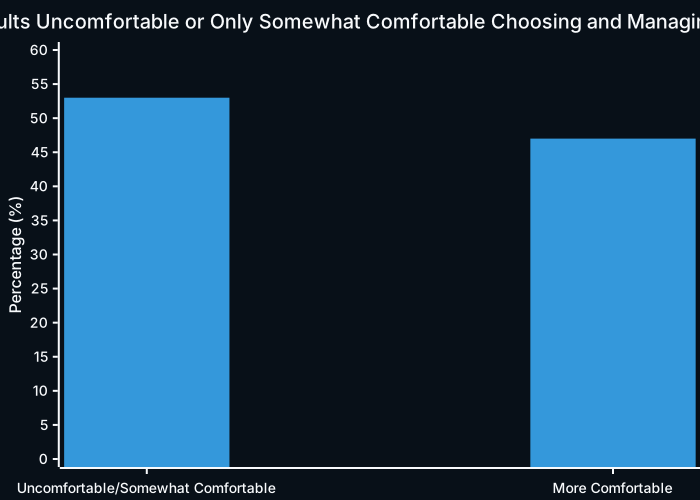
Source: Federal Reserve data cited by J.P. Morgan Wealth Management in 2026. (chase.com)
This figure highlights something important:
Investing access has become easier. Investing confidence has not.
Confidence Is Not the Ability to Predict the Market
A confident investor doesn’t necessarily think:
I know the market will go up next month.
In fact, that could be a sign of overconfidence.
Confidence is:
I don't know what the market will do next week
↓
But I understand my asset allocation
↓
I understand my time horizon
↓
I understand the level of loss I can tolerate
↓
I have a plan
J.P. Morgan also emphasizes that no one can predict the stock market with certainty; confidence should come from understanding fundamentals, risk tolerance, time horizon, and an investment plan. (chase.com)
Step 1: Understand Risk Before Thinking About Return
Many people start investing with the question:
How much can I earn?
The question that should come before that is:
How much can I lose and still stick to my plan?
The SEC notes that every investment carries a degree of risk and investors can lose a portion or all of the money invested in a particular security. (sec.gov)
Risk isn’t just:
Portfolio drops today
It can be:
- Market risk
- Inflation risk
- Concentration risk
- Interest-rate risk
- Liquidity risk
- Credit risk
- Behavioral risk
In reality, one of the biggest risks is sometimes:
The investor selling at the exact moment the market is falling because they can’t tolerate the volatility.
Risk and Return Often Go Hand in Hand
The SEC describes risk and reward as two closely linked factors: assets with higher return potential often come with a higher degree of risk. (sec.gov)
A simplification:
Potential return ↑
       │
       │
       │
       │
       └────────────→ Risk ↑
This does not mean:
High risk definitely means high return.
It only means:
If you want to expect higher returns, you often have to accept greater uncertainty.
Step 2: Look at Long-Term History, Not Just One Year
The S&P 500 is one of the most common benchmarks for large-cap equities in the United States. According to S&P Dow Jones Indices, this index covers approximately 80 percent of the available market capitalization of the U.S. equity market. (spglobal.com)
As of August 31, 2026, the S&P 500 Price Return was:
- 1 year: 18.98 percent
- 3 year annualized: 19.47 percent
- 5 year annualized: 11.19 percent
- 10 year annualized: 13.48 percent
Chart: S&P 500 Annualized Price Return Over Time
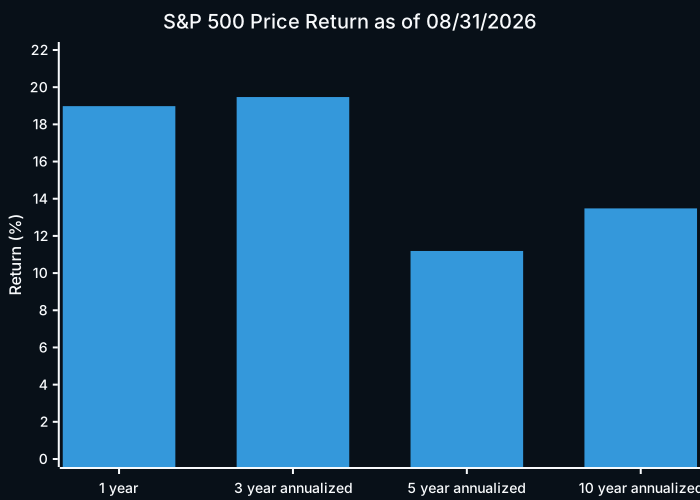
Source: S&P Dow Jones Indices. This is price return, not including dividends. (spglobal.com)
This chart does not mean 13.48 percent is the return you can definitely expect in the future.
It only shows:
Returns vary greatly depending on the measurement period.
Don’t Turn Historical Returns Into a Promise
The SEC has noted that the stock market has historically generated returns of approximately 10 percent per year before inflation over the long term, equivalent to about 6 to 7 percent real return after inflation in some historical calculations. But the SEC also emphasizes that “long term” can be very long and there is no guarantee that history will repeat itself. (sec.gov)
This is a very important distinction:
Historical average
≠
Guaranteed future return
A confident investor should not say:
The stock market gives 10 percent per year.
But should understand:
Over the long term, equities have provided high returns, but individual years can vary greatly and losses still occur.
Step 3: Understand Volatility Instead of Fearing It
S&P Dow Jones Indices also publishes the annualized risk of the S&P 500, calculated as the standard deviation of monthly values.
As of August 31, 2026:
- 3-year Risk: 12.90 percent
- 5-year Risk: 15.83 percent
- 10-year Risk: 15.35 percent
Chart: Return and Volatility Are Not the Same Thing
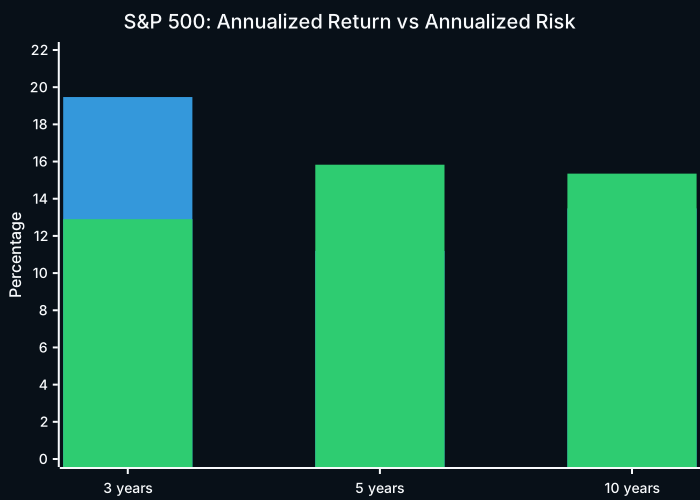
First column: annualized price return. Second column: annualized risk.
Source: S&P Dow Jones Indices, data as of 08/31/2026. (spglobal.com)
Volatility is one of the prices investors must pay for the potential to receive higher returns.
But volatility does not equate to permanent loss.
Step 4: Diversification Doesn’t Make Market Risk Disappear
The SEC describes diversification with the familiar principle:
Don’t put all your eggs in one basket.
When one investment performs poorly, other investments can help reduce the impact on the overall portfolio. (sec.gov)
But diversification does not mean:
Diversified portfolio
=
Never loses money
The SEC notes that diversification does not guarantee a portfolio will not decline when the entire market goes down. (sec.gov)
It primarily helps reduce:
unnecessary concentration risk.
How Simple Does Concentration Risk Look?
Suppose you have:
Portfolio A
100% Company X
If Company X encounters serious problems:
Portfolio
↓
Almost entirely affected
A more diversified portfolio:
Stocks
+
Bonds
+
Multiple sectors
+
Multiple companies
+
Potentially multiple regions
does not eliminate market risk, but it reduces your future dependence on a single decision.
Step 5: Asset allocation is more important than finding the “best stock”
A beginner often spends a lot of time asking:
Which stock will go up?
While a more important question might be:
How much should I allocate between risky assets and safer assets?
The SEC suggests that asset allocation should depend on at least:
- Time horizon
- Risk tolerance
- Financial goals
(sec.gov)
For example, money needed in one year and money for retirement after 30 years should not be handled the same way.
Time horizon changes the meaning of risk
If you need money in:
6 months
a 30 percent market decline could be catastrophic.
If you don’t need money for:
30 years
a short-term decline might just be part of a longer journey.
This is why the question:
Is this investment risky?
is not enough.
A better question is:
Is this investment risky for my goal and time horizon?
Step 6: Long-term wealth often comes from consistency more than excitement
Investing that looks appealing on social media often appears as:
Find next winner
↓
Buy
↓
Double money
↓
Repeat
But long-term wealth is often more boring:
Earn
↓
Save
↓
Invest regularly
↓
Diversify
↓
Keep costs reasonable
↓
Stay invested
↓
Repeat for years
The SEC also recommends investors consider investing regularly over a long period to avoid the risk of putting all their money in at a single point in time. (sec.gov)
Compounding needs time more than excitement
A simple illustration:
Assume 10,000 dollars grows at an assumed 7 percent per year, with no additional contributions.
This is a mathematical example only, not a forecast return.
| Year | Illustrative Value |
|---|---|
| 0 | $10,000 |
| 5 | $14,026 |
| 10 | $19,672 |
| 20 | $38,697 |
| 30 | $76,123 |
Chart: The power of compounding at an assumed 7 percent
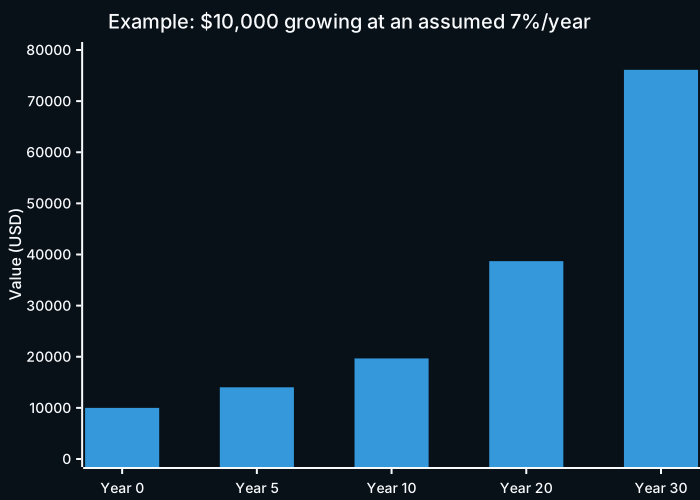
This is an illustrative model with a fixed 7 percent return, not an investment return forecast.
The main point is the shape:
Early period
Slow growth

↓

Longer period
Compounding starts to accelerate
Confidence often fails in the behavior part
You might understand diversification.
You might understand compounding.
You might understand ETFs.
But when the portfolio drops 20 percent, the question becomes:
Will you still follow the plan?
This is where investing shifts from mathematics to psychology.
An investor might:
Buy high
↓
Market falls
↓
Panic
↓
Sell low
↓
Wait
↓
Market recovers
↓
Buy again
Knowledge doesn’t automatically prevent this behavior.
You need a framework defined before volatility appears.
Write a personal investment policy
You don’t need a 40-page document.
A simple investment policy can answer:
Goal
What am I investing for?
Horizon
When do I need the money?
Allocation
Which asset classes are expected to be in the portfolio?
Contributions
How much do I invest each month?
Rebalancing
When do I bring the allocation back to target?
Selling
Under what conditions would I actually sell?
Behavior
What will I do if the market drops 20 percent?
This is a simple but very powerful exercise.
You take decisions out of the moment of panic.
From the “Invest with Confidence book” to a structured learning plan
An investment book might explain:
- Markets
- Risk
- Diversification
- Compounding
- Asset allocation
- Behavioral finance
But like personal finance, investing has a problem:
Read
↓
Understand
↓
Close book
↓
Do nothing
This is where a learning plan can be more useful than a random reading list.
Traudio now offers a Guided Learning journey:
Invest with Confidence — 7-day plan
Understand the ideas behind markets, risk, and long-term wealth.
This plan is part of Traudio’s Guided Learning, where book summaries are curated around a goal instead of requiring users to select each book from a catalog. (traudio.net)
Traudio doesn’t promise to turn you into an investor in seven days
It’s important to understand the correct positioning.
Seven days are not enough to:
- Become a professional investor
- Master valuation
- Predict the market
- Understand every asset class
- Build a perfect portfolio
But seven days can be enough to:
Day 1
Understand markets

↓

Day 2
Understand risk

↓

Day 3
Understand diversification

↓

Day 4
Understand time horizon

↓

Day 5
Understand long-term compounding

↓

Day 6
Understand investor behavior

↓

Day 7
Connect ideas into a framework
This is an illustrative learning framework, not an official syllabus published by Traudio.
The meaning of the plan lies in reducing scope:
Not learning all of investing.
But:
Understanding foundational ideas enough to continue learning better.
Why can seven focused days be useful?
If each day you spend an assumed 15 minutes:
15 minutes
×
7 days
=
105 minutes
Chart: How a 7-day learning sprint accumulates
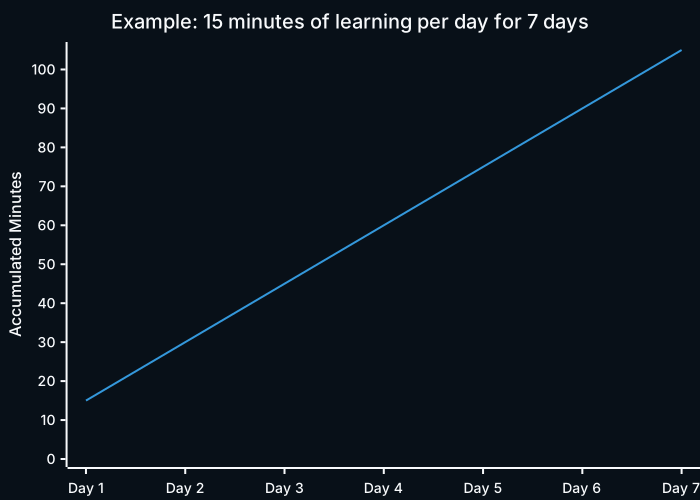
This is an illustration with an assumed 15 minutes/day, not the mandatory duration of the plan.
105 minutes won’t make you an expert.
But it’s small enough to:
actually start.
How to use the Invest with Confidence plan more effectively
Don’t just listen to content.
After each learning session, create an output.
For example:
| Topic | Practical Action |
|---|---|
| Markets | Rewrite stock, bond, and ETF in your own words |
| Risk | Note the short-term loss you can tolerate |
| Diversification | Check if your portfolio has concentration risk |
| Time horizon | Assign a timeframe to each financial goal |
| Compounding | Calculate a long-term investment scenario |
| Behavior | Write what you will do when the market drops sharply |
| Long-term plan | Write a one-page investment policy |
This is not Traudio’s official curriculum.
This is how to turn:
Learning
into:
Decision framework
One insight, one question, one action
You can apply this rule every day.
Insight
What did I just learn?
Question
How does this change how I understand investing?
Action
What do I need to check or change?
Example:
Insight
Diversification reduces concentration risk.
Question
Is my portfolio too dependent on one company or sector?
Action
Open your portfolio and calculate percentage allocation.
This is Active Learning.
Not just consumption.
Invest with Confidence does not mean “buy more risk”
A common misunderstanding:
I’m more confident → I should buy more aggressive assets.
Not true.
True confidence can actually make you realize:
Short-term goal
↓
Should not take on too much market risk
or:
Low risk tolerance
↓
Portfolio needs a more suitable allocation
Investing confidence is alignment, not bravado.
Don’t confuse diversification with owning everything
You also don’t need to own 100 types of investments just to say you’re diversified.
Diversification should have a purpose.
For example:
Company risk
↓
Many companies

Sector risk
↓
Many sectors

Asset-class risk
↓
Can combine stocks, bonds, or cash depending on goal

Geographic risk
↓
Can consider multiple markets
Complexity does not automatically create safety.
A complex portfolio that you don’t understand can create another type of risk.
Small fees can also become large in the long run
Another notable point in SEC guidance is that fees and expenses can make a significant difference over time. (sec.gov)
Assume two portfolios both have a gross return of 7 percent per year for 30 years.
This is an illustrative model only:
Portfolio A
Net return: 6.8 percent
Portfolio B
Net return: 6.0 percent
With an initial 10,000 dollars:
| Net Return | Value after 30 years |
|---|---|
| 6.8% | Approximately $71,900 |
| 6.0% | Approximately $57,400 |
The difference:
more than 14,000 dollars
just on the initial 10,000 dollars.
No additional contributions.
That’s why cost matters.
Mistakes that easily break investing confidence
1. Checking your portfolio too often
If your horizon is 20 years but you check your portfolio:
20 times/day
you are putting yourself into too short a feedback loop.
2. Changing strategy based on headlines
News
↓
Fear
↓
Sell

News
↓
Excitement
↓
Buy
Strategy becomes reaction.
3. Confusing recent performance with future performance
An asset that has risen sharply recently does not mean it will continue to outperform.
4. Not knowing what risk you are taking
“Diversified” is just a word if you don’t understand your portfolio allocation.
5. Learning stock picking before investing fundamentals
You might know how to read a P/E ratio but still not know:
- Time horizon
- Risk tolerance
- Asset allocation
- Diversification
This is like learning race car driving techniques before understanding traffic laws.
A checklist to know if you are ready to invest with more confidence
- I know my investment goals
- I know my time horizon
- I understand that returns are not guaranteed
- I know my portfolio can drop significantly
- I understand what diversification does and does not do
- I know my current asset allocation
- I know what fees I am paying
- I have a contribution plan
- I know when I will rebalance
- I have rules to avoid panic selling
- I have emergency savings separate from investments
- I do not invest money needed in the short term into an inappropriate level of risk
If many boxes are empty, that’s not a signal to “invest faster.”
That’s a signal to:
learn more before increasing risk.
Who is Traudio’s Invest with Confidence plan for?
The plan might be suitable if you:
- Are new to investing
- Have invested but still feel confused when the market drops
- Know many terms but lack a framework
- Want to understand long-term investing before stock picking
- Don’t have time to read many finance books
- Like audio microlearning
- Want a learning path instead of choosing books yourself
Traudio describes the plan with a sentence that accurately reflects this goal:
Understand the ideas behind markets, risk, and long-term wealth. (traudio.net)
Discover Invest with Confidence on Traudio
Do you need Traudio to learn investing?
No.
You can build a different learning stack:
SEC Investor Education
+
Books
+
Research
+
Spreadsheet
+
Practice
Traudio’s Guided Learning offers value by reducing decision fatigue.
Instead of:
Which 20 investing books should I read?
it starts with:
I want to understand investing better in a week.
Then the content is organized around that goal. Traudio also currently offers other seven-day journeys such as Master Your Money, Deep Focus in a Distracted World, and Habits That Stick. (traudio.net)
What to do after 7 days?
Don’t go straight from:
Learning plan completed
to:
Buy random stocks
A better progression:
Understand fundamentals
↓
Define goals
↓
Define horizon
↓
Assess risk tolerance
↓
Learn asset allocation
↓
Understand costs
↓
Build simple plan
↓
Start gradually
↓
Review periodically
Confidence comes from the process.
Not adrenaline.
A simple framework for continued learning
After the plan, you can divide investing into five layers.
Layer 1 — Why
Why do I invest?
Layer 2 — Time
When do I need the money?
Layer 3 — Risk
How much volatility and loss can I tolerate?
Layer 4 — Portfolio
How will I allocate assets?
Layer 5 — Behavior
How will I stick to the plan when the market is unpleasant?
If an investment idea doesn’t fit these five layers, be careful.
Conclusion: Invest with Confidence is not about learning certainty
If you’re looking for an Invest with Confidence book, the most important thing might not be to find a single book with that exact title.
It’s about building a robust investment mindset that doesn’t rely on weekly market predictions.
S&P 500 data shows that equities can generate strong long-term returns, but volatility is still very real: as of the end of August 2026, the S&P 500 had a 10-year annualized price return of 13.48 percent, while the 10-year annualized risk was 15.35 percent. (spglobal.com)
That is the essence of investing:
Return
+
Risk
+
Time
+
Behavior
You cannot take just one factor.
A book can help you understand the framework.
The SEC and official educational resources can help you understand risk, diversification, and asset allocation.
And if you want a short, structured starting point, Invest with Confidence — Traudio’s 7-day plan focuses precisely on three fundamental ideas:
markets, risk, and long-term wealth. (traudio.net)
Seven days won’t make investing certain.
But it can help you shift from:
What should I buy?
to a better question:
What am I investing for,
what risk am I taking,
and do I have enough time for the plan to work?
That is a much better starting point for investing with confidence.
Related Articles
Master Your Financial Mindset Today
Download the Traudio app for iOS & Android to listen to synchronized audiobook summaries and chat with StickWise AI.
Download Traudio App Free