Raise Happy Kids Books: How to raise connected, confident, and happier children

Searching for Raise Happy Kids books often means more than just wanting a list of parenting books.
Behind this keyword are usually bigger questions:
- How can children feel safe and connected?
- How can we set boundaries without turning everything into a battle?
- How can we help children be confident without relying on praise?
- How can we talk so children truly want to share?
- How can we manage screen time without just resorting to bans?
- And how can parents avoid burnout in the process?
This is also why “raise happy kids” can be easily misunderstood.
The goal should not be:
Always happy child
+
Never disappointed
+
Never fails
A more realistic goal is:
CONNECTION
+
SAFETY
+
BOUNDARIES
+
AUTONOMY
+
EMOTIONAL SKILLS
+
CONFIDENCE
=
A STRONGER FOUNDATION
A child’s happiness is not a fixed emotional state.
It’s closer to the ability to feel loved, understood, capable, and to have a safe place to return to when things don’t go as planned.
Raising Happy Kids doesn’t mean eliminating all negative emotions
An emotionally healthy child will still:
- get angry,
- feel frustrated,
- be sad,
- feel jealous,
- be anxious,
- fail.
If the parenting goal is:
How can my child never be uncomfortable?
parents can easily fall into:
Child discomfort
↓
Parent fixes immediately
↓
Child gets short-term relief
↓
Fewer chances to practice coping
Another perspective:
DIFFICULT FEELING
↓
CONNECTION
↓
NAME IT
↓
REGULATE
↓
PROBLEM-SOLVE
↓
RECOVER
Happy kids are not necessarily the children who encounter the fewest difficulties.
They need to gradually learn how to navigate difficulties without feeling like they have to face them alone.
Parenting is also happening in a very high-pressure environment
Before talking about children, we need to talk about parents.
The U.S. Surgeon General reported in 2023 data:
- 33% of parents reported high levels of stress in the past month, compared to 20% of other adults.
- 48% of parents said that on most days, their stress was completely overwhelming, compared to 26% of other adults.
- 41% of parents said that on many days they were so stressed they couldn’t function normally.
Chart: Parental stress is higher than other adults
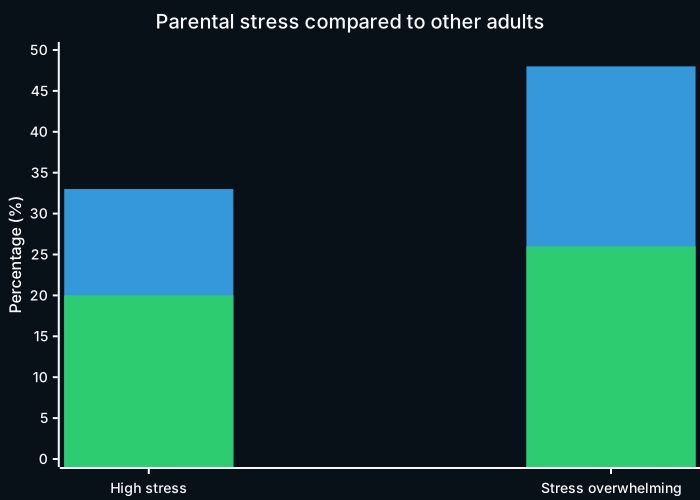
First bar: Parents Second bar: Other adults
Source: U.S. Surgeon General, Parents Under Pressure.
This is important because a parenting plan cannot assume that parents are always:
- calm,
- well-rested,
- have time,
- have support.
Good parenting must be realistic enough to work even when adults are also tired.
Step 1: Connection before correction
When children misbehave, the natural reaction is:
Correct the behavior immediately.
But effective correction is often more likely to happen after connection.
For example:
Child melts down
↓
"Stop crying."
↓
More escalation
compared to:
Child melts down
↓
"I can see you're really upset."
↓
Calm first
↓
Then boundary
Validation does not mean agreement.
You can say:
You’re allowed to be angry. You’re not allowed to hit your sibling.
Both statements can be true.
Family connectedness truly plays a protective role
The CDC considers connectedness with family or trusted adults a protective factor for youth development. The CDC also lists the ability to talk about problems with parents, regular shared activities, and the stable presence of parents at times of day like dinner or bedtime as protective factors.
A study hosted by the CDC also showed that adolescents who felt more connected to their parents reported:
- fewer depressive symptoms,
- less suicidal ideation,
- less non-suicidal self-injury,
- fewer conduct problems,
- higher self-esteem.
This does not mean connection can eliminate all risks.
But it shows:
The relationship itself is part of the intervention.
Step 2: Monitoring is different from controlling
The CDC defines parental monitoring in the Youth Risk Behavior Survey with questions like:
Do parents or other adults in the family know where the child is going and who they are with?
In the 2021 YRBS data, 86.4% of US high school students reported high levels of parental monitoring, and high monitoring was protectively associated with all risk behaviors and experiences analyzed in the study.
Chart: Parental monitoring among high school students
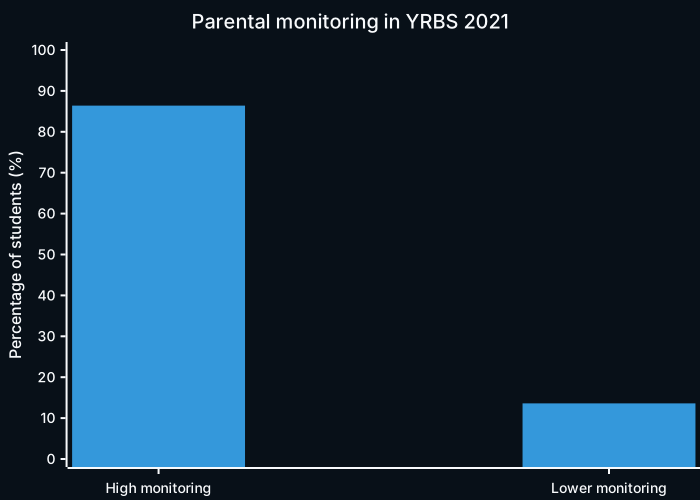
Source: CDC Youth Risk Behavior Survey 2021.
Good monitoring is not necessarily:
Check every message
↓
Track every minute
↓
Interrogate
It can be:
Know
+
Ask
+
Stay involved
+
Build enough trust that child shares
The best monitoring is often based on relationship
Two models can look similar from the outside.
Control-based
I have to know where my child is because they can’t be trusted.
Connection-based
I need to know where my child is because safety is a parent’s responsibility, and my child knows they can call me if needed.
The boundary is the same.
The tone and relationship are very different.
Step 3: Confidence is not built by continuous praise
A common mistake:
"You are so smart."
"You are amazing."
"You are the best."
Sounds positive.
But if self-worth depends entirely on approval:
Praise
↓
Feel good
↓
Need more praise
confidence becomes fragile.
A better approach is to help children create evidence of competence.
For example:
Instead of:
You’re so smart.
try:
You tried three different ways before you solved that problem.
Instead of:
You’re the best player.
try:
I saw you kept practicing even when you couldn’t do it at first.
You shift attention from:
IDENTITY LABEL
to:
PROCESS
+
EFFORT
+
STRATEGY
+
RECOVERY
Confidence comes from doing, not just hearing
A child confidence loop can be:
TRY
↓
STRUGGLE
↓
ADJUST
↓
DO SOMETHING HARD
↓
"I CAN HANDLE THINGS"
If parents always remove struggle:
Problem
↓
Parent solves
↓
Child never practices
the intention is loving.
But the opportunity to build competence is reduced.
Step 4: Don’t rescue your child from every frustration
For example:
The child can’t put a puzzle together.
Rescue response
Here, let me do it for you.
Coaching response
Where are you getting stuck?
Or:
Do you want to try a little longer or would you like a hint?
You still support.
But the child still retains ownership.
A useful rule:
HELP ENOUGH
TO KEEP MOVING

NOT SO MUCH
THAT YOU TAKE OVER
Step 5: Emotional vocabulary is a parenting tool
Children often act before they know how to express emotions.
A child might say:
I hate school.
but behind it could be:
- embarrassment,
- loneliness,
- anxiety,
- frustration.
If the parent immediately says:
There’s nothing to hate.
the conversation closes.
Another response:
What happened today that made you feel that way?
Then:
Do you feel more angry, sad, or embarrassed?
You are helping the child transition:
BODY FEELING
↓
EMOTION
↓
WORDS
↓
CHOICE
Words create distance between feeling and action.
Step 6: Boundaries create safety, not opposition to gentle parenting
Connected parenting does not mean children decide everything.
Children still need:
- bedtime,
- safety rules,
- school responsibilities,
- limits,
- consequences.
A good boundary is:
Clear
No tablets during dinner.
Predictable
The rule doesn’t change with the parent’s mood.
Calm
No need to shout for a boundary to be real.
Age-appropriate
Expectations must match development.
WARMTH
+
BOUNDARY
are not two opposing choices.
Parental monitoring is linked to many mental-health outcomes in adolescents
2023 YRBS data shows that high parental monitoring is associated with a lower prevalence of almost all mental-health and suicide-risk indicators studied, with adjusted prevalence ratios ranging from approximately 0.51 to 0.74, except for poor mental health in general.
This can be visualized as follows:
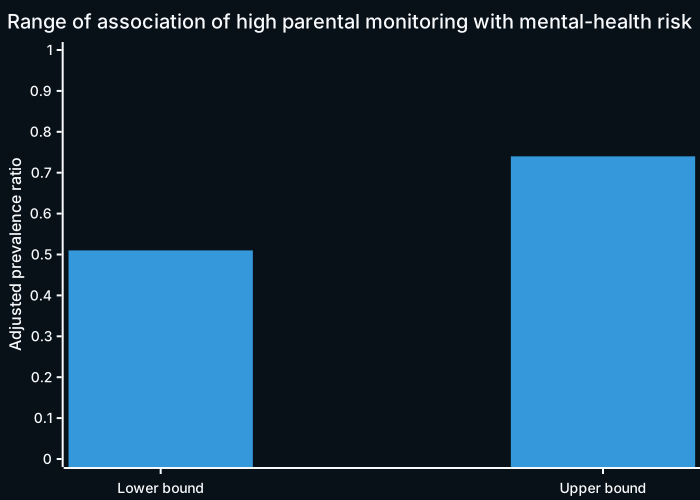
Values below 1 indicate a lower prevalence in the high parental monitoring group. This is an association from an observational survey, not proving a causal effect.
Step 7: Screen time needs a family system, not just child rules
Digital parenting is currently one of the most challenging parts.
The American Academy of Pediatrics currently does not recommend a single screen-time number applicable to all older children, as the impact depends on:
- content,
- context,
- age,
- type of interaction,
- activities replaced by media.
The AAP advises focusing on quality and balance, and using a Family Media Plan tailored to each family.
This is different from:
Screen = bad.
Screens are deeply present in children’s lives
The AAP reports that approximately 45% of adolescents say they are online almost constantly.
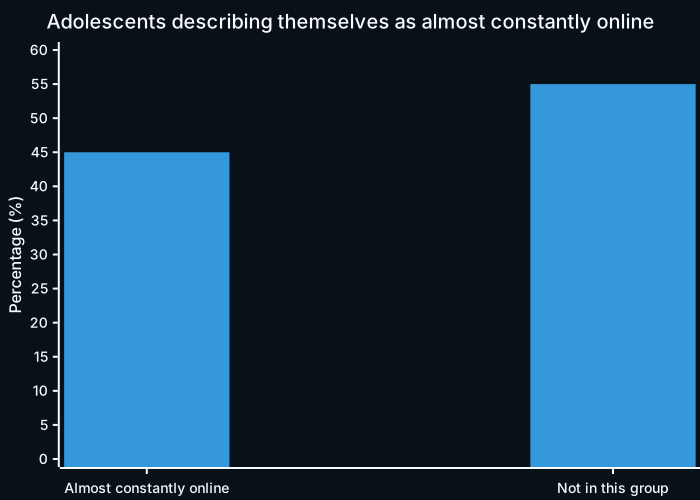
This makes a parenting strategy based solely on:
Confiscate the phone.
difficult to be a complete solution.
Children need to learn:
- self-regulation,
- digital judgment,
- boundaries,
- online safety,
- attention management.
Parent behavior is also part of the screen-time problem
The AAP emphasizes that parents are also heavy digital users; over 75% of parents use social media according to evidence compiled by the Family Media Plan. Studies on “technoference” show that parent device use can compete with verbal and emotional engagement with children.
Therefore:
Parent:
"Stop looking at your phone."

while parent is checking phone
is not the strongest message.
Family media rules work better when:
SOME RULES APPLY TO EVERYONE
What does a good family media rule look like?
Instead of:
You can’t use your phone much.
try:
DINNER
=
Phone-free for everyone
or:
BEDROOM
=
No device at bedtime
The AAP currently recommends creating screen-free periods for the whole family, prioritizing sleep, movement, reading, homework, and family time, and suggests phone-free zones at meals, in bedrooms, and about an hour before bedtime.
Rules are easier to maintain when they are:
- specific,
- shared,
- predictable.
Step 8: Happy kids still need chores and responsibility
A child-centered home doesn’t necessarily mean:
Adults do everything to keep children happy.
Responsibility helps children experience:
I CONTRIBUTED
↓
I MATTER
↓
I AM CAPABLE
Age-appropriate contributions can include:
- putting away toys,
- clearing the table,
- packing their bag,
- caring for pets,
- doing their share of household chores.
The goal is not free labor.
The goal is:
belonging through contribution.
Step 9: Connected parenting doesn’t always mean agreeing
You can say:
I understand you really want to go.
and still say:
But today the answer is no.
Connection:
"I understand."
Boundary:
"The limit remains."
Children don’t need every decision to go their way to feel loved.
They need to know that disagreement doesn’t make the relationship disappear.
Step 10: Repair is more important than perfect parenting
Parents will:
- shout,
- react too quickly,
- misunderstand,
- be tired,
- say things they regret.
A parenting model that demands perfection will soon fail.
A more important skill:
repair.
For example:
I yelled earlier. I still need you to stop doing that, but I shouldn’t have spoken to you that way. I’m sorry.
Notice two parts:
APOLOGY
+
BOUNDARY STILL EXISTS
Repair does not diminish authority.
It models:
- accountability,
- humility,
- relationship recovery.
Step 11: Don’t try to raise a “always well-behaved” child
A child who never:
- protests,
- gets angry,
- asks questions,
- disagrees,
might seem very easy to raise.
But the long-term goal can be broader than obedience.
You want children to gradually develop the ability to:
- think,
- question,
- say no,
- recognize unsafe situations,
- communicate needs,
- make decisions.
Therefore:
SHORT-TERM COMPLIANCE
is not always equal to:
LONG-TERM CONFIDENCE
Parenting often has to balance these two things.
Step 12: Parent well-being is also parenting work
Returning to the Surgeon General’s data:
48% of parents say stress is completely overwhelming on most days.
If a parent is in a state of:
OVERLOADED
+
SLEEP-DEPRIVED
+
NO SUPPORT
then advice like:
Always be calm with your child.
is not realistic.
The parenting system also needs:
- sleep,
- partner coordination,
- childcare,
- community,
- time alone,
- boundaries with work.
Supporting parents is not selfish.
It can improve the conditions for better parenting to occur.
Chart: Parents are not only more stressed but also more easily overwhelmed
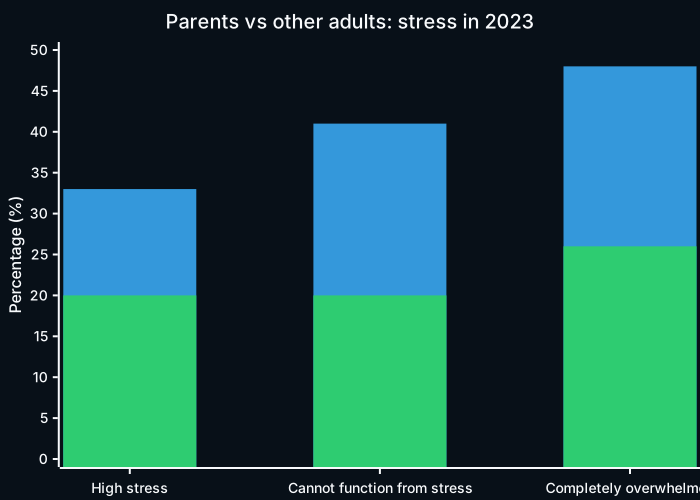
First bar: Parents Second bar: Other adults
Source: U.S. Surgeon General advisory.
This is a good reason to abandon the mindset:
If I’m a good parent, everything should be easy.
No.
Parenting can be very difficult even when you’re doing many things right.
From “Raise Happy Kids books” to a 7-day parenting reset
Parenting books can be very helpful.
But they have a failure mode:
Read
↓
Agree
↓
Highlight
↓
Child melts down
↓
Old reaction returns
The problem isn’t a lack of knowledge.
It’s knowledge that hasn’t become a response pattern.
Traudio currently has a Guided Learning journey:
Raise Happy Kids — 7-day plan
Seven perspectives for more connected, confident parenting.
The notable point is that this wording doesn’t promise:
Make your kids happy in seven days.
It talks about:
- perspectives,
- connection,
- confidence.
This is a much more reasonable framing.
What can 7 days accomplish in parenting?
Not enough to:
- change a child’s personality,
- solve every behavioral challenge,
- eliminate tantrums,
- cure anxiety,
- create a perfect family routine.
But seven days can be enough for a parent to realize:
What triggers me?
↓
How do I respond?
↓
Does child feel heard?
↓
Are boundaries clear?
↓
Am I helping too much?
↓
Where is connection missing?
A week can be an observation + adjustment sprint.
What a Raise Happy Kids week might look like
The framework below is a suggested practice, not Traudio’s official syllabus.
Day 1 — Connect before correct
Choose a moment that often creates conflict.
Try:
Name emotion
↓
Then boundary
Day 2 — Listen
Have a 10-minute conversation where you don’t:
- lecture,
- fix,
- check phone.
Just ask and listen.
Day 3 — Confidence
Replace an identity praise:
You’re so smart.
with process feedback:
You tried again even though it didn’t work the first time.
Day 4 — Responsibility
Assign an age-appropriate responsibility that a parent previously did for them.
Day 5 — Boundaries
Choose a rule that is currently vague.
Rewrite it to be clear and predictable.
Day 6 — Digital connection
Create a:
PHONE-FREE FAMILY MOMENT
for example, dinner.
The rule applies to adults too.
Day 7 — Repair and review
Ask:
- What created more connection?
- Which triggers made me lose my temper?
- Which boundaries need to be maintained?
- Which behavior do I want to continue?
Chart: How 10 minutes of daily connection accumulates
Suppose a parent dedicates 10 minutes of undivided attention to their child every day.
After:
- 7 days: 70 minutes
- 30 days: 300 minutes
- 365 days: 3,650 minutes
That’s approximately 60.8 hours per year.
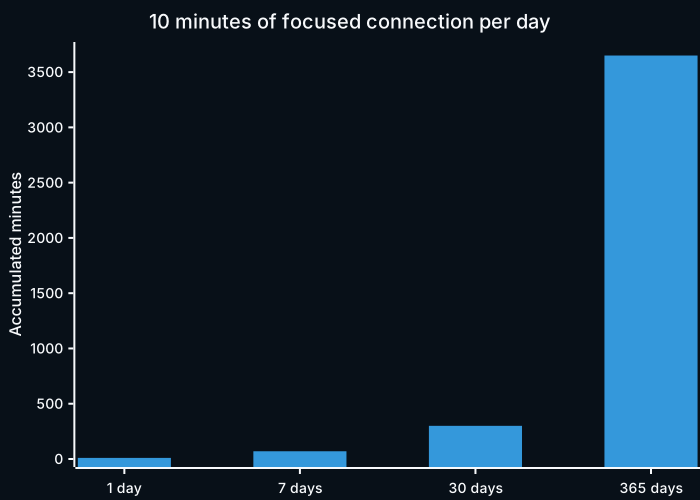
This is just an illustrative calculation, not a study stating 10 minutes is the optimal threshold.
The main point is:
small moments can compound into a lot of relationship time.
”Quality time” doesn’t necessarily require a special activity
Connection can happen when:
- coming home from school,
- washing dishes,
- eating dinner,
- walking,
- bedtime,
- driving.
The CDC lists frequent shared activities and parental presence at familiar times such as when children wake up, come home, eat dinner, or go to bed among relationship protective factors.
This is very helpful.
You don’t need every weekend:
Theme park
to create connection.
Many relationships are built by:
ORDINARY
+
REPEATED
+
PRESENT
A connected parenting checklist
You don’t need to tick everything every day.
Use it for review.
- Did I listen to my child without immediately fixing?
- Did I state a clear boundary?
- Did I help my child name their emotion?
- Did I praise the process instead of just the outcome?
- Did I let my child solve part of a problem themselves?
- Did the family have at least one screen-free moment?
- Did I model the behavior I want my child to learn?
- If I overreacted, did I repair?
- Do I know who my child is spending time with?
- Did I have a positive interaction not tied to performance?
You don’t need 10/10.
A good checklist shows:
Where should I pay attention?
Raise Happy Kids should not become child optimization
There’s a danger in modern parenting:
Best school
+
Best activities
+
Best food
+
Best emotional development
+
Best future
Childhood becomes project management.
But children also need:
- play,
- boredom,
- mistakes,
- downtime,
- ordinary family life.
Happiness is not a KPI.
A better question than “Are you happy?”
Instead of just asking:
Are you happy?
observe:
- Does my child feel safe?
- Do they dare to speak up when there’s a problem?
- Can they fail without completely falling apart?
- Do they have a few good relationships?
- Do they have age-appropriate autonomy?
- Do they have responsibilities?
- Can they play and rest?
- Do they feel loved regardless of achievement?
Happiness often appears as an outcome of the system, not a direct target.
Screen-time conversations should start with “what is it replacing?”
The AAP now emphasizes the quality of media and whether media replaces important activities, rather than a universal number for all older children.
A good question:
What is the screen replacing?
If it’s replacing:
Homework
Sleep
Movement
Family meal
Real-world friendship
that’s a clearer problem.
If the screen is used to:
- video call family,
- create,
- learn,
- collaborate,
the context is different.
Young children are a different case
The AAP still has more specific guidance for younger children.
In 2026, a Pediatrics article cited a meta-analysis of 95 samples with approximately 90,000 young children showing that only:
- 25% of children under 2 years old
- 34% of children aged 2 to 5 years old
met the screen-media recommendations used in that analysis.
Chart: Percentage of young children meeting screen-media recommendations
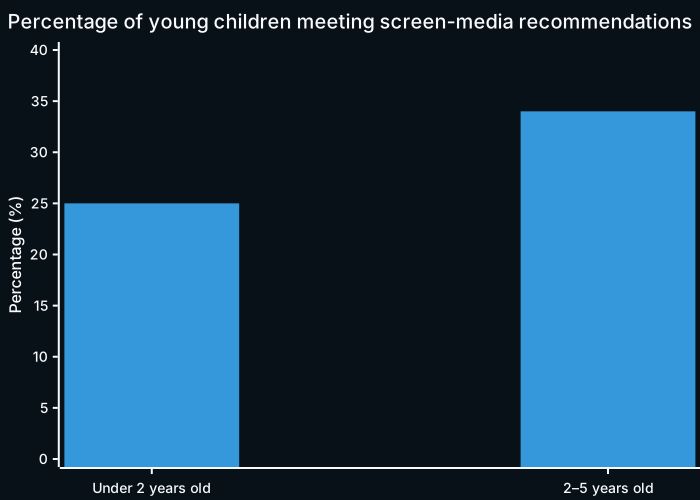
The notable point is that even simple guidelines are very difficult to implement in real family life.
That’s why parenting advice needs to have compassion for parent bandwidth.
Parent modeling is more powerful than parent lecturing
You want your child to:
read more.
But the child sees:
Parent on phone all evening
You want your child to:
calm down.
But conflict happens:
Parent screams:
"CALM DOWN!"
Children learn rules.
But they also learn patterns.
A very powerful principle:
MODEL
WHAT YOU REPEATEDLY ASK FOR
Not perfectly.
Just more consistently.
Common mistakes when trying to Raise Happy Kids
1. Fix every emotion
Sadness is not a malfunction.
2. Praise everything
Praise loses meaning and can create dependence on external validation.
3. Confuse boundaries with punishment
Good boundaries should be predictable.
4. Talk more than listen
Advice before understanding often doesn’t land.
5. Do too much for the child
Help can unintentionally take away competence.
6. Make every moment educational
Children also need free play.
7. Parent from guilt
Guilt often creates inconsistency:
Say no
↓
Feel guilty
↓
Reverse rule
↓
Child learns boundary is negotiable through escalation
8. Compare children
Sibling or peer comparison turns performance into a relationship metric.
Who is Traudio’s Raise Happy Kids for?
The 7-day plan might be a good fit if you:
- want more connection in your parenting,
- frequently find yourself in power struggles,
- want to help your child be more confident,
- want to set boundaries more calmly,
- are concerned about digital habits,
- want to learn parenting through book summaries instead of reading many individual books,
- feel you know a lot of parenting advice but find it hard to apply when stressed.
Traudio describes the journey as:
Seven perspectives for more connected, confident parenting.
The word “perspectives” is very important.
Parenting rarely needs another universal rule.
It often needs a better way of looking at a familiar situation.
Do you need Traudio to parent better?
No.
You can learn from:
- Pediatricians
- Child-development professionals
- Parenting books
- CDC
- AAP
- Family counselors
- Parenting programs
And when there’s a significant developmental, behavioral, or mental-health concern, a professional assessment is more important than a self-help plan.
The usefulness of Guided Learning is its structure:
ONE GOAL
↓
CURATED IDEAS
↓
SHORT DAILY LEARNING
↓
ONE EXPERIMENT
instead of:
Parenting book
↓
Podcast
↓
Instagram reel
↓
Another expert
↓
Conflicting advice
How to use Raise Happy Kids without turning parenting into homework
After each session, choose one experiment.
Not five.
For example:
| Perspective | One experiment |
|---|---|
| Connection | 10 minutes of undistracted attention |
| Emotion | Name feeling before correction |
| Confidence | Praise process once |
| Autonomy | Let child solve one problem |
| Boundary | Clarify one family rule |
| Digital life | Create one phone-free moment |
| Repair | Apologize after one overreaction |
A parenting idea is only truly useful when:
IDEA
↓
REAL INTERACTION
Chart: 7 Small Days Can Still Create 7 Parenting Experiments
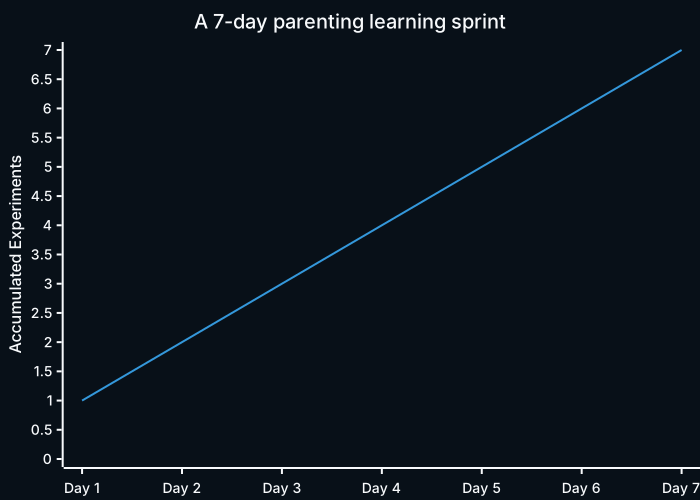
This is an illustrative framework.
The main point is not the number 7.
But rather the shift from:
READING ABOUT PARENTING
to:
OBSERVING YOUR OWN FAMILY
What happens after 7 days?
Don’t keep all seven experiments.
Choose two or three behaviors that bring more clarity to your family.
For example:
10 MIN CONNECTION
+
CALM BOUNDARY
+
PHONE-FREE DINNER
Then repeat.
A realistic progression:
WEEK 1
Notice

↓

WEEK 2–4
Repeat

↓

MONTH 2+
Adjust to child
A parenting system must evolve because the child is also developing.
A 10-Minute Weekly Parenting Review
Each weekend, ask:
Connection
When were we closest?
Conflict
Which patterns are repeating?
Confidence
Am I helping too much?
Boundary
Which rules are inconsistent?
Parent
Where am I feeling overwhelmed?
Next week
Which behavior is worth trying?
No need to score your child.
You are reviewing your family’s system.
Conclusion: Raise Happy Kids Starts with Connection, Not Perfection
If you’re looking for Raise Happy Kids books, it’s easy to fall into the feeling that good parenting requires more:
- technique,
- activity,
- enrichment,
- rule,
- monitoring.
But research often brings us back to simpler foundations.
The CDC identifies family connectedness, the ability to talk with parents, shared activities, and parental presence as important relationship protective factors.
In YRBS 2021, 86.4% of high-school students reported high parental monitoring, and this monitoring was associated with protection against many risk behaviors and experiences.
CDC 2023 continues to note that high parental monitoring is associated with lower prevalence of many mental-health and suicide-risk indicators.
Meanwhile, the parenting environment is becoming more challenging: 48% of parents in Surgeon General data reported stress being completely overwhelming on most days.
And digital life is changing childhood, with about 45% of adolescents describing themselves as online almost constantly. The AAP therefore emphasizes family media planning, quality, balance, and parent modeling instead of relying solely on a single screen-time number.
A good parenting foundation can be simpler:
CONNECT
↓
LISTEN
↓
SET BOUNDARIES
↓
LET THEM TRY
↓
REPAIR
↓
REPEAT
A parenting book can provide a framework.
A difficult moment provides practice.
An apology can model accountability.
A family dinner can create connection.
And if you want to start with a structured week of learning, Raise Happy Kids — Traudio’s 7-day plan is built around the goal:
Seven perspectives for more connected, confident parenting.
Seven days cannot create a “perfect parent”.
Nor can it guarantee a “happy child”.
But seven days can be enough for you to shift from:
"How do I make my child behave?"
to:
"What does my child need
to feel connected,
become capable,
and grow more confident?"
That’s a much better question to start with.
Related Articles
Master Your Financial Mindset Today
Download the Traudio app for iOS & Android to listen to synchronized audiobook summaries and chat with StickWise AI.
Download Traudio App Free