Master Your Money Book: From Reading About Finance to Truly Controlling Your Money

Search for Master Your Money book and you’ll quickly encounter a problem: this isn’t the title of just one book.
Many authors use Master Your Money or very similar variations for personal finance books.
For example, Ron Blue’s Master Your Money: A Step-by-Step Journey to Financial Strength focuses on money management, saving, investing, giving, taxes, long-term planning, and getting out of debt. A new edition is set to be released by Moody Publishers in 2026.
Another book by Ryan Blake, titled Master Your Money: How to Build Financial Freedom and Stop Living Paycheck to Paycheck, Even If You Are in Debt, published in 2026, focuses more directly on the paycheck-to-paycheck cycle, debt, and financial anxiety.
There’s also Master Your Money, Secure Your Future by Marc Butler and Eric Butow, which revolves around budgeting, debt, credit, insurance, investing, and financial goals.
The book titles differ slightly.
But they all point to a larger question:
How do you go from worrying about money to actively controlling it?
This is also why simply reading another finance book is sometimes not enough.
What Does “Master Your Money” Really Mean?
“Master your money” easily makes people think of:
- Earning a lot of money
- Choosing good stocks
- Becoming rich
- Maximizing profits
But the foundation of personal finance often starts at a more basic level:
Knowing where your money goes
↓
Controlling spending
↓
Creating a buffer
↓
Reducing bad debt
↓
Saving consistently
↓
Investing long-term
↓
Using money for what truly matters
You can earn a lot of money and still feel out of control.
Conversely, someone without a very high income can still build an increasingly solid financial system.
Therefore, mastering money is not just about maximizing net worth.
It’s also about building a healthier relationship with money.
Why Is This Problem Important?
Financial stress is not a small issue.
Bankrate’s 2025 Money and Mental Health survey shows that 43 percent of US adults say money negatively impacts their mental health at least sometimes. This number has decreased from 52 percent in 2023 and 47 percent in 2024, but money remains the most frequently mentioned factor in the survey.
Among those whose mental health is affected by money, 69 percent cite inflation or rising prices as a cause.
Chart: Money and mental health
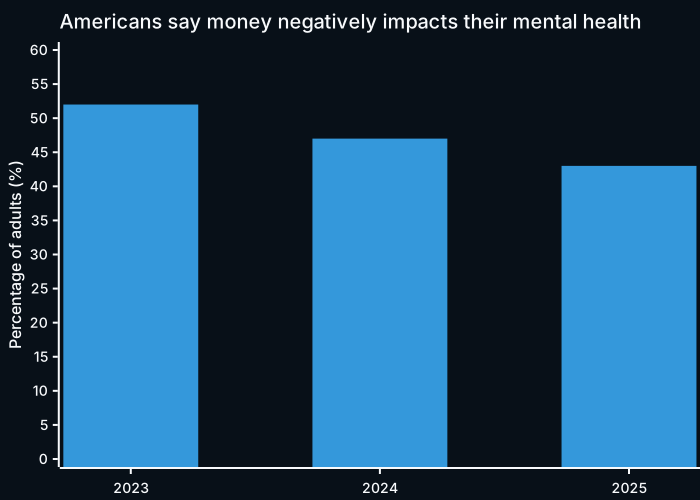
Source: Bankrate Money and Mental Health Survey 2025. The corresponding percentages are 52 percent in 2023, 47 percent in 2024, and 43 percent in 2025.
It’s noteworthy that the number is trending downwards.
But 43 percent still equates to more than 2 in 5 adults.
The problem with money is therefore not just:
How much do I have?
But also:
Do I feel in control of what I have?
Financial Stress Can Create a Loop
Another notable finding from Bankrate is that people who say money affects their mental health are about three times more likely to have paid a bill late in the previous month compared to those not affected: 22 percent versus 7 percent.
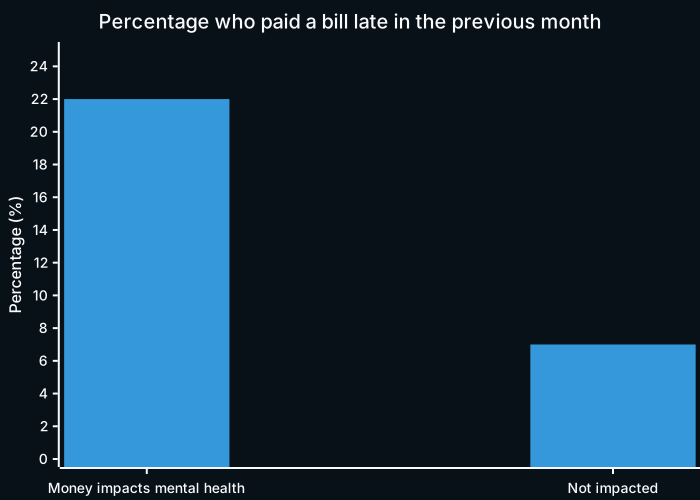
This is a correlation from the survey, not proof that stress directly causes late bill payments.
But it illustrates an important problem:
Money out of control
↓
Anxiety
↓
Avoiding looking at finances
↓
Delayed decisions
↓
Bigger financial problems
↓
More anxiety
“Master your money” should therefore not start by finding the highest-return investment.
Sometimes the first step is simply:
looking directly at the numbers.
Step 1: Know Where Your Money Actually Goes
Try to answer without opening your banking app:
- What was your net income last month?
- Total fixed expenses?
- How much do you spend on food?
- Monthly subscriptions?
- Total current debt?
- Interest rate of each debt?
- Emergency fund sufficient for how many months?
- Current savings rate?
If most of your answers are:
Roughly…
then this might be where you should start.
Not investing.
Not crypto.
Not passive income.
But visibility.
A Simple Money Map
You can start with:
INCOME
│
├── NEEDS
│   ├── Housing
│   ├── Food
│   ├── Utilities
│   └── Transport
│
├── DEBT
│   └── Payments
│
├── FUTURE
│   ├── Emergency fund
│   ├── Retirement
│   └── Investing
│
└── WANTS
    ├── Entertainment
    ├── Shopping
    └── Lifestyle
You don’t need to decide on perfect percentages yet.
The first thing is to know which direction the money is flowing.
Step 2: Don’t Start with a Perfect Budget
One of the reasons budgeting fails is that we build a system that’s too detailed.
For example:
Coffee: $37
Restaurants: $184
Streaming: $42
Clothes: $73
Transport: $119
...
After a few weeks, tracking becomes a second job.
A lighter approach is to start with four buckets:
| Bucket | Question |
|---|---|
| Essentials | How much do I have to spend to maintain my life? |
| Debt | How much am I paying for the past? |
| Future | How much am I setting aside for the future? |
| Flexible | How much can I freely use? |
The initial goal is not optimization.
The goal is awareness.
Step 3: Emergency Fund Before Thinking Too Far Ahead
One of the factors causing financial anxiety is the feeling:
Just one unexpected event and everything falls apart.
An emergency fund creates a distance between:
Unexpected expense
and:
Debt
Without a buffer:
Car repair
↓
Credit card
↓
Interest
↓
Monthly payment increases
With a buffer:
Car repair
↓
Emergency savings
↓
Rebuild fund
That’s not just a difference in money.
It’s also a difference in stress.
Step 4: Understand Debt Before Trying to Beat the Market
Not all debt is the same.
A low-interest mortgage is different from high-interest revolving credit-card debt.
So, make a table:
| Debt | Balance | Interest rate | Minimum payment |
|---|---|---|---|
| Credit card A | … | … | … |
| Credit card B | … | … | … |
| Student loan | … | … | … |
| Auto loan | … | … | … |
Only then decide on a strategy.
Two popular methods:
Debt snowball
Smallest debt
↓
Pay off
↓
Next debt
↓
Build momentum
Debt avalanche
Highest interest rate
↓
Pay off
↓
Next highest interest debt
↓
Reduce interest cost
Snowball prioritizes psychological momentum.
Avalanche prioritizes mathematical efficiency.
A good system is one you can actually maintain.
Step 5: Savings Must Become a System, Not a Monthly Decision
A common mistake:
Get paid
↓
Spend
↓
See what's left at month-end
↓
Save the rest
The problem is usually there isn’t much left.
Another system:
Get paid
↓
Automatic saving
↓
Bills
↓
Spending
The change seems small but is very important.
You shift saving from:
a decision requiring willpower
to:
default behavior.
Step 6: Investing Is Only One Part of Mastering Money
Personal finance content on the internet can easily overemphasize investing.
But investment returns cannot fix a broken cash-flow system.
A more logical foundation is:
Cash-flow visibility
        ↓
Emergency buffer
        ↓
High-cost debt
        ↓
Consistent saving
        ↓
Long-term investing
It’s not strictly necessary for everyone to go through the steps in absolute order.
But jumping directly to:
Which stock should I buy?
while not knowing monthly expenses is often optimizing the wrong problem.
A Bigger Problem: Knowing the Right Thing But Not Doing It
This is where many Master Your Money books and personal finance books in general reach their limit.
You finish reading and know:
- You should have a budget
- You should save
- You should reduce debt
- You should invest
- You should have goals
- You should avoid lifestyle inflation
But then what?
Read book
↓
Feel motivated
↓
Close book
↓
Life continues
↓
Three weeks later
↓
Nothing changed
The problem is no longer a lack of information.
It’s the gap between:
knowledge and behavior.
Financial Regret Shows This Gap Is Quite Large
A 2025 Bankrate survey shows that 74 percent of Americans have at least one financial regret.
Among those with financial regrets, issues mentioned include:
- 22 percent: not starting retirement savings early enough
- 15 percent: accumulating too much credit-card debt
- 13 percent: not saving enough for emergency expenses
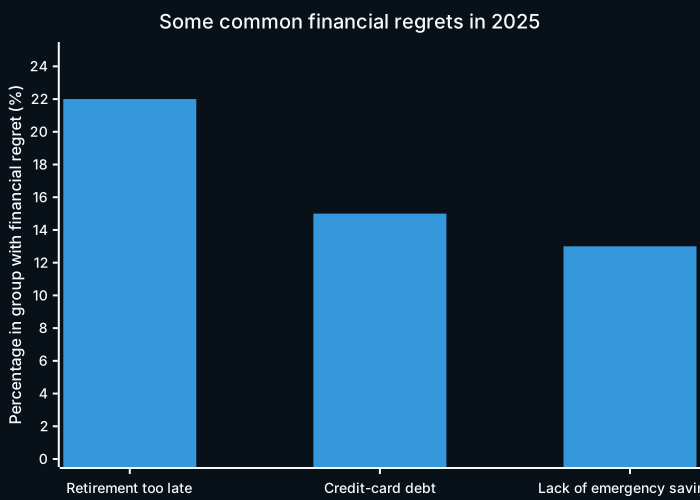
These are problems very few people are hearing about for the first time.
Most of us know:
You should save early.
You shouldn’t accumulate too much credit-card debt.
You should have an emergency fund.
The gap lies in consistent execution over many years.
From Master Your Money Book to Master Your Money Plan
This is an interesting way to approach the problem.
Instead of reading another book and trying to change your entire finances at once, you can turn learning into smaller sessions.
Traudio currently offers a Guided Learning plan called:
Master Your Money — 7-day plan
Build a healthier relationship with money in seven focused days.
The plan appears in Traudio’s Guided Learning system, where book summaries are selected based on learning goals rather than just letting users browse a large catalog themselves.
The noteworthy point is not the promise that you’ll be “rich in 7 days.”
Traudio does not position the plan that way.
The more logical idea is:
7 days
×
a focused period each day
=
a structured starting point
How Traudio’s Master Your Money Differs from a Book
A traditional book often has the flow:
Chapter 1
↓
Chapter 2
↓
Chapter 3
↓
...
↓
Finish
Guided Learning changes the question to:
What goal do I want to achieve?
Then:
Goal
↓
Curated ideas
↓
Short daily learning
↓
Review
↓
Next step
Traudio describes Guided Learning as curated book summaries for the goal you want to reach next, with Master Your Money being a seven-day journey.
Can One Week Change Your Finances?
No.
At least not in the sense of:
Day 1
Low net worth

↓

Day 7
Financial freedom
That would be an unrealistic promise.
But seven days can be enough to change something else:
clarity.
For example, a one-week learning sprint can be used with the logic:
Day 1
Reflect on your relationship with money

Day 2
Understand cash flow

Day 3
Look at spending behavior

Day 4
Understand saving and financial buffer

Day 5
Review debt

Day 6
Think about investing and long-term wealth

Day 7
Turn knowledge into a system that continues
This is a suggested practical framework, not Traudio’s official lesson list.
The main point is to limit the scope.
You’re not trying to “learn personal finance.”
You just need to:
take one step today.
Chart: Why Breaking Down Learning Makes Sense
Let’s assume you spend 15 minutes each day for 7 days.
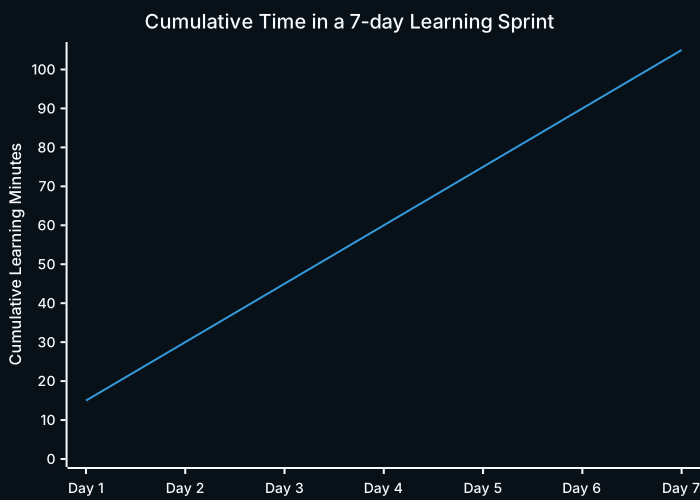
After one week:
15 minutes × 7
=
105 minutes
This is just an illustration with the assumption of 15 minutes per day, not the mandatory duration of the plan.
105 minutes might sound small.
But that’s precisely the idea.
You don’t need to find:
a free afternoon to fix all your finances.
You just need to protect:
a small enough amount of time that you can commit to daily.
How to Use the 7-Day Plan More Effectively
Don’t just listen.
After each session, take a small action.
For example:
| Learning | Action |
|---|---|
| Cash flow | Check last month’s spending |
| Budgeting | Divide expenses into 4 buckets |
| Emergency fund | Record current amount |
| Debt | List balance and interest rate |
| Saving | Set up an automatic transfer |
| Investing | Check retirement/investment account |
| Long-term plan | Write 3 financial goals |
This is not Traudio’s official curriculum.
This is a way to turn learning into behavior when using the plan.
Rule: One Insight, One Action
Instead of:
Listen to 5 summaries
↓
Learn 50 ideas
↓
Do 0 things
try:
Listen to 1 session
↓
Choose 1 insight
↓
Take 1 action
For example:
Insight: Emergency savings reduce reliance on credit.
Action:
Set up a small automatic transfer today.
Or:
Insight: I don’t know where my money goes.
Action:
Export the last 30 days of transactions.
Learning becomes valuable when it changes a behavior.
Do You Need Traudio to Do This?
No.
You can absolutely:
- Read a Master Your Money book
- Use a spreadsheet
- Track your spending
- Read personal finance blogs
- Use a budgeting app
- Build a seven-day plan yourself
Traudio’s appeal lies in its structure and low friction.
Instead of asking yourself:
Which book should I read next?
Guided Learning starts from:
What do I want to improve?
Traudio currently organizes many seven-day journeys this way, including Master Your Money, Invest with Confidence, Deep Focus in a Distracted World, and Habits That Stick.
Explore Master Your Money and Guided Learning on Traudio
Master Your Money Doesn’t End on Day 7
This is perhaps the most important part.
Seven days is not a financial transformation.
It should be:
7-DAY RESET
      ↓
30-DAY SYSTEM
      ↓
1-YEAR BEHAVIOR
      ↓
LONG-TERM COMPOUNDING
You can use the first week to identify three numbers:
1. Monthly cash flow
Income - Expenses
2. Emergency buffer
Emergency savings
÷
Essential monthly expenses
3. Savings rate
Amount saved
÷
Income
×
100
Then track them over time.
You don’t need 25 metrics.
Three numbers might be enough to see the direction of movement.
The Most Important Financial Chart Can Be Very Boring
A good financial plan usually doesn’t create a chart like:
🚀🚀🚀
It might look like:
Emergency fund
▂▃▄▅▆▇

Debt
▇▆▅▄▃▂

Long-term investments
▂▂▃▄▅▆▇
Slow.
Steady.
Repeatable.
That’s exactly what you want.
Mistakes to Avoid After Reading Master Your Money
1. Trying to Fix Everything at Once
New budget.
New investment account.
New credit card.
New side hustle.
New savings target.
After two weeks:
Burnout
Instead:
one change at a time.
2. Only Learning Without Measuring
If you don’t know:
- Debt balance
- Monthly spending
- Savings
- Investments
it’s very hard to know if you’re making progress.
3. Only Measuring Without Understanding Behavior
A spreadsheet can tell you that you spent 400 dollars on restaurants.
It doesn’t explain:
Why?
Stress?
Convenience?
Social life?
Lack of meal planning?
This is why a healthier relationship with money is broader than budgeting.
4. Cutting Out All Fun
Financial discipline doesn’t necessarily mean:
Coffee = bad
Travel = bad
Restaurant = bad
Entertainment = bad
A sustainable financial system must allow you to spend money on things that are truly important to you.
The goal is not to:
spend nothing.
But to:
spend intentionally.
5. Confusing Financial Education with Financial Advice
A book, audiobook summary, or learning plan can help you understand:
- Budgeting
- Compounding
- Debt
- Risk
- Diversification
- Saving
But specific decisions about investing, taxes, insurance, or estate planning can depend heavily on personal circumstances and the laws where you live.
Educational content should be a starting point for understanding issues, not an automatic replacement for professional advice.
Master Your Money Checklist
If you want to turn this article into action, check:
- I know my monthly take-home income
- I know my essential monthly expenses
- I know my total debt balance
- I know the interest rates of my major debts
- I have emergency savings
- I have automatic saving
- I know how much I’m investing each month
- I have at least one specific financial goal
- I review my finances regularly
- I am learning about money through a system instead of randomly
If you only ticked three boxes:
That’s okay.
You just found seven things to improve.
Which Master Your Money Book Is Right for You?
If you’re looking for the exact phrase Master Your Money book, check the author before buying, as there are currently many books with similar or identical titles.
Ron Blue – Master Your Money: A Step-by-Step Journey to Financial Strength is suitable if you want a Christian-based approach to financial planning, including saving, investing, giving, debt, taxes, and estate planning.
Ryan Blake – Master Your Money: How to Build Financial Freedom and Stop Living Paycheck to Paycheck, Even If You Are in Debt focuses more on financial anxiety, bills, debt, and breaking free from the paycheck-to-paycheck cycle.
Marc Butler and Eric Butow – Master Your Money, Secure Your Future covers a broad range of budgeting, credit, insurance, investing, and financial decisions at various life stages.
However, if you’re not looking for a specific book but a structured way to start learning, Traudio’s Master Your Money offers a different approach: a 7-day Guided Learning plan designed around the goal:
Build a healthier relationship with money in seven focused days.
Conclusion: Master Your Money Is Not About Finishing a Book
A Master Your Money book can give you a framework.
An audiobook can help you absorb the framework on the go.
A spreadsheet can give you visibility.
A budgeting app can help with tracking.
A learning plan like Traudio’s Master Your Money – 7-day plan can help turn a very broad goal into a structured week of learning.
But ultimately, mastering money happens at the next step:
LEARN
↓
UNDERSTAND
↓
ACT
↓
MEASURE
↓
REPEAT
Not:
READ
↓
READ MORE
↓
READ MORE
If you only retain one principle from this article, choose the simple one:
Every time you learn something about money, turn at least one insight into a small action.
Seven days won’t make you rich.
But seven focused days can be enough to help you start seeing money more clearly, make more intentional decisions, and build a system you can continue for years.
Related Articles
Master Your Financial Mindset Today
Download the Traudio app for iOS & Android to listen to synchronized audiobook summaries and chat with StickWise AI.
Download Traudio App Free