The Startup Playbook Books: Important Lessons to Find, Validate, and Grow a Startup
Searching for The Startup Playbook books can lead you to various resources on how to build a startup.
One of the prominent books is The Startup Playbook by David S. Kidder, which compiles practical lessons from founders and entrepreneurs on how to identify opportunities, build products, utilize resources, and grow a company. (traudio.net)
There is also Startup Playbook by Sam Altman, a free resource written during his time at Y Combinator. This playbook focuses on four foundational elements:
- Idea
- Team
- Product
- Execution
Sam Altman explains that the goal of the document is to distill the highly generalized advice Y Combinator typically gives to new founders. (playbook.samaltman.com)
Interestingly, good startup playbooks often don’t start with:
How do I raise capital?
They start with harder questions:
Does anyone actually need this product?
Is this team capable of executing?
Are we building a good enough product?
Can we learn fast enough before we run out of money?
That’s the core of startup building.
A Startup Playbook Is Not a Guaranteed Formula for Success
The word “playbook” can easily create the impression that a startup can be built according to a checklist:
Idea
↓
MVP
↓
Funding
↓
Growth
↓
Success
Reality rarely unfolds that way.
A startup is closer to:
Hypothesis
↓
Test
↓
Customer feedback
↓
Wrong assumption
↓
Adjust
↓
Test again
↓
Traction?
A good playbook doesn’t give you answers.
It helps you ask better questions and detect mistakes earlier.
How Hard Is It for a Startup to Actually Survive?
Data from the Business Employment Dynamics of the U.S. Bureau of Labor Statistics shows that the 5-year survival rate for new startups/business establishments is typically around half.
For example:
| Year of business birth | Survival rate after 5 years |
|---|---|
| 1994 | 54.3% |
| 2001 | 52.3% |
| 2003 | 55.3% |
| 2006 | 49.8% |
| 2010 | 56.0% |
| 2018 | 57.3% |
(bls.gov)
Chart: 5-year startup survival rate
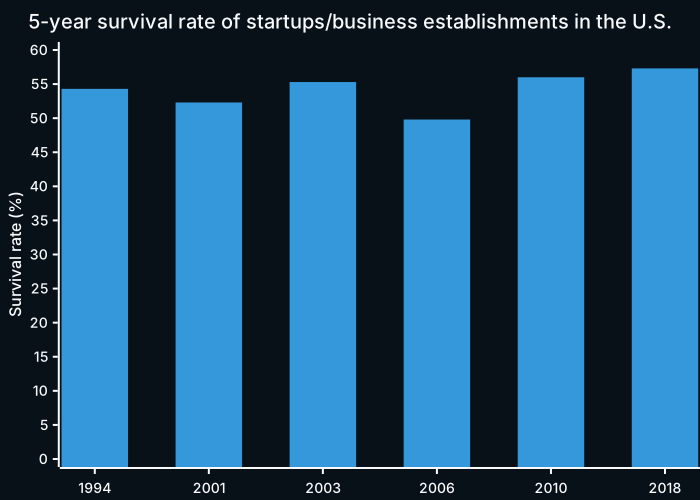
Source: U.S. Bureau of Labor Statistics, Business Employment Dynamics.
This does not mean:
Half of startups are guaranteed to fail.
BLS data measures business establishments in general, not just VC-backed tech startups.
But it shows something important:
survival is not the default outcome.
Startups need to continuously find ways to prove that their business model deserves to exist.
The Biggest Problem Is Not Always a Lack of Funding
A 2026 analysis by CB Insights examined 431 VC-backed companies that shut down from 2023 onwards.
Among 385 companies where the cause of failure could be identified:
- 70% ultimately ran out of capital
- 43% encountered poor product-market fit
- 29% were affected by timing or macro conditions
- 19% had unsustainable unit economics
CB Insights emphasizes that “ran out of capital” is often the final cause, not the root cause. (cbinsights.com)
Chart: Some causes appearing in recent startup failures
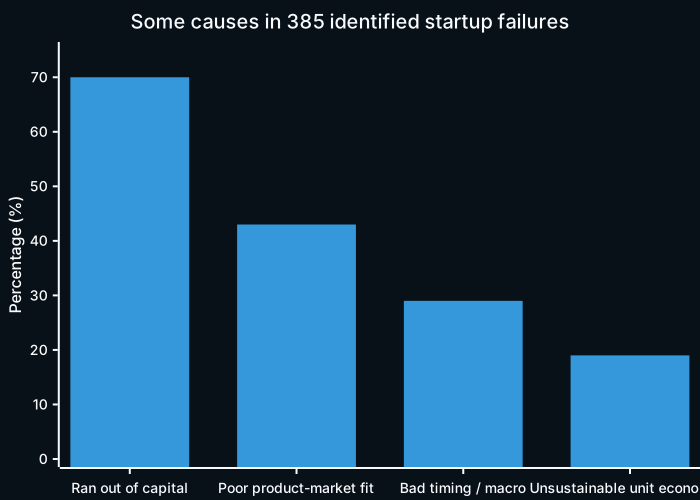
Source: CB Insights, 2026. A startup can have multiple causes, so percentages do not add up to 100 percent.
This is an extremely important distinction.
Startups rarely fail just because:
Money = 0
A chain of causes might be:
Weak market need
↓
Low retention
↓
Poor revenue
↓
Harder fundraising
↓
Runway disappears
Cash is sometimes just where the problem finally reveals itself.
Step 1: Start with the problem, not the startup idea
Founders often begin:
I have a great idea.
A safer approach:
I see a recurring problem.
For example:
Idea-first
I want to build an AI calendar assistant.
Problem-first
Knowledge workers are losing too much time coordinating meetings and constantly changing schedules.
The second statement allows for many different solutions.
The first statement locks you into a product too early.
A Problem Worth Building a Startup Around Usually Has 4 Characteristics
Frequent
Does it happen often?
Painful
Is it annoying enough that users want a change?
Expensive
Does it cost users money, time, or opportunity?
Underserved
Are current solutions not good enough?
A simple framework:
Frequency
×
Pain
×
Willingness to pay
×
Reachability
=
Opportunity quality
This is not an actual mathematical formula.
It’s a forcing function to make founders not just ask:
Is the idea cool?
Step 2: Customer Interview Before Product Interview
A bad customer interview:
If I made an app that helps you manage your finances with AI, would you use it?
The interviewee can easily answer:
Yes, that sounds good.
But that answer is almost worthless.
Better questions:
- When was the last time you encountered this problem?
- How did you handle it?
- How long did it take?
- What solution are you currently paying for?
- What’s the most annoying thing?
- What happens if you don’t solve it?
You are looking for past behavior, not promises about the future.
Step 3: Product-Market Fit Before Growth
A 2026 CB Insights analysis showed that 43 percent of identified startup failures had poor product-market fit. (cbinsights.com)
This explains why growth too early is very dangerous.
If the product can’t retain 100 users:
Ads
↓
1,000 users
↓
Churn
does not solve the problem.
You’re just buying more churn.
A more logical progression:
Problem
↓
Small solution
↓
Users try
↓
Users return
↓
Users pay
↓
Users recommend
↓
Then scale
Growth should amplify an engine that is working.
Not hide an engine that isn’t.
Step 4: MVP Must Test Assumptions, Not Just Be Small
“MVP” is sometimes misunderstood as:
Build a bad version of the full product.
No.
A good MVP answers a critical question.
For example:
Assumption
Users want AI to automatically generate meeting notes.
Test
Do it manually for 20 users first.
If no one comes back:
You learned before building a complex system.
A good MVP:
Critical assumption
↓
Cheapest meaningful test
↓
Evidence
↓
Decision
Step 5: Founders Must Distinguish Usage from Traction
A product with:
10,000 signups
sounds very good.
But if:
Week-4 retained users
=
200
the story changes.
Stronger traction can appear as:
- Retention
- Revenue
- Repeat purchase
- Usage frequency
- Referrals
- Expansion
- Low churn
Vanity metrics create presentations.
Behavior metrics create evidence.
Step 6: Team Is Important Because Startups Constantly Change Problems
Sam Altman places A Great Team right after the Idea section in his Startup Playbook. (playbook.samaltman.com)
The reason is very practical.
The original idea might be wrong.
The market might change.
Customer feedback might change the product direction.
If the company is only strong because:
the initial idea was great,
the startup becomes fragile.
If the team has the ability to:
Learn
↓
Decide
↓
Build
↓
Sell
↓
Adapt
the startup has more options.
Cofounder Alignment Should Happen Before Crisis
These questions should be discussed early:
- Who decides when there’s a disagreement?
- How is equity split?
- What is the commitment level?
- Expected salary?
- Do we want to raise VC?
- Exit goal?
- What if a founder wants to leave?
- Who owns the product?
- Who owns sales?
Don’t wait for:
Company struggling
+
Cash low
+
Founder conflict
to talk about expectations.
Step 7: Runway Is Time to Learn
Founders often view runway as:
How many months can we survive?
A better perspective:
How many experiments do we have left before we run out of time?
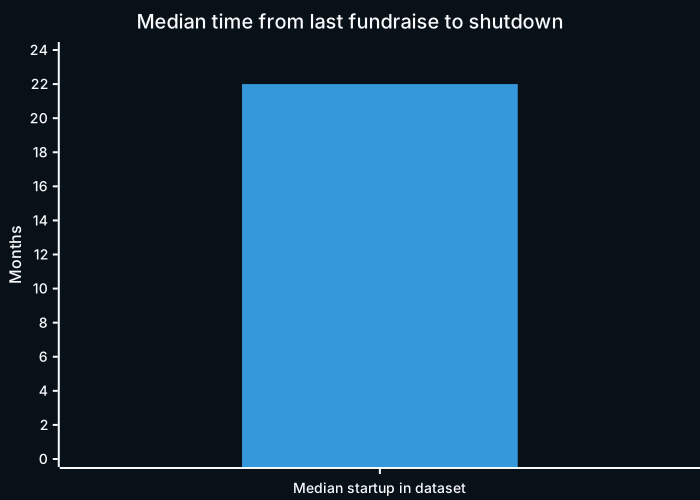
CB Insights reported that among the 431 startup failures analyzed in 2026, the median time from the last funding round to shutdown was 22 months. More than half of the companies in the dataset died within two years of their last round. (cbinsights.com)
Chart: Runway after last funding round in failed startup group
Funding is not the finish line.
It buys:
time to learn.
Burn Rate Should Be Translated as Learning Rate
Assume:
Cash
=
$1,200,000

Monthly burn
=
$100,000
Runway:
12 months
But founders should ask:
What do we need to prove in those 12 months?
For example:
Month 1–2
Problem validation

Month 3–4
MVP

Month 5–6
Retention signal

Month 7–9
Revenue experiments

Month 10+
Scale or rethink
This is not a universal timeline.
The main point:
capital must buy evidence.
Step 8: Unit economics before “growth at all costs”
A startup can increase revenue and still destroy value.
For example:
Customer pays
$100

Cost to acquire
$150
If each new customer costs the company more money:
More customers
=
Faster problem
That’s why CB Insights in 2026 reported 19 percent of failures had unsustainable unit economics. (cbinsights.com)
A founder should understand at least:
- CAC
- Gross margin
- Retention
- Churn
- LTV
- Payback period
A perfect model isn’t necessary.
But you need to know if the economics are heading in the right direction.
Step 9: Speed is important, but learning speed is more important than shipping speed
Shipping fast might look like:
Feature
Feature
Feature
Feature
but no one knows which feature creates value.
Learning speed:
Hypothesis
↓
Ship
↓
Measure
↓
Interpret
↓
Decide
A fast startup isn’t the startup that writes the most code.
It’s the startup that shortens the time from assumption to evidence.
Step 10: A startup CEO must maintain focus
Sam Altman dedicates a section in his Startup Playbook to Focus & Intensity and another to Jobs of the CEO. (playbook.samaltman.com)
Founders are easily pulled by:
- Fundraising
- Hiring
- Product
- Press
- Partnerships
- Social media
- Competitors
- Networking
But a company usually has only one or two real bottlenecks.
Leadership question:
What, if not solved in the next 30 days, will make everything else irrelevant?
That could be:
No demand
or:
Retention
or:
Cash
Focus means saying no to 20 real problems to solve the decisive one.
What’s noteworthy about David S. Kidder’s The Startup Playbook?
Traudio describes The Startup Playbook by David S. Kidder as a practical guide built around lessons from founders and business experience.
Key topics include:
- Entering promising markets early
- Solving real adoption problems
- Protecting an emerging vision
- Using resources effectively
- Reacting quickly to serious problems
- Building loyal customers
- Building motivated employees
- Always looking to the future from the customer’s perspective
The interesting point is that these principles don’t really focus on:
How to look like a startup?
They focus on:
How to make the company survive long enough to find the right thing.
David Kidder and Sam Altman: How do their two startup playbooks complement each other?
It can be viewed simply:
| David S. Kidder | Sam Altman |
|---|---|
| Lessons from many entrepreneurs | Advice from YC |
| Opportunity | Great idea |
| Customer adoption | Great product |
| Resource discipline | Execution |
| Leadership | Great team |
| Future orientation | Growth / focus |
| Founder lessons | CEO / hiring / managing |
The two documents don’t need to compete.
A good way to use them:
Kidder
↓
Founder perspectives

+

Altman
↓
Startup operating principles

=

Better questions
But reading startup books is not yet startup building
Founders have a very comfortable failure mode:
Read Lean Startup
↓
Read Zero to One
↓
Read Startup Playbook
↓
Read founder biographies
↓
Watch YC
↓
No customer conversations
Learning can become very well-disguised procrastination.
Startup knowledge is only valuable when it translates into:
Customer conversation
Experiment
Landing page
Prototype
Sale
Decision
From The Startup Playbook books to a 7-day startup learning sprint
This is where a goal-oriented learning plan can be helpful.
Traudio currently offers a Guided Learning journey:
The Startup Playbook — 7-day plan
Find, shape, and grow a business idea with practical discipline. (traudio.net)
The plan is part of Traudio’s Guided Learning system, where book summaries are curated around a goal instead of requiring users to browse the entire business library themselves.
Important point:
7 days does not mean launching a successful startup in 7 days.
A more appropriate positioning:
7 DAYS
=
BETTER QUESTIONS
+
INITIAL EVIDENCE
+
CLEAR NEXT STEP
What could a 7-day startup sprint look like?
The framework below is a suggested practice, not Traudio’s official syllabus.
Day 1 — Problem
Write a clear problem.
No solution.
Who has the problem?
When?
How often?
How painful?
Day 2 — Customer
Talk to at least one potential customer.
No pitch.
Ask about current behavior.
Day 3 — Market
Find:
- Existing solutions
- Competitors
- Alternatives
- DIY behavior
If “no competitor”:
Could be an opportunity.
Or it could be no market.
Day 4 — Value proposition
Complete:
We help [customer] achieve [outcome] without [painful alternative].
If you can’t write a clear sentence:
The product might not be clear yet.
Day 5 — MVP
Choose the riskiest assumption.
Design the cheapest test.
Day 6 — Economics
Estimate:
- Price
- Acquisition path
- Variable cost
- Revenue model
- Runway
Doesn’t need to be precise.
Needs to show if the business has basic logic.
Day 7 — Decision
Choose:
CONTINUE
or:
CHANGE
or:
STOP
Stopping a weak idea early is also startup progress.
Chart: How a week of startup learning accumulates
Assume each day:
- 15 minutes learning
- 30 minutes practice
Total:
45 minutes/day
×
7
=
315 minutes
That’s 5 hours 15 minutes.
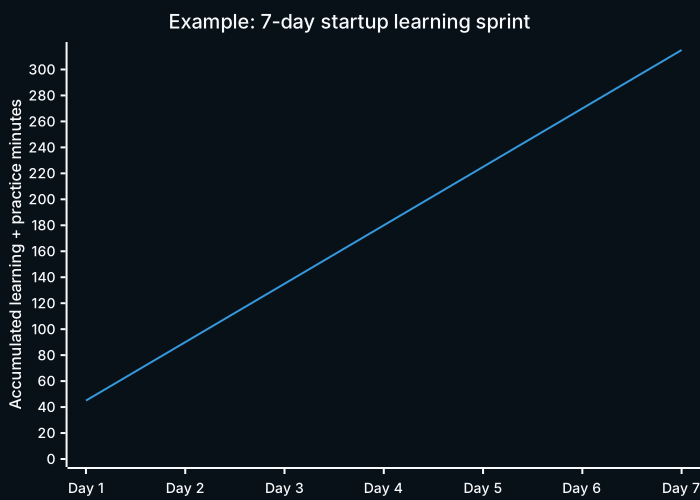
This is illustrative data, not Traudio’s mandatory duration.
5 hours is not enough to build a startup.
But 5 hours can be enough to avoid wasting 5 months on a wrong assumption.
A useful rule when using Traudio’s The Startup Playbook
After each learning session:
1 IDEA
↓
1 ASSUMPTION
↓
1 TEST
Example:
Idea
Great startups solve real problems.
Assumption
Freelancers genuinely find current invoicing too time-consuming.
Test
Interview 5 freelancers.
Not:
Listen to 7 summaries
↓
Highlight 50 ideas
↓
Build nothing
Startup learning needs output.
Chart: Capital does not protect startups from fundamental mistakes
In CB Insights’ 2026 dataset of 431 startup failures:
- Total equity funding before shutdown: 17.5 billion dollars
- Median funding/company: 11 million dollars
- Average funding/company: 48 million dollars
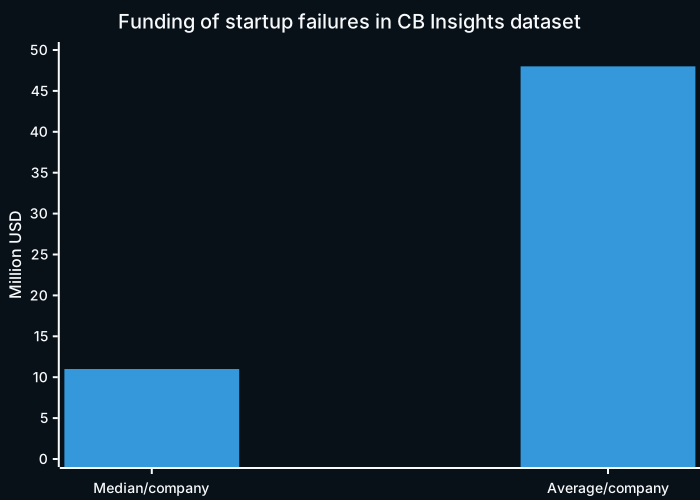
The average is much higher than the median because some heavily funded failures pulled the average up.
Notable point:
Funding does not automatically solve product-market fit.
431 companies in the dataset raised a total of 17.5 billion dollars before dying. (cbinsights.com)
Capital buys time.
Not truth.
A minimal founder dashboard
You don’t need 50 KPIs.
An early-stage startup can start with:
Customer conversations
How many users did we talk to this week?
Activation
How many users reached first value?
Retention
How many came back?
Revenue
Did anyone actually pay?
Burn
How much cash is lost each month?
Runway
How many months are left?
CUSTOMER
↓
USAGE
↓
RETENTION
↓
REVENUE
↓
RUNWAY
If your dashboard only has:
Downloads
Followers
Page views
be careful.
Startup idea scorecard
Before committing months, try scoring each factor 1–5:
| Question | Score |
|---|---|
| Is the problem real? | /5 |
| Does the problem occur frequently? | /5 |
| Has the customer tried to solve it? | /5 |
| Does the customer have a willingness to pay? | /5 |
| Can the customer be reached? | /5 |
| Does the team have an unfair insight/capability? | /5 |
| Can it be tested quickly? | /5 |
| Are the economics likely to work? | /5 |
A low score doesn’t automatically kill the idea.
But it points to where you need evidence.
Mistakes startup books can’t save you from if you don’t act
1. Falling in love with the solution
Founders defend the product instead of the problem.
2. Asking customers for compliments
Do you like this idea?
Instead of seeking evidence.
3. Confusing signups with demand
Free signups are very cheap in terms of commitment.
Payment is stronger.
Repeat usage is even stronger.
4. Scaling before retention
You’re pouring more water into a leaky bucket.
5. Hiring to solve lack of clarity
Problem unclear
↓
Hire more people
↓
More coordination
↓
Problem still unclear
6. Treating funding as success
Funding is:
input.
Customer value is the real:
business.
7. Not killing weak ideas
Founders sometimes think persistence means never giving up.
Better persistence:
Persistent about problem
Flexible about solution
Who is The Startup Playbook suitable for?
Traudio’s 7-day plan can be helpful if you:
- Have a startup idea but haven’t validated it
- Want to start a business but don’t know where to begin
- Have built a product but have low traction
- Are a first-time founder
- Are considering a side business
- Want to learn entrepreneurship through book summaries
- Have read too much startup content but lack a process
- Want to pressure-test an idea before investing a lot of money
Traudio describes the journey with a sentence quite fitting for this goal:
Find, shape, and grow a business idea with practical discipline. (traudio.net)
Do you need Traudio to learn about startups?
No.
You can use:
- Sam Altman Startup Playbook
- Y Combinator resources
- Founder interviews
- Business books
- Customer interviews
- Startup metrics
- Actual experiments
The usefulness of Traudio Guided Learning lies in its structure:
Goal
↓
Curated book ideas
↓
Short learning
↓
Application
instead of:
YouTube
↓
Blog
↓
Podcast
↓
Book
↓
Thread
↓
More content
Founders usually don’t lack content.
They lack sequence and disciplined application.
What should you do after 7 days?
Don’t start with:
Register company
↓
Hire
↓
Raise funding
Just because the plan is complete.
The next step should depend on evidence.
If the problem is weak
Interview more or stop.
If the problem is strong but the solution is weak
Re-prototype.
If usage is good but retention is low
Fix retention.
If retention is good but monetization is unclear
Test pricing.
If there’s revenue and repeat behavior
You can start thinking more seriously about scale.
EVIDENCE
↓
NEXT DECISION
Not:
ENTHUSIASM
↓
NEXT DECISION
A 30-day follow-up after the Startup Playbook
Week 1
Problem interviews.
Week 2
Prototype or concierge MVP.
Week 3
Usage / payment test.
Week 4
Review evidence.
At the end of the month, write:
What we believed
↓
What we tested
↓
What happened
↓
What changed
↓
What we do next
This is the startup learning loop.
Conclusion: The Startup Playbook is not a get-rich-quick guide
If you are looking for The Startup Playbook books, there are at least two notable resources to start with.
The Startup Playbook by David S. Kidder focuses on lessons from founders about opportunity, customer adoption, resources, leadership, and growth. (traudio.net)
Startup Playbook by Sam Altman organizes advice for new founders around idea, team, product, and execution. (playbook.samaltman.com)
But startup failure data shows that simply reading the right principles isn’t enough.
In CB Insights’ 2026 analysis, 43 percent of startup failures had poor product-market fit, 29 percent were related to bad timing or macro conditions, 19 percent had unsustainable unit economics, and the remaining 70 percent ran out of capital. (cbinsights.com)
That brings startup building back to a very simple loop:
FIND A REAL PROBLEM
↓
TALK TO CUSTOMERS
↓
TEST CHEAPLY
↓
MEASURE BEHAVIOR
↓
LEARN
↓
DECIDE
↓
REPEAT
A startup book can help you see patterns.
Customer conversations provide evidence.
An MVP helps test assumptions.
Metrics help avoid telling yourself too rosy a story.
And if you want to start with a structured learning sprint, Traudio’s The Startup Playbook — 7-day plan is designed around the goal:
Find, shape, and grow a business idea with practical discipline. (traudio.net)
Seven days are not enough to build a successful startup.
But seven days can absolutely be enough to transition from:
"I have a great idea."
to:
"I have a hypothesis,
some evidence,
and a clear next experiment."
For a new founder, that is a much bigger step forward than just reading another startup playbook.
Related Articles
Master Your Financial Mindset Today
Download the Traudio app for iOS & Android to listen to synchronized audiobook summaries and chat with StickWise AI.
Download Traudio App Free